

Australia’s mental health crisis is one many have experienced firsthand, and now a striking campaign is aiming to help spark important conversations in a visible and unexpected way.
The Blue Tree Project is a national initiative that encourages communities to paint dead trees blue as a visual reminder to reduce stigma around mental health and suicide. Launched in Western Australia in 2019, the grassroots movement has since grown into a global symbol of support and awareness.
In the ACT, the project is backed by the territory government, which recently called on locals to “start important discussions that could make a real difference”. Last Thursday, the Office for Mental Health and Wellbeing hosted a tree-painting event in Acton to launch Canberra’s Tree Week.
“Openly talking about mental health can reduce stigma, shift outdated attitudes, and create safer spaces where people can seek help without judgment,” said Gabrielle from the Office for Mental Health and Wellbeing. “It’s great to see so many people come together to create a more open, supportive community where mental health is recognised and talked about.”
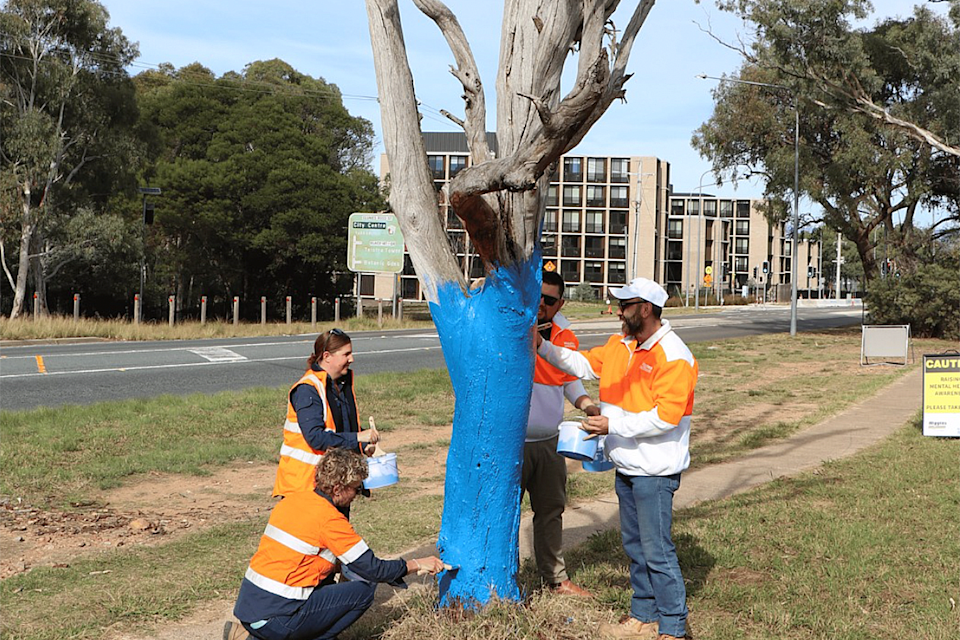
In the ACT, the Blue Tree Project is backed by the territory government. Source: ACT Government
The ACT Government said the initiative is successfully sparking the kinds of mental health conversations it set out to promote. “When someone asks ‘Why is that tree blue?’ it can lead to meaningful discussions that help reduce stigma,” a spokesperson told Yahoo News, adding that the aim is to create “safer spaces where people can seek help without fear of judgment.”
They said the community response has been “overwhelmingly positive”, with feedback coming from a diverse range of Canberrans — including students, tradespeople, public servants, and retail workers. “Many have said the trees offer a sense of connection, visibility, and hope, reminding people they are not alone in their mental health journey.”
There are currently several Blue Trees across the ACT, including three painted by the government in Lyons, Holt and Acton, with more planned. The government said it continues “to identify suitable locations for future trees”, and encourages the public to view the full list online.
Only non-living trees are painted, following environmental and cultural assessments. Trees are chosen for their visibility, and non-toxic paint is used to “ensure environmental safety.”

The blue trees are meant as a symbol of the largely hidden problem that continues to plague Australia. Source: Blue Tree Project/Facebook
Important truth behind unique campaign
The Blue Tree Project was founded by CEO Kendall Whyte, who started the organisation a year after losing her brother to suicide in 2018.
“Like many initiatives, there will always be people who don’t connect with our cause and mission,” she previously told Yahoo. “However, the support over the last six years has been overwhelmingly positive.”
With suicide the leading cause of death for Australians aged 15 to 49, according to ABS data, the group now runs workshops and collaborates with corporate partners to better equip people to have difficult but vital conversations.
“Outdated attitudes are still deeply ingrained across Australia, which is preventing many from seeking support,” Kendall said. “Education is crucial, not only in shifting old attitudes, but also in upskilling ourselves to have the harder and more confronting conversations in life.”
The idea of painting trees began with a joke her late brother once played by painting a tree on the family’s Western Australian property to surprise their dad. Today, more than 1,300 registered blue trees — all dead trees known as stags — have become symbols of hope around the world.
“There is now a blue tree on every continent of the world — making us a global movement,” Kendall said.
Readers seeking support and information about suicide prevention can contact Beyond Blue on 1300 22 4636, Lifeline on 13 11 14 or Suicide Call Back Service on 1300 659 467.
Do you have a story tip? Email: newsroomau@yahoonews.com.
You can also follow us on Facebook, Instagram, TikTok, Twitter and YouTube.
