
The past days marked my first visit to the US following the swearing-in of Donald Trump for his second mandate as president.
I did not travel to Uncle Sam territory to discuss the disastrous effects, in particular on the world economy, of Trump’s savage and egoistic trade measures. My trip was instead dictated by academic-cultural motivations: marketing Maltese history and culture to an American audience.
My first stop was at Columbia University in New York where, at the invitation of Prof. Konstantina Zanou, and together with Gabriele Montalbano from the University of Bologna and Giuliano Fleri, from the Swiss National Science Foundation, I contributed to a seminar on Islands and Migration in the Central Mediterranean, in the framework of the course on Mediterranean humanities. My intervention centred on Maltese and Italians in contact in early 19th century Tunisia.
My second stop was at Princeton, where I participated in the 39th International RAIS Conference on Social Sciences and Humanities, organised by the Princeton Theological Seminary, which houses the second biggest library in the world after the Vatican Library of religious books and manuscripts. The paper I presented was entitled Early Maltese migration to Corfu (1815-1830).
As has always happened in my 48 years’ experience as a researcher, wherever I go I try and uncover some unknown Malta finding in the local library or archives.
This time I consulted the Princeton University Library catalogue, inserted the usual four-letter word ‘Malt…’ in the search engine for manuscripts and, lo and behold, up comes this description: “Copy of the Qur’ān; missing first folio, begins with Sūrat al-Baqarah (The Cow) 1 (2:1). Instructions for how much to read from the Qur’ān every day of the week written in modern script in pink ink on lined paper pasted onto f. 238v and the inside back cover”.
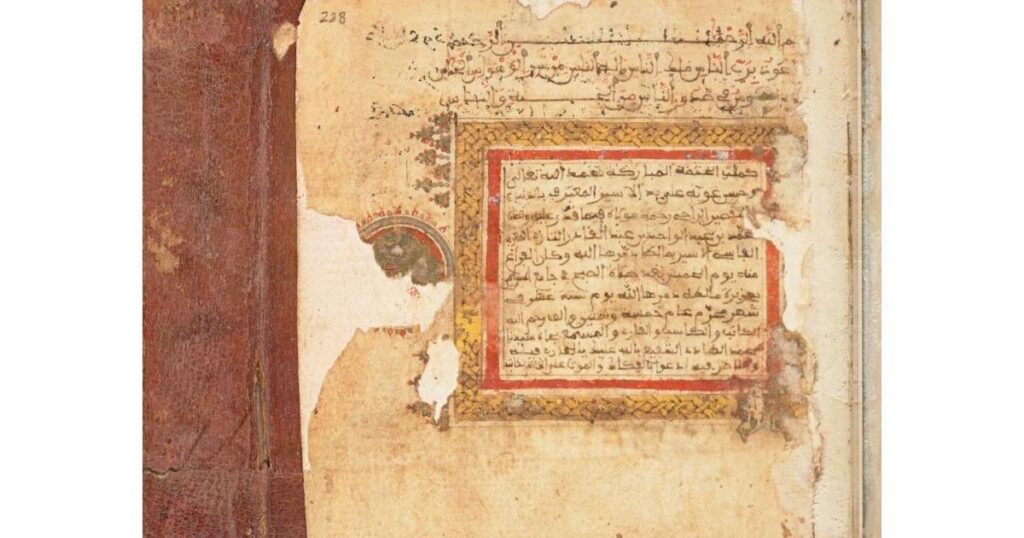
The catalogue number of this manuscript is Ms. Codex 1904, and it is quite small in size, of square format rather than rectangular, and measuring 87 square millimetres.
The fantastic thing about this manuscript copy of the Qur’ān is that it is dated 1654 and that it was written in the island of Malta.
The Princeton catalogue information refers to the original copy of this manuscript, which is to be found at the Columbia, Rare Book and Manuscript Library.
The manuscript had belonged to Gordon A. Block. According to the Philadelphia Area Archives, he left his extensive collection of Lincolniana to the University of Pennsylvania in his will and it was received by the library in 1965.
The description given in the Pennsylvania catalogue is: “This is a small, square copy of the Qur’ān made on Malta by an enslaved man. The date 16 Muharram 1065 A.H (November 26, 1654 CE), when this copy was finished, is during the time when Malta was ruled by the Order of the Knights of Saint John and captured Muslims were enslaved. The copyist gives his name as Muḥammad ibn ‘Abd al-Wāhid ibn ‘Abd al-Qādir al-Fāsī, which suggests that he was originally from Fez, Morocco, before ending up on Malta. The copy is in a neat, maghribī script with some headings in blue, red and gold, though the gold is now flaking off”.
It would seem that very little is known about Muḥammad ibn ‘Abd al-Wāḥid ibn ‘Abd al-Qādir al-Fāsī. He seems to have originated from Fez, in Morocco, and he ended up a slave in Malta. However, insights on his condition and on his feelings for Malta can be gathered from the inscription placed at the end of the manuscript, which gives some details about it.
Muḥammad was certainly not happy with his condition of slavery in Malta
I am basing my comments here on the erudite translation of this colophon by the renowned Arabist Michael Cooperson, of the UCLA, University of California, Los Angeles.
This colophon, which the Princeton University describes as “Colophon framed in red and yellow border with braided pattern and marginal medallion (f. 238r)”, reveals that Muhammad must have been working on this copy of the Qur’ān for quite some time.
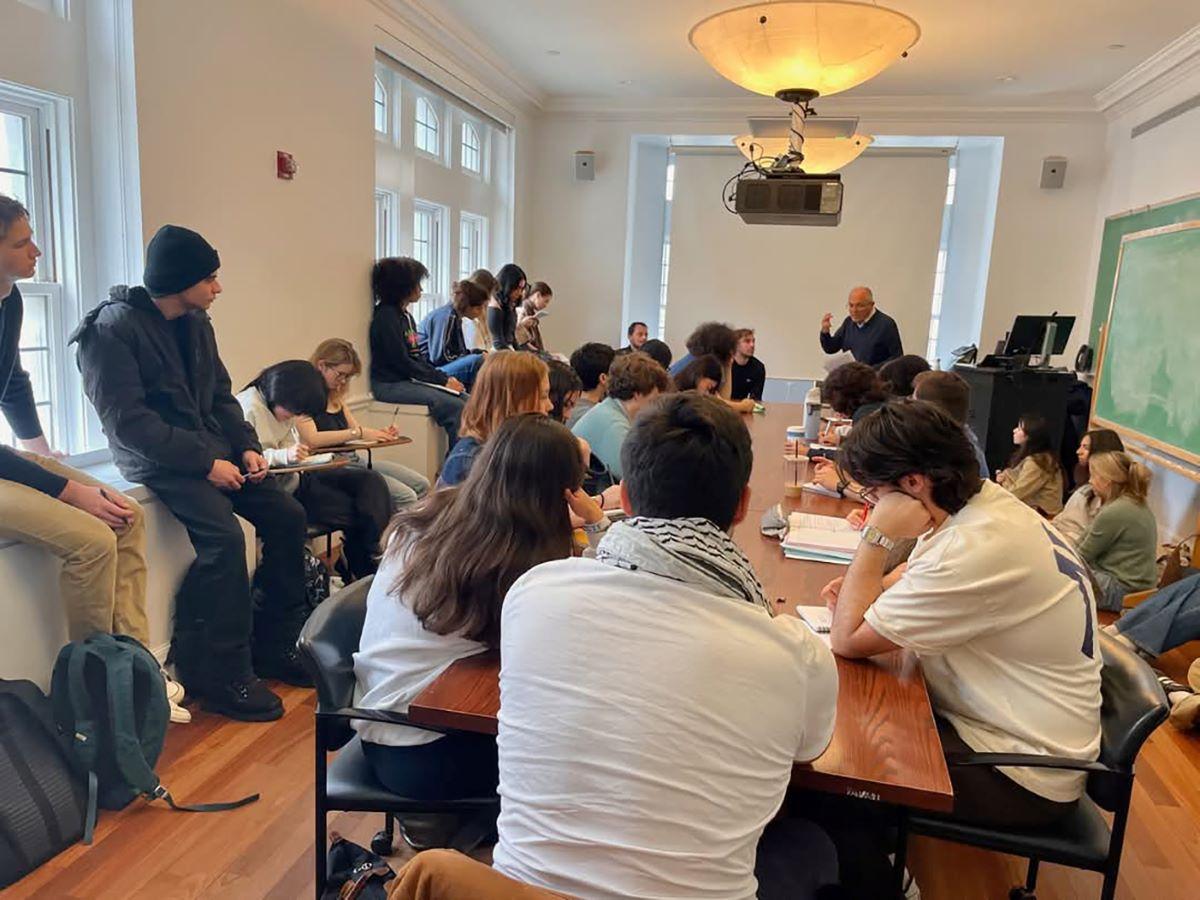 Arnold Cassola teaching at Columbia University, N.Y., April 2025.
His work as a copyist might have started in some other country, but it was then completed in Malta on the morning of Thursday, 16 Muharram 1065 A.H, ergo November 26, 1654. Muhammad also gives the reader the exact place where the work was completed, i.e. in the “mosque of the Muslims” of Malta.
Muḥammad was certainly not happy with his condition of slavery in Malta. He emphasised this unhappiness with his state by repeating the invocation “May God destroy it”, the two times he mentioned the name of our country in the colophon.
According to Humphrey J. Fischer (2001), Muslim slaves were allowed to gather and pray in Malta in mid-18th century. In his seminal work on slaves in Malta (2002), Godfrey Wettinger not only confirms this but also points out that the earliest reference to a mosque in the Maltese archives is dated 1702. This was a mosque situated in the slaves’ prisons.
In 1725 the mosque was closed down by the Grandmaster of the Order of St John, in retaliation against the closing down of three Catholic churches in Tunis.
Of course, as Wettinger points out, while in the 18th century mosques existed at the slaves’ prisons both in Valletta, Senglea and Vittoriosa, “at the extreme end of the Valletta prison by 1599 a place was already furnished as a mosque, maintained by the slaves themselves”.
Muḥammad’s testimony in the Pennsylvania Quran goes to show that a gathering place where Muslims could practice their religion already existed in 1654. Whether he was referring to a free-standing mosque or whether the place of worship was sited at the Valletta prisons is still to be ascertained. Only further research will tell.
A translation of the colophon in UPenn Ms. Codex 1904 by Michael Cooperson, UCLA:
The blessed copying [of the entire Qur’ān] was completed, with thanks to Almighty God and with His good help, by the captive, the avowed sinner and insufficiently [pious] one who [nevertheless] hopes that his Lord will be merciful in whatever He decrees and foreordains for him, Muḥammad ibn ‘Abd al-Wāhid ibn ‘Abd al-Qādir al-Tāwitī al-Maghribī al-Fāsī, captive on Malta – may God destroy it!
The [copying] was completed on Thursday after the morning prayer in the [Friday] mosque of the Muslims on the island of Malta – may God destroy it! – the 16th of the month of Muḥarram 1065. May God have mercy on the copyist and on anyone who acquires [this copy], reads it, or hears it, by virtue of our master Muḥammad, the guide and intercessor. I adjure you by God, o you who reads any of it, or looks at it: pray for release [from captivity] and a death in good standing [as a Muslim] for its copyist.
View the UPenn Ms. Codex 1904 at the Princeton University Library Catalogue here. View the Quran in the Gordon Block collection of Lincolniana, 1760-1963 (bulk: 1840-1950), Kislak Center for Special Collections, Rare Books and Manuscripts, University of Pennsylvania here.