
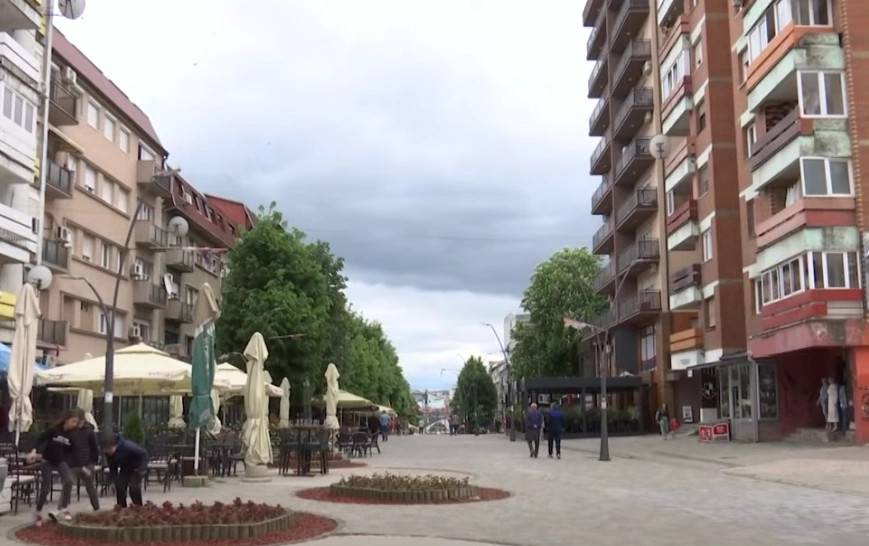
International and Kosovo authorities have different views on the situation in northern Kosovo. In three separate responses from representatives of three embassies in Kosovo, referring to the actions of the Government, the situation in this area is not considered tense. But according to the Kosovo executive, its institutional commitments are made with the aim of improving the security and welfare situation for citizens and putting under control the facilities and services that for nearly 25 years have been managed by illegal structures.
International authorities in Kosovo do not consider the security situation in the four northern municipalities to be completely de-escalated. Representatives of EU member states and the United States assess that the actions of the Kosovo Government to close down illegal institutions in the north are contributing to this.
In a written response, the German Embassy in Kosovo says that the actions of the Kosovo executive have negatively affected citizens.
“From Germany’s perspective, the recent events in the north have not led to de-escalation. On the contrary, the actions of the Kosovo authorities have contributed to increasing the sense of insecurity among the affected population,” the embassy’s response states.
The statement further emphasizes that the Government of Kosovo has been called upon to ensure that the concerns of communities affected by actions in the north are addressed.
“We have consistently called for the Government of Kosovo to take measures that genuinely engage affected communities and ensure that their concerns are taken into account. What is needed is an environment that fosters stability, inclusion and a sustainable path towards a prosperous and secure future for all communities in Kosovo.”
The French Ambassador to Kosovo, Oliver Guerot, assesses that the situation in the north is stable but fragile. According to him, closing down illegal institutions in the north does not help de-escalate the situation in the north and such actions send negative signals to Kosovo’s partners.
“Unilateral and uncoordinated actions undermine efforts to build trust between communities, risk escalating tensions, and must therefore be stopped. Both Kosovo and Serbia should engage constructively in the EU-facilitated dialogue to implement the Brussels-Ohrid agreement and resolve the issue of Serbian-run structures. This includes establishing the Association of Serb-majority Municipalities,” his response states.
According to the French ambassador, after serious incidents such as the attack in Banjska and the attack against the Iber-Lepenc canal, “there has been some de-escalation in the north.”
“Recent years have been characterized by tensions and several very violent incidents, including the attack in Banjska and the explosive attack on the Iber-Lepenc canal. I am convinced that the people want nothing more than a peaceful life and economic development. It is the responsibility of the Kosovo authorities, both at the central and local levels, to provide the appropriate framework to achieve this. Political issues between Kosovo and Serbia should be addressed through EU-facilitated dialogue,” Ambassador Guerot’s response states.
And the US Embassy said that security and stability in Kosovo are essential for the country in the region. A spokesperson for this embassy called for the status of illegal institutions to be resolved within the framework of the dialogue with Serbia.
“Security and stability in Kosovo are essential for the country and the region. Sudden changes in the status of institutions jeopardize the provision of vital services to the citizens of Kosovo. It is the responsibility of the Government of Kosovo to ensure that all its citizens can live in peace and that their needs are met. The Government of Kosovo should discuss how the status of these institutions will be resolved in a coordinated manner, through established channels, such as the EU-led dialogue,” the response states.
However, Kosovo Government officials have a different perspective. Spokesperson Përparim Kryeziu estimates that with the actions taken by the relevant institutions, the situation in the four municipalities in the north has improved.
“In the four municipalities in the north of the country, in these four years, especially in recent years, we have increased the services of public enterprises and state agencies for citizens there, and at the same time we have increased public safety. Within less than a year, more than 300 new businesses have opened there, which means more employment and more well-being for the residents there – evidence of the normalization, security and improvement of the situation in these municipalities,” Kryeziu’s response states.
Regarding the closure of parallel structures, Kryeziu said that they have violated the security of citizens.
“In the north of the country, especially in the four northern municipalities, there have been illegal Serbian structures that have operated illegally and unconstitutionally, and which by offering parallel services have seriously damaged the integration process of our Serbian fellow citizens. For a long time there has been an abnormal situation there, with individuals, groups and structures that have violated the constitutionality of the country and the security of citizens. Our state institutions have a responsibility to take action based on data and evidence of illegal actions.”
Over the past few weeks, Kosovo authorities have continued activities in the north with the aim of taking control of facilities and services that were previously managed by illegal institutions.
On Tuesday, officials from the public enterprise “Ibër-Lepenci” entered a facility near Lake Ujman, which was suspected of being used by a parallel Serbian institution.
While days ago, the authorities in Kosovo took control of, among other things, the Water Factory in Zubin Potok, the parallel water supply company in North Mitrovica, the one in Shtërpcë, and the Office for Sports, Youth and Specialized Services.