

At the San Lázaro rock shelter near Segovia in central Spain, a team of scientists has discovered a granite cobble bearing a red ochre dot, upon which the fingerprint of a Neanderthal was imprinted approximately 43,000 years ago.
The finding, confirmed through forensic techniques and advanced microscopy, represents the oldest evidence of a human fingerprint in the world and constitutes the earliest known symbolic object in Europe attributable to this species.
The discovery, published in Archaeological and Anthropological Sciences, is the result of a collaboration between the Complutense University of Madrid (UCM), the Geological and Mining Institute of Spain (IGME-CSIC), the General Commissariat of Scientific Police of the National Police, and the University of Salamanca (USAL). It demonstrates that Neanderthals, far from being primitive beings devoid of abstraction, deliberately used pigments to imprint their identity on objects with possible ritual or communicative meaning.
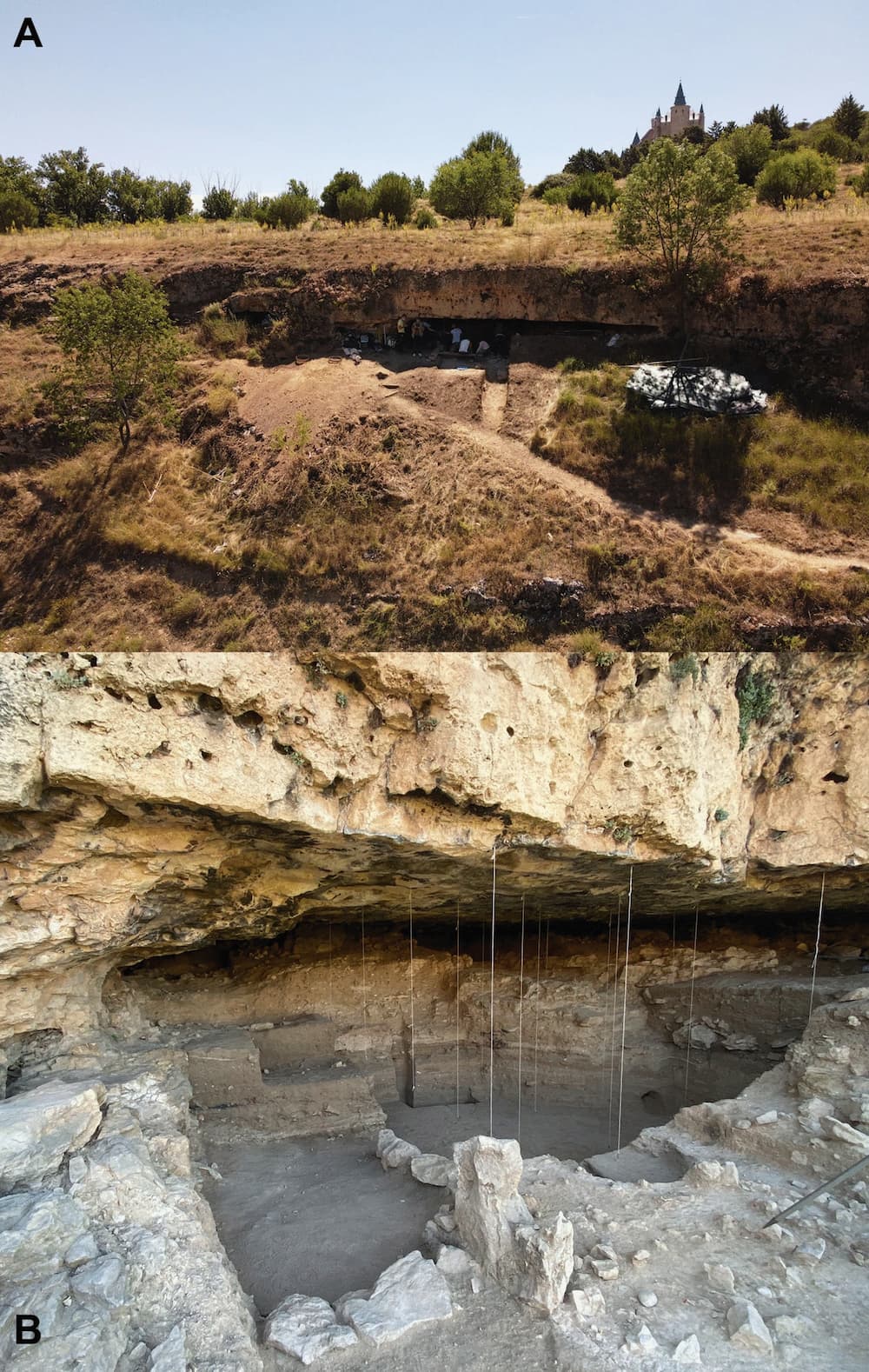 The San Lázaro shelter in Segovia, the place of the find.
Credit: D. Álvarez-Alonso et al.
The piece was found during one of the campaigns of the First Settlers of Segovia project, an archaeological initiative that has been studying the sites of Abrigo del Molino and San Lázaro since 2012 under the coordination of IGME-CSIC.
What initially appeared to be a simple rock with traces of pigment was subjected to scanning electron microscopy (SEM) and multispectral spectroscopy analyses, revealing that it was the pad of a finger, likely the index or thumb of a Neanderthal, imprinted in fresh ochre on the cobble’s surface.
The dating of the layer in which it was found, corresponding to the Middle Paleolithic, places its age at around 43,000 years, coinciding with the final phase of Neanderthal presence on the Iberian Peninsula. It is not just a fingerprint; it is the signature of an individual who manipulated this object with a purpose that goes beyond the utilitarian, one of the researchers explains.
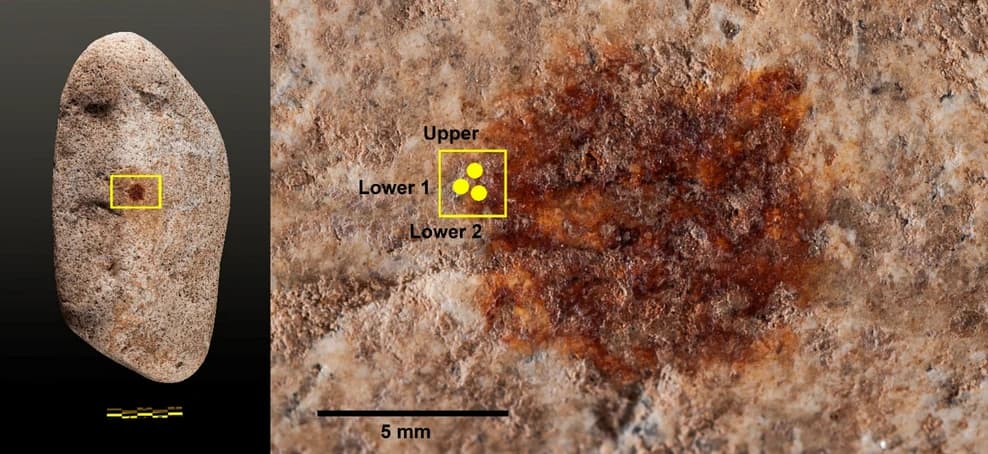 The boulder with the red ochre spot containing the Neanderthal fingerprint. Credit: D. Álvarez-Alonso et al.
The absence of signs of flaking or wear from use supports the hypothesis that the cobble was employed for symbolic purposes, perhaps as a territorial marker, a talisman, or even a primitive form of artistic expression.
To confirm the anthropogenic origin of the fingerprint, the team employed methodologies from modern criminology. Using fingerprint identification systems, the Scientific Police compared the ridges and grooves of the print with modern human patterns, ruling out the possibility of a geological accident or an animal mark. The matches are indisputable: the spacing between the lines, their arrangement, and curvature can only correspond to a human finger, they state.
Moreover, chemical analyses of the pigment confirmed that the ochre was applied intentionally, ruling out the possibility that the rock had come into casual contact with a mineral. Granite does not absorb pigment; someone held it, painted it, and placed it there, the researchers explain.
The finding places Segovia—and by extension, Castile and León—at the center of the debate over the symbolic capacity of Neanderthals. Until now, evidence of abstract thought in this species, such as the cave paintings of Ardales (Málaga) or personal ornaments found at other European sites, had been a matter of controversy. However, the San Lázaro fingerprint offers tangible proof that these hominins used pigments with a precision that suggests a deliberate act.
Discover more from LBV Magazine English Edition
Subscribe to get the latest posts sent to your email.

In the Altai Mountains, in southern Siberia, lies the famous Denisova Cave, the only place in the world where the presence of three distinct types of humans has been demonstrated:…

In war, ice is often treacherous, as the Dutch learned when French cavalry seized a fleet by riding over the frozen Niewediep canal. Or the Teutonic knights who sank into…

Four years ago, archaeologists from the Bavarian State Office for Monument Conservation (BLfD) discovered a child’s tomb at the Mattsies site in southern Germany. Inside was the body of a…

A new archaeological investigation casts doubt on one of the most emblematic accounts of the Roman conquest of Britain, questioning whether the violence at the famous Iron Age hillfort of…

Just a few kilometers from Seville lies the archaeological site of Valencina de la Concepción, which five thousand years ago was one of the largest settlements in Europe, contemporary with…

The world’s largest gold reserves—approximately 99.999% of all the gold on Earth—are at an unreachable depth beneath more than 3,000 kilometers of solid rock, alongside other elements in the planet’s…

In the 1970s, a tomb was discovered in the Al-Asasif necropolis on the west bank of Luxor, Egypt, which archaeologists designated Kampp 23. The identity of its owner had remained…
A team of Italian researchers has discovered markings on the walls of Pompeii that could be the first known evidence of the use of an ancient and sophisticated weapon of…

Although the relationship between plants and pollinators has been studied for decades, not much attention has been paid to the sounds emitted by insects as they fly, land, or hover…

A joint study by researchers from the University of Huddersfield (United Kingdom), the Smurfit Institute of Genetics at the University of Dublin, and several archaeological institutions from the Valencian Community…
Load more articles
Something went wrong. Please refresh the page and/or try again.