
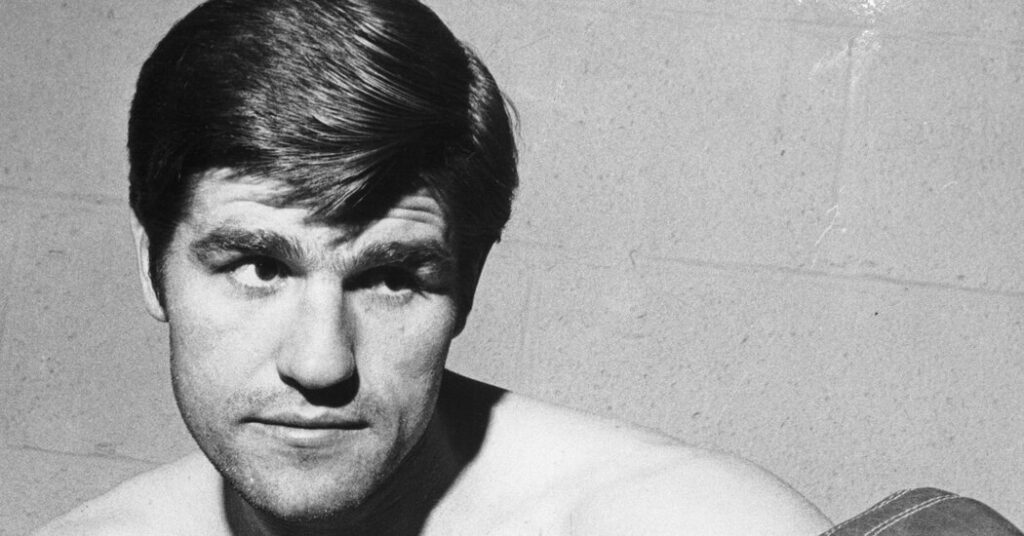
Nino Benvenuti, an Italian boxer who won the welterweight title at the 1960 Rome Olympics and was named the outstanding fighter of those Games over a certain teenage light-heavyweight named Cassius Clay, better known as Muhammad Ali, died on Tuesday in Rome. He was 87.
His death was announced by the Italian Olympic Committee, which did not cite a cause or specify where in Rome he died.
Unlike Ali, a three-time world heavyweight champion, Benvenuti never became one of the world’s most recognized and socially relevant figures. But he built his own exceptional career; handsome and possessed of elegance and power in the ring, he was considered Italy’s greatest boxer.
Outside the ring, according to Sports Illustrated, he read Hemingway, Voltaire and Steinbeck and listened to Beethoven’s Ninth Symphony in his Lincoln Continental on the way to fights. Primal and incandescent battles against the Hall of Fame middleweights Emile Griffith of the Virgin Islands and Carlos Monzon of Argentina turned into poignant friendships when his former antagonists became troubled. (Benvenuti himself was inducted into the International Boxing Hall of Fame in 1992).
Benvenuti was 119-1 as an amateur and the winner of an Olympic gold medal. After turning professional in 1961, he built a record of 82-7-1 with 35 knockouts, and won the world light middleweight championship and the world middleweight championship twice. He retired in 1971 after losing for a second time to Monzon, when his corner threw in a white towel of surrender.
It was Benvenuti’s Olympic victory in his home country that carried the most meaning, he told The Ring magazine in 2016. Why? “Because it lasts forever,” he said. “I’m now a former middleweight champion of the world yet I’m still an Olympic gold medalist.”
He did not realize the significance of being named the top boxer at the Rome Games until years later, he once said, “when Muhammad Ali really became Muhammad Ali and the best boxer in the world.”
Giovanni Benvenuti was born on April 26, 1938, on the Adriatic coast in what was then Isola d’Istria, Italy (now Izola, Slovenia). He started boxing at age 11. Two years later, according to Sports Illustrated, he began riding his bicycle roughly 13 miles to Trieste, Italy, to participate in amateur bouts and, later, some professional ones.
After retiring, Benvenuti appeared in a couple of movies, playing a farmer in one and a tough-fisted gangster in another; opened a restaurant; and became a television commentator and, briefly, a city councilman in Trieste.
The 45 rounds he spent in the ring with Griffith over three bouts in New York in 1967 and 1968 led to an unassailable bond between the men.
Benvenuti asked Griffith in 1980 to be the godfather of one of his sons. And, as recounted in The Daily News of New York, he gave Griffith $10,000 in 2009 when his rival turned friend, who by then had dementia, was struggling financially. (Griffith died in 2013.)
He supported Monzon when he went on trial in 1988; he was convicted of killing his wife (some reports said it was his estranged girlfriend). When Monzon died in 1995, Benvenuti served as a pallbearer at his funeral.
Information about Benvenuti’s survivors was not immediately available. He had reportedly been married twice; his second wife, Nadia Bertorello, died in 2023. He once lamented to Il Messaggero, a leading Italian newspaper, that with “a more serene love life,” he could have remained champion “for a hundred years.”
Asked by The Ring in 2016 about the best overall fighter he faced, Benvenuti named Sugar Ray Robinson, whom he beat on points. But, alas, the two never actually met — he had only faced him in a very vivid dream.