
limate change is a term we hear often, in the news, classrooms and policy speeches. But its true weight only lands when it arrives uninvited at your doorstep.
“People don’t really think about climate change,” said Christian von Wissel, professor of urban theory at the City University of Applied Sciences in Bremen. “In everyday life, normally you don’t think about it, until you’re directly affected.”
Located in the low-lying Wesermarsch region, Bremen has long taken climate adaptation seriously, with investments in dikes, floodplains and urban planning. Yet in the winter of 2023, a combination of storm surges and inland rain overwhelmed parts of the city’s defenses, causing flooding, transportation disruption, damage to buildings and renewed public concern.
In response, the city announced plans to raise the dikes by 2 meters. Alongside these technical measures, the Bremen Center for Building Culture, where Von Wissel serves as academic director, proposed an exhibition to spark international conversations to understand the challenge better and explore alternative solutions.
Von Wissel immediately thought of Jakarta, a megacity grappling with even more extreme threats from land subsidence and sea-level rise.
“Jakarta is a famous case of a sinking city,” he said. “My background is in urban anthropology and architecture. And I’m really interested in how people, in their everyday lives, deal with these problems.”
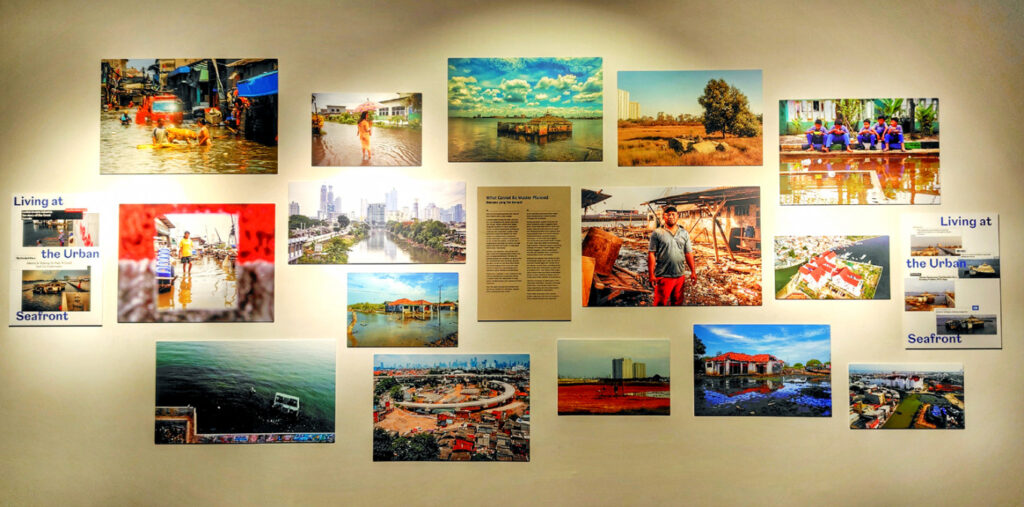
An open call was issued, and 47 works by 15 Indonesian and two German photographers were selected, documenting life along the water’s edge, where tidal floods, erosion and subsidence shape everyday realities.