
For the first time in 30 years, all fans of George Rodrigue will be given a peek into the Blue Dog artist’s studio.
It’ll happen when PBS premieres the documentary “BLUE: The Life and Art of George Rodrigue” nationally on public television stations starting May 29. Though LPB, does not have the film scheduled to air that day, but said it likely will show it in August.
Meanwhile, “BLUE” also will begin streaming May 29 on PBS.org.
WLAE in New Orleans is the presenting station for the film, which will be distributed by American Public Television.

George Rodrigue’s son, Jacques Rodrigue, executive director of the George Rodrigue Foundation of the Arts, is shown as he is being interviewed for the film, ‘BLUE: The Life and Art of George Rodrigue.’
PROVIDED PHOTO
“This will be the first-ever career spanning documentary about my dad,” said Jacques Rodrigue, the artist’s son and executive director of the George Rodrigue Foundation of the Arts. “I know people are going to learn so much because it’s a really great chronological showing. And we filmed in his studio for the first time in 30 years, which is at my mom’s house, and my brother, Andre, and I give a little tour of where he painted all of his Cajun works and where it all started.”
Producer-director Sean O’Malley’s O’Malley Productions debuted “BLUE” last October at the New Orleans film festival.
“The producers first approached us about making the film almost three years ago,” Jacques Rodrigue said. “For years, I’ve been archiving and digitizing dad’s catalog, but also his materials and, footage and old TV interviews. So when the filmmakers first approached us, we had a real treasure trove of things to share with them.”
Sean O’Malley is director and producer of ‘BLUE’: The Life and Art of George Rodrigue.’
PROVIDED PHOTO
The film is an intimate portrait of resilience and creativity of the world-renowned Cajun artist who told the story of his exiled ancestors through brushstrokes.
Lots of interviews
“BLUE” also offers a rich, in-depth look at George Rodrigue’s life and work through new, candid interviews with his family, curators, critics, collectors and such notable admirers as chef/restaurateur Emeril Lagasse, former New Orleans Saints quarterback Drew Brees, political strategist James Carville, former New Orleans mayor and President of the National Urban League Marc Morial, artist James Michalopoulos.
Along with Jacques Rodrigue and his brother, Andre, the film also features their mother — George Rodrigue’s first wife — Veronica Hidalgo Redman; and the artist’s second wife, Wendy Rodrigue-Magnus.
George Rodrigue’s second wife, Wendy Rodrigue-Magnus, is shown in an interview scene during the filming of ‘BLUE: The Life and Art of George Rodrigue.’
PROVIDED PHOTO
Viewers will see rare footage, unseen for nearly 50 years, offering an up-close look into Rodrigue’s reflections on his roots and artistic inspirations.
“I hope audiences see ‘BLUE’ as a tribute to George Rodrigue’s enduring impact on art and culture in Louisiana and around the world,” O’Malley said. “His story as an artist is layered and deeply inspiring. From his majestic oak trees and evocative Cajun portraits to the iconic Blue Dog, his masterworks weave an extraordinary narrative and serve as a powerful testament to his perseverance and the deep impact he and his art have had on so many lives.”
“BLUE” is produced by WLAE New Orleans’ 6th Street Studios, in association with O’Malley Productions.
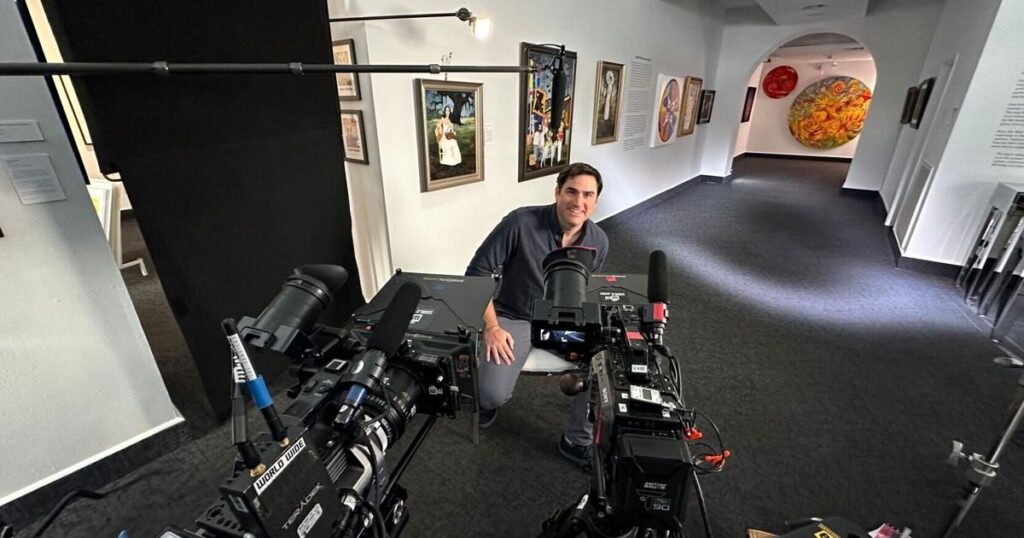
A location shot in the Rodrigue Gallery in Lafayette for the film ‘BLUE: The Life and Art of George Rodrigue.’
PROVIDED PHOTO
O’Malley, a New Orleans native, and writer Jeannine O’Malley, are the forces behind O’Malley Productions, which also produced documentaries “Fats Domino — Walking Back to New Orleans,” ‘A Tribute to Toussaint” and “Irma Thomas: The Soul Queen of New Orleans.”
How it started
The artist often told the story of his introduction to art through the gift of a paint-by-numbers set when he was confined to bed with polio in the third grade. But, he opted to forgo the numbers for the back of the canvas to create his own work.
He later studied art at the University of Louisiana at Lafayette and the ArtCenter College of Design in Los Angeles, then returned home to document the fading Cajun culture first through a series depicting oak trees with moss-laden limbs then moving on to paintings that showed Cajun people.
George Rodrigue’s 1971 painting, ‘Aioli Dinner.’
PROVIDED PHOTO BY MURRAY RISS/GEORGE GODFREY RODRIGUE JR. FAMILY TRUST
“He was painting Cajun people before Chef Paul Prudhomme’s Cajun revival,” Jacques Rodrigue said. “This was when the Cajun culture really wasn’t a thing to be celebrated. You know, if you’d told my grandmother that she was Cajun, she may have slapped you, because the Cajuns were considered ignorant, uneducated and didn’t speak proper French and weren’t a proper culture. But for my dad’s generation, this was a thing to be celebrated.”
So Rodrigue celebrated through such evocative works as his 1971 piece, “The Aioli Dinner,” and “Jolie Blonde” in 1975.
Cajuns celebrated
“The more I stayed in Los Angeles (for art school), the more I realized how different I was,” George Rodrigue says in a restored 1970 interview in the film. “Louisiana is different. The people are different. I wanted to paint my early childhood feeling. We had a different food, we had different music. There was nobody to record the last 200 years why we were here.”
George Rodrigue’s 1974 painting, ‘Jolie Blonde.’
PROVIDED PHOTO BY GEORGE GODFREY RODRIGUE JR. FAMILY TRUST
He also wanted to depict his culture’s resilience in hardship.
“They (the Cajuns) had to go to live in the swamps, you know?” George Rodrigue said. “They were not allowed in New Orleans. They were not allowed in the populated areas. This is what I want to show: the pain, the suffering of all these people.”
In the 1960s and 1970s, critics in the art world dismissed or struggled to understand George Rodrigue’s paintings. Museums and galleries wouldn’t show his artwork.
George Rodrigue’s 1991 painting, ‘Loup Garou.’
PROVIDED PHOTO BY GEORGE GODFREY RODRIGUE JR. FAMILY TRUST
“He realized early on that you can’t listen to what critics say as long as you’re painting what’s in your heart and believe in the public,” Jacques Rodrigue said. “He believed the public would respond.”
Finally, the one-hour film explores the origins of the Blue Dog, first painted in 1984 and inspired by the Loup-Garou — a “crazy werewolf dog” from Cajun lore — and was modeled after Rodrigue’s family canine, Tiffany.
What started as a ghost story illustration evolved into a global pop icon in the early 1990s, featured in presidential portraits, high-profile ad campaigns for Absolut Vodka, Neiman Marcus, and Xerox, and acquired by such celebrity collectors as Sylvester Stallone and Whoopi Goldberg.
For more information, visit wlae.com/rodriguebluedogfilm.