

 Na’im Qassem during his speech (al-Manar, May 25, 2025)
 Hussein al-Hajj Hassan (al-Manar, May 22, 2025)
 President Aoun and President el-Sisi hold a press conference (al-Qahera, May 19, 2025)
 Reward notice for information on Hezbollah activity in South America (X account of Rewards for Justice, May 19, 2025)
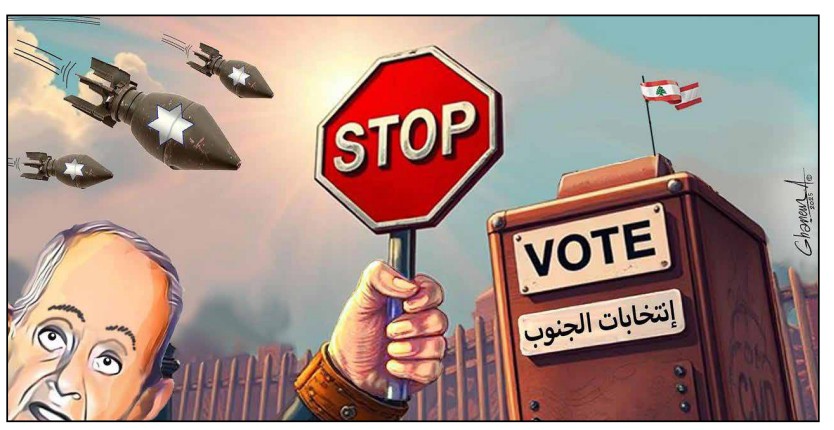 Cartoon of Israel’s alleged veto power to prevent local elections in Lebanon (al-Joumhouria, May 24, 2025)
 President Joseph Aoun voting in the elections (al-Jadeed, May 24, 2025)
 Cartoon criticizing the Lebanese government for focusing on disarmament rather than responding to Israeli attacks. The cartoon references the Lebanese-Palestinian summit and poses the question, “Is diplomatic dialogue stronger than fire and bullets?!” (al-Liwaa, May 22, 2025)
Overview
- IDF forces continued operations against Hezbollah’s presence in south Lebanon, which violates the understandings of the ceasefire agreement, and against the organization’s attempts to renew its military capabilities. A specialist in constructing facilities for the production of precision surface-to-surface missiles and operatives from the organization’s elite Radwan Force were eliminated.
- Hezbollah used the events marking the 25th anniversary of the IDF’s withdrawal from Lebanon to emphasize the role of the “resistance”[1] and to pressure Lebanese state institutions to take action to end the Israeli “violations.” Hezbollah’s secretary general, Na’im Qassem, warned that if the state did not act, there were “other options,” but added that the use of weapons was based “solely on the interests of the people.”
- Lebanese officials said they were continuing efforts with the international community to exert pressure on Israel to implement the agreements and withdraw from the five disputed points in south Lebanon.
- Hezbollah continues to face challenges in its military reconstruction in the wake of the fighting with Israel. In fear of targeted killings, senior Hezbollah figures have reportedly not resumed regular meetings. Syrian security forces found rockets and other weapons intended for smuggling into Lebanon.
- The joint Hezbollah-Amal list won the overwhelming majority of municipalities in south Lebanon in the local elections. Hezbollah Secretary General Qassem praised the election results across the country and said Hezbollah had proven it was a “national safety valve.”
- Palestinian Authority chairman Mahmoud Abbas visited Lebanon and met with the Lebanese leadership and representatives of Palestinian “factions.”[2] They reached an agreement to disarm Palestinian weapons in refugee camps beginning in June 2025. Hamas demanded to be consulted regarding the issue of weapons.
The Ceasefire
The IDF
- The IDF continued to operate against Hezbollah targets in south Lebanon which violated the November 27, 2024 ceasefire agreement, which prohibits the organization’s presence south of the Litani River. The IDF attacked Hezbollah’s efforts to restore its military capabilities, including an integrated aerial attack on 15 Hezbollah targets in south Lebanon which included rocket and missile launchers and other Hezbollah military capabilities. A site containing rockets and other weapons was attacked in the Beqa’a Valley region. The IDF reported that six Hezbollah operatives were eliminated in the attacks in south Lebanon, including an operative who specialized in the manufacture precision surface-to-surface missiles, and three operatives of the organization’s elite Radwan Force (IDF .6
Hezbollah
- used Resistance and Liberation Day, which marked the anniversary of the IDF’s withdrawal from south Lebanon in 2000, to boast of the role of the “resistance” and to pressure the decision-makers in Lebanon to take action against the [alleged] ongoing Israeli “aggression:”
- In a speech for Resistance and Liberation Day, Hezbollah Secretary General Na’im Qassem accused Israel of 3,300 “violations” of the ceasefire, while claiming the Lebanese state and the “resistance”[3] had fully complied with the agreement. He said the “resistance” was waiting patiently and allowing the state to lead the “confrontation,” but added that “action must be taken.” He said if the state failed to fulfill its obligations, “other options” existed, and the “resistance” was not prepared to remain silent in the face of “injustice” and would not surrender. However, Qassem also claimed that “resistance is not a weapon used daily or for constant attacks,” and that weapons were [allegedly] used “only when necessary, and in a manner that suits the interests of the people.” Qassem said, “Israel’s conditions will not be met, and no one will threaten us, and we will not threaten anyone. We have two options, victory or martyrdom, and we are prepared for both” (al-Manar, May 25, 2025).
Na’im Qassem during his speech (al-Manar, May 25, 2025)
-
- Hezbollah’s bloc in the Lebanese Parliament released a statement for the 25th anniversary of the IDF’s withdrawal, stating that choosing “resistance” had brought the “precious victory of liberating the land from aggression” and restored pride, dignity, sovereignty and independence. The statement expressed appreciation for the men of the “resistance,” its supporters and admirers. It opposed any attempt to “[make the resistance] surrender and normalize [relations with Israel]” and warned against attempts to normalize the enemy’s attacks in south Lebanon. Members of the bloc urged the Lebanese leadership to show awareness, courage and foresight for the good of the state and the people, and not to surrender to pressure from the American administration, “which seeks to serve the interests of the Israeli enemy at the expense of the Lebanese” (al-’Ahed Telegram channel, May 22, 2025).
- Hussein al-Hajj Hassan, a member of the Hezbollah faction in the Lebanese Parliament, condemned the Israeli attacks in Lebanon and criticized the Lebanese government for not responding to them. He also addressed Arab and Christian leaders, asking, “What will you do in the face of Israel’s actions in the West Bank, the Gaza Strip, Syria and Lebanon? What is the point of declarations and conferences if Israel continues to threaten the region and escalate its aggression?” (al-Manar, May 22, 2025).
Hussein al-Hajj Hassan (al-Manar, May 22, 2025)
-
- Ali Fayyad, a member of the Hezbollah faction in the Lebanese Parliament, claimed the path to “stability and recovery” in Lebanon began with pressuring Israel to withdraw from the disputed five points, stop “hostile acts,” release prisoners, respect Lebanese sovereignty and facilitate reconstruction efforts. He said the state had to protect the Lebanese people, and the complexity of the current phase required greater responsibility and steadfastness, and called for maintaining national unity. He claimed Hezbollah was prepared to cooperate in recovery, stability and reform, but would reject any attempt to impose political conditions that harmed Lebanon’s sovereignty or denied the Lebanese their right to self-defense (al-Nashra, May 19, 2025).
- Hezbollah allies in the Shi’ite community also criticized the Lebanese government and called for increased international pressure to bring about an end to Israeli attacks and the withdrawal of IDF forces from the five points it controls in south Lebanon:
- The Amal Movement, Hezbollah’s partner in the “Shi’ite duo,” said in a statement for Liberation Day that there was a need to “confront the facts and rules that the Israeli enemy has tried to impose for the past 15 months with its daily aggression” through a comprehensive national response at various levels. The statement said that all forms of pressure had to be exerted on the international community and the countries guaranteeing the ceasefire agreement to compel Israel to stop its “crimes and aggression” and enforce a withdrawal from the land it still “occupies,” land which “we will never accept as anything but Lebanese.” Amal said that it would not agree that the five points held by Israel in south Lebanon become a buffer zone or scorched earth, and that “no matter how great the sacrifices may be,” they would not accept it (al-Nashra, May 25, 2025).
- Sheikh Ali al-Khatib, deputy head of the Supreme Shi’ite Council, said he was surprised that nothing had been done regarding the implementation of UN Security Council Resolution 1701, despite the fact that the United States and France had guaranteed it. He claimed that only the Lebanese side was fulfilling the agreement, and accused the government of merely tightening “restrictions and the siege” against the Shi’ite community. He warned that they were “pushing the country toward an explosion” and that the Shi’ite community would not submit to the status quo or remain passive in the face of measures taken against it. He demanded immediate action on reconstruction and that “no aid be given to enemy in its financial siege” on the Shi’ite community (al-Manar, May 23, 2025).
- Senior Shi’ite Mufti Sheikh Ahmed Qabalan asked, “Where is the state, equality, national strength, and the protection of Lebanese sovereignty in the face of Zionist attacks? Or are the south and the Beqa’a Valley not part of Lebanon? Or is national courage forbidden?” He said “resistance”[4] was the only solution and that issues such as disarmament were merely “comedy” meant to undermine Lebanon’s sovereignty (al-Manar, May 22, 2025). He also claimed that the “attacks, violations and killings by Israel” in south Lebanon, the Beqa’a Valley and the Dahiyeh al-Janoubia in Beirut “trample the dignity of the state and push us to amass power and never relinquish it” (MTV, May 23, 2025).
The Lebanese leadership
- Lebanese President Joseph Aoun visited Cairo and met with Egyptian President Abdel Fattah el-Sisi. They held a joint press conference where they called on the international community to exert pressure on Israel to implement signed agreements and withdraw from Lebanese territory in accordance with Resolution 1701 (al-Qahera, May 19, 2025).
President Aoun and President el-Sisi hold a press conference (al-Qahera, May 19, 2025)
- Lebanese Prime Minister Nawaf Salam said Lebanon was continuing diplomatic contacts with the United States, France and Lebanon’s allies to pressure Israel to stop its attacks and withdraw from Lebanese territory. Regarding reports of a possible prisoner exchange deal involving Iraq, Iran and Israel which would also include Hezbollah [terrorist] operatives held in Israel, Salam said, “Israeli guarantees cannot be trusted.” He added that Lebanon continued to demand the release of Lebanese detainees held in Israel, just as it continued to demand the release of the “occupied” Lebanese lands (X account of the Lebanese Prime Minister, May 24, 2025).
- In a statement for Liberation Day, Salam said the celebration would not be complete “until all Lebanese land is liberated from Israeli occupation.” He added that all necessary measures had to be taken to liberate Lebanese land, impose sovereignty over the entire country and rebuild what had been destroyed by “Israeli aggression” with Arab and international support (X account of Nawaf Salam, May 25, 2025).
The Lebanese army
- Lebanese army Commander Rodolph Haykal issued a message for Resistance and Liberation Day, which marks the IDF’s withdrawal from Lebanon in 2000. He called it a national achievement which was a result of the Lebanese people’s steadfastness. He added that Resistance and Liberation Day came in the midst of a difficult and dangerous stage following the “comprehensive aggression launched by the Israeli enemy” against Lebanon, especially in the south, which had caused thousands of deaths and injuries and widespread destruction of property and infrastructure. Haykal said the “effects of the aggression” were still visible, but they had demonstrated the Lebanese people’s commitment to their national spirit (X account of the Lebanese army, May 22, 2025).
UNIFIL
- UNIFIL spokesperson Andrea Tenenti conducted a helicopter tour over the Blue Line[5] and noted that there was extensive destruction along the entire border, from Rosh HaNikra in the west to Shebaa in the east. He added that UNIFIL had remained in place throughout the conflict and it was important that it continued. He noted the importance of continued support for the Lebanese army as it deployed in south Lebanon as a condition for restoring regional stability (UNIFIL Telegram channel, May 23, 2025).
Disarming Hezbollah
Hezbollah
- Hezbollah Secretary General Na’im Qassem indirectly addressed the issue of the organization’s disarmament in his Resistance and Liberation Day speech. He claimed that only after Israel withdrew, stopped the “aggression,” released Lebanese detainees and fulfilled its commitments under the ceasefire agreement, would Hezbollah be willing to “discuss any matter” (al-Manar, May 25, 2025).
- Internal debates are ongoing in Hezbollah regarding the continued transfer of weapons to the Lebanese army. According to the report, some support patience while others claim it is entirely impossible and that disarmament should be resisted while presenting the organization’s demands to the Lebanese government (al-Hadath, May 22, 2025).
The Lebanese government
- The United States-Lebanon Coordination Committee sent a letter to Lebanese President Joseph Aoun and Prime Minister Nawaf Salam outlining its priorities for helping the country to advance and make progress. It stated that a date had to be set for the disarmament of illegal weapons and the expansion of state sovereignty over its territories. The committee also praised the Lebanese leadership’s efforts to implement UN Security Council resolutions, including Resolution 1701, and noted that Arab and international support presented a unique opportunity for Lebanon’s reconstruction (Lebanese National News Agency, May 21, 2025).
- Lebanese Foreign Minister Youssef Rajji said government decisions had already been made regarding exclusive control over arms, and that only [sic] implementation remained. He said patience was necessary in dealing with the issue but exclusive control over weapons would resolve all of Lebanon’s problems. Rajji said Lebanon had to implement economic reforms and the principle of exclusive arms control, as they were conditions for national reconstruction, economic recovery and international political support (LBC, May 21, 2025).
- Lebanese Prime Minister Nawaf Salam said they would not rest as long as there were weapons not under state authority. He added that the majority of the Lebanese people supported the leadership’s position and the goal was to restore the people’s trust in state institutions (Sky News Arabia, May 26, 2025).
Hezbollah
Na’im Qassem’s speech
- Hezbollah Secretary General Na’im Qassem delivered a speech for Resistance and Liberation Day, saying it was the first time the event was being marked without the presence of the late Secretary General Hassan Nasrallah. He used the speech to reaffirm the role of “resistance” and Hezbollah’s involvement in the Lebanese arena even after the fighting with Israel (al-Manar, May 25, 2025):
- Commitment to pursuing the path of Hassan Nasrallah: Qassem said it was the first time since the IDF’s withdrawal 25 years ago that they were marking Resistance and Liberation Day without Nasrallah, who “carried the resistance and led it to its victories, its status and its spread throughout the region.” He admitted that Nasrallah’s absence was “deeply painful,” but added that it was comforting to know he was “watching and following” and that they would continue to fulfill “his covenant.”
- The role of the “resistance”[6] in Lebanon: Qassem declared that the “resistance” had achieved Lebanon’s liberation and the independence of the “new Lebanon” in 2000, and had become “a fundamental component of Lebanon and a pillar of its strong future.” He claimed that after the “resistance” succeeded in “expelling” Israel after 22 years of “occupation,”[7] there was no longer any debate over the importance of the “resistance” and its role. He added that the “resistance” had proved to be the only option for liberation and had ended Israel’s ability to “expand” into Lebanon.
- Appeal to the United States and its administration: Qassem accused the United States of meddling in Lebanon’s sovereign affairs and demanded that it stop. He stressed that the United States was mistaken if it thought it could pressure Lebanese officials into ceding to Israel’s demands, as they had not been achieved even through war. He addressed the American president directly and warned that giving Israel free rein in the Gaza Strip and Lebanon would only damage the United States’ opportunity to invest in Lebanon and the region.
- Rebuilding the country: Qassem urged the government to act more effectively, especially as there were countries prepared to help and only waiting for Lebanon to take the first step. He said Iran had expressed willingness to support Lebanon, but the state preferred to fund the reconstruction by itself. He said reconstruction was the foundation of stability and security for the citizens.
- Hezbollah’s post-war involvement: Qassem claimed Hezbollah was involved in every development in the country, and that the organization’s “positive fingerprints” were visible in the election of the president, the formation of the government, the municipal elections, appointments and legislative processes. He rejected efforts to interfere in Hezbollah’s involvement, which he claimed were influenced by foreign powers, and said no one would blackmail them in exchange for stability and reconstruction.
Challenges to Hezbollah’s reconstruction
- Senior Hezbollah figures have reportedly not yet resumed regular meetings due to fears for their safety and concerns of being targeted by Israeli attacks. According to the report, Hezbollah is expected to launch an internal workshop to uncover the security and political breaches that occurred before and during the war, and in consequence to plan the organization’s reconstruction. Upon completion of the workshop Hezbollah will publish a document similar to the one released in 2009 outlining its vision for Lebanon and the region in light of current events and developments (al-Hadath, May 22, 2025).
- Syrian internal security forces in Homs announced the discovery of a large weapons cache in the al-Qusayr area in the western agricultural area surrounding Homs before it could be smuggled to Hezbollah in Lebanon. The shipment, which was supposed to be smuggled via the village of Hawsh al-Sayyid Ali, contained dozens of Grad and other types of rockets, Kalashnikov rifles, machine guns and ammunition (al-Hadath, May 25, 2025).

Rockets discovered before they could be smuggled to Lebanon
(X account of the Umayyad News Agency, May 25, 2025)
- The United States State Department offered a reward of up to $10 million for information leading to the disruption of Hezbollah’s financial networks in the Tri-Border Area of South America, the triangle between Brazil, Argentina, and Paraguay. The region has been a zone of Hezbollah activity for years, where it operates with supporters and launders money, traffics in drugs and illicit diamonds, smuggles fuel and cigarettes, trades in luxury goods and counterfeits dollars, generating millions of dollars for the organization’s coffers (Rewards for Justice website, May 19, 2025).
Reward notice for information on Hezbollah activity in South America
(X account of Rewards for Justice, May 19, 2025)
Criticism of the Lebanese government
- Hassan Fadlallah, a member of the Hezbollah faction in the Lebanese Parliament, said reconstruction was primarily the responsibility of the Lebanese government, which had to ensure compensation payments to victims, but the current government had done nothing. He added that the country could not be rebuilt and achieve peace while abandoning hundreds of thousands of its citizens to suffer from Israeli attacks without reconstruction. Despite internal and external attempts at delay, Fadlallah said the first phase of Hezbollah’s reconstruction has been completed by providing alternative housing to 400,000 families (al-Akhbar, May 23, 2025).
- On May 23, 2025, Lebanese Prime Minister Nawaf Salam attended the reopening of the Camille Chamoun Sports City Stadium in southern Beirut, after six years of renovations. A group of fans chanted slogans in support of Hezbollah, including, “Nawaf, listen closely. [We are] at your orders, Nasrallah.” In response, Hezbollah’s media office issued a statement condemning the slogans and accusations against the prime minister as “disgraceful and unacceptable,” stating they contradicted national interests and did not serve internal stability (al-’Ahed, May 23, 2025). Salam said he did not view chants which accused him of being “a Zionist” as provocation, noting that accusations of treason had become a political tool in Lebanon. He added that they wanted peace, but a just and sustainable one, and “it is sad that part of Lebanon is still occupied” (Sky News Arabia, May 26, 2025).
Hezbollah and the municipal elections in Lebanon
- On May 24, 2025, local elections were held in municipalities across the South Lebanon and Nabatieh Governorates as part of the fourth and final round of municipal elections in Lebanon, the first since 2016. Even before voting began, the victory of the Development and Loyalty lists, which were jointly backed by Hezbollah and Amal, was assured in 102 of the 272 municipalities in the two districts due to early agreements. In the actual vote, the joint lists won in another 61 towns (al-’Ahed, May 24, 2025).
- Ahead of the vote in south Lebanon, Hezbollah Secretary General Na’im Qassem issued a message noting that massive voter turnout was part of the long-term reconstruction effort that included the elected municipalities and the state, which had to shoulder its responsibilities (al-Mayadeen, May 23, 2025). In his Resistance and Liberation Day speech following the elections, he praised the results of the Development and Loyalty list, stating that support in some districts reached over 50% and describing it as “an exceptional achievement.” He claimed Hezbollah and Amal had proved to be “a safety valve” for national balance and their electoral partnership demonstrated strength and unity around the “resistance and national project.” He thanked voters who supported the list in the Beqa’a Valley, Beirut, the southern suburbs, and north and south Lebanon (al-Manar, May 25, 2025).
- Qassem also defended the decision to run on a joint list with other parties, including rival Christian parties, in the Beirut elections on May 18, 2025. He said they put the state’s interests first to ensure balance and reassure Christians that they were not a target, and to guarantee that everyone worked together (al-Manar, May 25, 2025). His remarks came amid unusual criticism from Lebanese al-Akhbar editor-in-chief Ibrahim al-Amin, who said Hezbollah had made a mistake by not remaining neutral in the Beirut municipal elections. He claimed Hezbollah had sought to increase voter turnout solely among Shi’ites to offset a drop in Sunni support, thereby sending a negative message to most of Beirut’s population, while the Christian parties on the list, whom he called “minions of the American-Saudi patrons,” rushed to distance themselves from Hezbollah immediately after the polls closed. He concluded that even if Hezbollah did not view the developments as mistakes, the organization had to begin reach out to the public and renew trust in the idea that Hezbollah truly cared about reform and change (al-Akhbar, May 21, 2025).
- Speaker of Parliament and Amal leader Nabih Berri met with Mohammad Raad, the leader of the Hezbollah faction in the Lebanese Parliament. They discussed recent political developments and the municipal elections. Raad claimed that the election results reflected “our people’s commitment to the option of resistance” (Lebanese National News Agency, May 26, 2025).
- Before the vote in south Lebanon, sources from the “Shi’ite duo” (Hezbollah and Amal) claimed that the objective of Israel’s escalating its attacks was to disrupt the elections, intimidate residents and deter them from voting. Lebanese media reported that Lebanon had received guarantees from Israel via the United States that it would not attack or interfere with the voting (al-Joumhouria, May 23, 2025). Israel did not attack in south Lebanon on election day.
Cartoon of Israel’s alleged veto power to prevent local elections in Lebanon
(al-Joumhouria, May 24, 2025)
- Lebanese President Joseph Aoun visited Sidon and Nabatieh to observe the progress of the municipal elections in south Lebanon and voted in his hometown of al-Aaichiyeh. Aoun said the elections in south Lebanon “confirm that the will to live is stronger than the will to die” (al-Jadeed, May 24, 2025).
President Joseph Aoun voting in the elections (al-Jadeed, May 24, 2025)
The Palestinians in Lebanon
Mahmoud Abbas visits Lebanon and the issue of disarmament
-
Palestinian Authority chairman Mahmoud Abbas conducted a three-day visit to Lebanon. He met with senior officials and discussed the situation in Palestinian refugee camps and steps to disarm “armed factions”[8]
as part of the Lebanese leadership’s vision to ensure the state’s monopoly over weapons:
- After Abbas met with Lebanese President Joseph Aoun they issued a joint statement affirming their shared commitment to strengthening cooperation and coordination. They agreed to establish a joint Lebanese-Palestinian committee to monitor the conditions in the refugee camps and to work to improve living conditions while respecting Lebanese sovereignty and the rule of law. The statement noted their commitment to the principle of exclusive state control over weapons and the elimination of any event or action outside the framework of the Lebanese state. Abbas promised not to use Lebanese territory as a launchpad for military operations and to respect Lebanon’s declared policy of non-intervention and regional neutrality. They agreed to enhance cooperation in combating terrorism and extremism and to ensure that the refugee camps did not become safe havens for “extremist groups” (X account of the Lebanese presidency, May 21, 2025).
- In separate meetings with Lebanese Prime Minister Nawaf Salam and Speaker of Parliament Nabih Berri, Abbas claimed the Palestinians in Lebanon were committed to the decisions of the Lebanese leadership until they “return to Palestine, their homeland.” A joint implementation committee was established to oversee the execution of the understandings and assist in improving conditions without infringing on Lebanese sovereignty (Wafa, May 22, 2025).
- Meeting with representatives of “Palestinian factions” in Beirut, Abbas noted the importance of adhering to the principle of exclusive state control over arms throughout Lebanese territory and ending behavior contrary to that principle. He also said national unity, Lebanon’s security and stability, and strengthening coordination and cooperation were in the interest of both peoples (Wafa, May 23, 2025).
- Immediately after Abbas’ visit, the first meeting of the joint committee to monitor the situation in the refugee camps was held. Prime Minister Salam attended the meeting and welcomed Abbas’ decision to resolve the weapons issue. Salam instructed the establishment of a clear implementation mechanism with a defined timeline (X account of the Lebanese Presidency, May 23, 2025).
- A “source in the Lebanese government” revealed that an executive mechanism had been agreed upon to begin the disarmament process in mid-June 2025 in Beirut’s camps, followed by camps in the Beqa’a Valley, then in the north and finally in the south. “Official Lebanese sources” stated that there were no obstacles, especially as the Palestinian factions had agreed to cooperate. Any party refusing to cooperate would face severe consequences, including revocation of residency permits and possible deportation (al-Araby al-Jadeed, May 23, 2025). President Aoun later informed a visiting United States delegation led by Senator Angus King (Me-Ind) that Lebanese-Palestinian committees would begin working in three Beirut camps within a month (al-Nashra, May 26, 2025).
Cartoon criticizing the Lebanese government for focusing on disarmament rather than responding to Israeli attacks. The cartoon references the Lebanese-Palestinian summit and poses the question, “Is diplomatic dialogue stronger than fire and bullets?!” (al-Liwaa, May 22, 2025)
- Prime Minister Salam warned that the weapons in the Palestinian refugee camps could be used in internal Palestinian conflicts. He said “Palestine’s” strength lay not in its weapons, but in international recognition and diplomacy (Sky News Arabia, May 26, 2025).
- On the eve of Abbas’ visit, a message delivered to some Fatah leaders in camps near Tyre (al-Rashidieh, al-Burj al-Shamali and al-Buss) hinted that disarmament south of the Litani River had already begun. The message listed strict measures regarding military activity, such as bans on carrying weapons in camp alleys, bans on military uniforms outside official offices and restrictions on security duties to within official centers. Fatah’s largest military camp, the Shaheed Yasser Arafat Camp, was to be converted to civilian, social and cultural purposes (al-Madan, May 20, 2025).
Reactions to Abbas’ visit
- Azzam al-Ahmed, secretary of the PLO Executive Committee, said the weapons held by “Palestinian factions” would be handed over to the Lebanese government. He reported the creation of a Lebanese-Palestinian committee to hand over lawbreakers to the Lebanese army. He also said that neither Hamas nor any other group could refuse to give up its weapons in Lebanon (al-Sharq and al-Hadath, May 21, 2025).
- “Sources in Hamas” said Abbas represented the Palestinian Authority in Ramallah, and any decision regarding Hamas weapons or those of other factions had to be made after consultation and dialogue. The sources claimed Hamas had not used its weapons for internal conflict, only during wartime and under Hezbollah’s supervision (al-Sharq al-Awsat, May 22, 2025).
- Lebanese Foreign Minister Youssef Rajji said that during his visit Abbas had emphasized the “temporary nature” of the Palestinian presence in Lebanon and respect for Lebanese sovereignty. Rajji added that implementation of the Supreme Defense Council’s decisions regarding Palestinian arms had begun, and that Abbas acknowledged that weapons were no longer useful (LBC, May 21, 2025).
- The Lebanese Forces party, led by Samir Geagea, welcomed Abbas’ visit and the agreement to hand over the weapons in the camps to the Lebanese army, calling it a positive development. The party urged the government to convene and set a viable timeline to collect weapons inside and outside the camps and to take full responsibility for camp security. The party noted that refugee rights should not be confused with weapons in the camps and the state was responsible for protecting the Palestinians in Lebanon (al-Hadath, May 21, 2025).
- Bassam Hammoud, deputy head of al-Jama’a al-Islamiyya’s political bureau, said the visit occurred during a sensitive period and could spark controversy around the weapons issue. He called for wise handling of the matter and urged resolving Palestinian divisions. He also called on Abbas to act as president of the Palestinian Authority, not just as Fatah leader, and criticized using the visit for internal political purposes. According to Hammoud, the solution would begin by granting Palestinians their rights in Lebanon and conducting constructive dialogue with the Lebanese state to reach a comprehensive solution (the Hamas-affiliated al-Risalah, May 21, 2025).
[1] Hezbollah and the Palestinian terrorist organizations operating in Lebanon.
[2] Terrorist organizations.
[3] Hezbollah and the Palestinian terrorist organizations operating in Lebanon.
[4] Anti-Israel terrorism and violence.
[5] The Blue Line is a demarcation line dividing Lebanon from Israel and the Golan Heights.
[6] Hezbollah and the Palestinian terrorist organizations operating in Lebanon.
[7] He most likely started counting in 1978 with the IDF ‘s Operation Litani in south Lebanon.
[8] Terrorist operatives.
Related Articles