
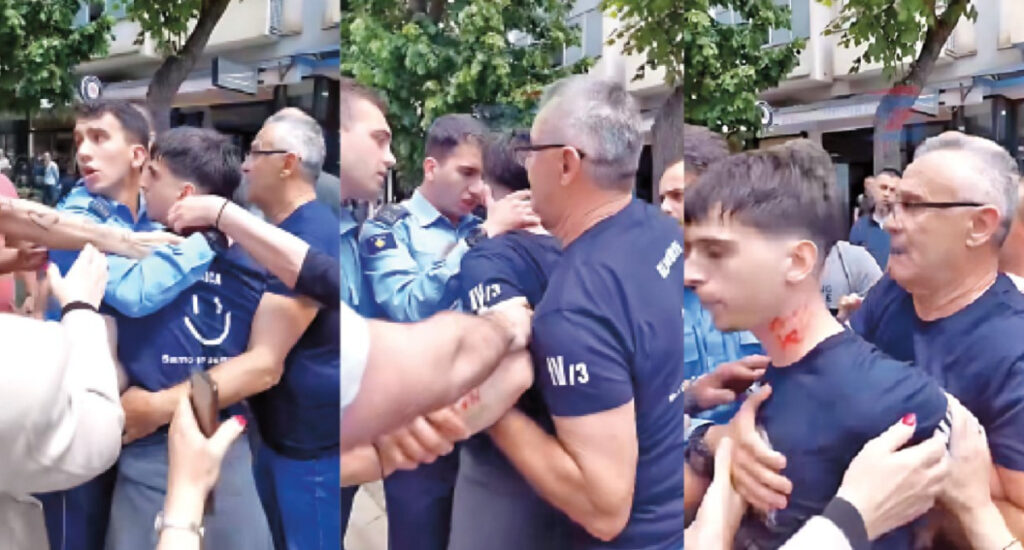
Sharp reactions from Kosovo police and their brutality towards citizens have not been new over the past two years. However, the latest incident, in which a police officer grabbed the neck of a high school graduate in the northern part of Kosovska Mitrovica, has particularly alarmed the Serbian public in Kosovo, as it involved a minor.
This incident is one among a series of sporadic events that have occurred over the past two years, following the Albanian leadership’s takeover of municipal buildings in northern Kosovo and subsequent serious clashes that have erupted. Since the conflict in Zvečan in May and then in Banjska in September 2023, there have been no major confrontations. Nonetheless, tensions continue to persist, exacerbated by the recent incident.
The incident took place during a celebration of high school graduation, when a group of graduates and their teachers were celebrating at the promenade in Mitrovica, having previously notified the Kosovo police about the gathering. Serbian flags were waved, the song “Vidovdan” was sung, and chants of “Kosovo is the heart of Serbia” were heard—elements that have been visible in previous years in northern Kosovo. However, what was different this time was that such a form of celebration disturbed some guests in Albanian cafes along the promenade. As seen in videos posted on social media, one of the attendees was showing the group of graduates the Albanian symbol—the double-headed eagle. This provoked a reaction from several graduates who responded with the three-finger salute, while one member of the group raised his middle finger. The police then reacted by surrounding the graduate, and a young Kosovo police officer was seen tightening his grip on the graduate’s neck. Videos show red marks on the graduate’s neck; however, it was revealed that these were not blood or injuries from the grip, but rather marker ink with which the students had written messages. The graduate was not detained, thus the specific situation calmed quickly, but the public reaction did not.
A resident of Kosovska Mitrovica, Miloš Timotijević, shared with NIN that, regarding this incident, he feels a personal as well as a collective sentiment of many he has spoken to—anger.
“This is an example of institutional violence, in this case from the police, specifically against Serbs, supported by the regime in Priština with its nationalist rhetoric and the criminalization of members of the Serbian community in Kosovo and Metohija. The police officer obviously pressed the graduate’s neck and injured him, but officials in Priština, led by Dželjalj Svečlja, loudly condemned—not the act itself—but the Serbian graduates who, according to him, provoked,” Timotijević states.
New problem – documents
Recently, the Kosovo police announced that soon, most likely from June 1, the use of Serbian personal identification cards issued by the Serbian Ministry of Internal Affairs, specifically its agencies that have been relocated from Kosovo to Serbia, will no longer be allowed at the borders between Kosovo and Serbia. This issue particularly concerns citizens in Kosovo who possess these documents as their only means of identification, and who have not become Kosovo citizens despite various administrative obstacles as well as personal sentiments, even when the Brussels Agreement offered facilitation.
Aleksandar Rapajić from the Center for the Advancement of Democratic Culture (ACDC) indicates that such resistance no longer exists and that institutions should now repeat the procedures that were in place several years ago.
“This would resolve issues within two to three months. Under the Brussels Agreement five or six years ago, there was a very simple procedure whereby people just brought in their documents and were then registered in the Kosovo system based on them,” says Rapajić. The Kosovo Ministry of Internal Affairs issued a regulation that, from early February to the end of April, allowed Kosovo citizens who possess only Serbian documents to register within the Kosovo system. However, numerous citizens were unable to do this—those who were adopted by birth or were born in cities in Serbia but live in Kosovo. The Kosovo Civil Registration Agency currently has no resolution for adopted individuals, while others are treated as foreigners.
The Kosovo police do not view the actions of their colleague as an abuse of authority, while the resigned minister, Dželjalj Svečlja, seeks blame elsewhere, asserting that Serbian graduates “provoked present citizens with nationalist symbols and chauvinistic slogans.”
“During the event, some participants began to provoke citizens present in the square with nationalist symbols and chauvinistic chants such as ‘Kosovo is the heart of Serbia’ and the three-finger symbol, which not only reminds us of the ethnic cleansing and genocide that Serbia committed in Kosovo but also expresses claims that are contrary to our republic,” Svečlja stated, claiming that the Kosovo police acted professionally to prevent further escalation. He added, “Kosovo guarantees all rights but cannot allow those democratic values to be expressed through similar actions stemming from the autocratic regime of Vučić’s pro-Russian system.”
However, events over the past two years contradict the claims of the Kosovo minister. Serbian symbols are almost invisible, in contrast to previous years when Serbian flags were displayed throughout northern Kosovo. They are now absent, and due to fears of potential punishment, no one dares to display them. Even a concrete pillar with the Serbian tricolor at Trg braće Milić (Milić Brothers Square) has been repainted, and Aleksandar Arsenijević from the Serbian Democracy was arrested for protesting. Displaying Serbian symbols is viewed as a provocation, leading to accusations of inciting ethnic animosity. Conversely, showing the Albanian eagle, displaying symbols of the Kosovo Liberation Army (OVK), and waving the flags of Greater Albania are not seen as problematic by the Kosovo police and minister. Kosovo police officers are often the ones leading these displays.
“When on one side you have the three-finger salute, and on the other side the double-headed eagle being shown, for the Kosovo police, only the former is considered a provocation. Trust in the police among Serbs is, especially after their withdrawal from institutions, at the level of statistical error, justified by their reactions,” says Miloš Timotijević. He also recalls that recently, four young men were brutally arrested, yet incorrectly, for a fight in which they did not participate, and previously, Miloš Subotić was beaten in a police station…
“We also have footage of brutal arrests and beatings of young men by police officers. Everywhere it has been said that young Serbs are provocateurs, but nowhere has there been evidence for that. About a year ago, cameras were installed throughout the city—they could now provide answers to the questions of who provokes whom and who beats whom, but the police have not publicly released any footage, likely because their statements are fabricated and cannot be corroborated by the cameras,” he asserts.
Closure of “illegal Serbian institutions”: Another reason for tensions
This incident is not the only one that has raised tensions in northern Kosovo. In the past two weeks, dozens of institutions operating under the system of the Republic of Serbia have been closed in the northern municipalities. The Kosovo authorities, with the support of the police, have taken over the “Waterworks,” several sports and cultural facilities, and the building of the Red Cross in Zubin Potok. This has been justified by claiming that these facilities housed “illegal Serbian institutions” and that the facilities are being returned to Kosovo municipalities. The sports hall and the Red Cross facility were built with funds from the Government of Serbia in 2018 and 2019, and the latter was inaugurated by Serbian President Aleksandar Vučić.
There is still no information on where approximately 1,000 children and youth from various clubs will train or where Red Cross activities, including blood donation for health institutions in Kosovo, will be organized. What is known is that the closed facilities are guarded by members of the Kosovo police.
“Banks, post offices, social services, employment agencies—all these institutions provided services to Serbs, but the police and municipal officials shut them down, offering no alternatives for people who are thus losing jobs and income. This economic pressure is just one of the systematic attempts by Priština to diminish the Serbian population in the north, in which they have partially succeeded, justifying their force through laws. Imagine someone living on social assistance or a severely ill person or a person with disabilities who must travel 50-100 kilometers in one direction to collect money they depend on. This places people in a very difficult situation where they must spend part of that already minimal financial resource on transportation. On the other hand, Kosovo officials typically relocate members of the Kosovo Ministry of Internal Affairs to the places of closed municipal institutions,” says Miloš Timotijević for NIN.
Timotijević believes that this latest incident will end as previous ones have—with futile investigations.
“In this case, there will not even be a reprimand; instead, that police officer will merely be transferred to work in southern Mitrovica. Mechanisms of control exist, complaints from Serbs about police behavior are more numerous than ever, but there are evidently no results. Hence, there is no trust as long as that police force does not have an ethnic composition that corresponds to the ethnic makeup in the northern part of Kosovska Mitrovica,” Timotijević states.
Since the withdrawal of Serbs from the Kosovo police in November 2022, this service has been predominantly composed of Albanian members in a mostly Serbian area. Since last year and the announcement of recruitment, young police officers from mainly the areas south of the Ibar River have been employed, with only a few dozen Serbs from Štrpce and other municipalities among them.
The presence of police in the streets of this city is noticeable, especially at the promenade where members of various ethnic groups circulate. Even on the day of the incident, there was a significant police presence in both uniforms and civilian clothing.
Nevertheless, despite Svečlja shifting responsibility onto the Serbian youth, reactions followed. Among them was that of Eulex mission chief Giovanni Pijetra Barabano, who expressed his deep shock and condemnation of the excessive use of force displayed by the police officer towards the young man in Mitrovica.
“I am confident that those responsible for this unacceptable act will be held accountable in accordance with the rule of law,” Barabano stated briefly.
In addition to reactions from civil society, Serbian political parties, and representatives of the government in Serbia, there has also been a response from the Kosovo Police Inspectorate. An investigation has been initiated against police officer Dulot Brahimi, who grabbed the neck of the Serbian graduate, and police director Gazmend Hodža has promised to “ensure that there are no oversights or mistakes,” which, he claims, provide grounds for viewing the Kosovo police as a force that does not respect the law and exceeds its authority.
Minister of Internal Affairs of Serbia Ivica Dačić announced that Brahimi would be arrested once available to Serbian authorities, a claim which Hodža regarded as “a continuation of the persecution of Kosovo police officers,” recalling the arrest of three officers in June 2023 by Serbian authorities.
There are also concerns from Serbian civil society regarding the operations of Kosovo police members, particularly special units, in the north. Five local organizations have published an extensive study on the conduct of Kosovo police officers. “Kosovo police officers in uniform, bearing symbols of Albania and the Kosovo Liberation Army, symbols that glorify extrajudicial justice, are sights commonly seen on social media and on the streets of Kosovo. Several instances have been recorded where police officers have been photographed next to a map of so-called Greater Albania,” highlights the joint study by the organizations Aktiv, Nova društvena inicijativa (New Social Initiative), KASA, ACDC, and InTer. They point out that all this constitutes a violation of laws and police procedures that remains unpunished, with Kosovo institutions and relevant international organizations neglecting it.
These five NGOs indicate that there has been a trend over the past three years on social media, especially TikTok, where “Kosovo police officers propagate Albanian ethnonationalism, contrary to the constitution and laws of Kosovo currently in force.” In this way, they not only violate the law but also at least 13 provisions of the sub-legal act on discipline. However, no sanctions have been imposed for such behavior.
In contrast, Serbs are arrested and punished even for messages on a t-shirt. For instance, Stefan Spasojević from the village of Dren, in the municipality of Zubin Potok, recently pleaded guilty in the Basic Court in Priština to the criminal offense of “inciting discord and intolerance.” He was arrested in October 2023 for wearing a t-shirt bearing a map of Kosovo and the slogan “We will not give you up, land of Dušan” (referring to Dušan the Mighty, a medieval Serbian king). He faced a potential prison sentence of six months, but after negotiating a plea and admitting guilt, he was fined between €2,500 and €3,000.