
For weeks, Republicans lawmakers in Texas had promised that they would require proof of citizenship to vote in most elections, hoping the 2025 Legislature would be a vanguard for other conservative states considering similar measures.
Voting rights groups cried foul. An analysis showed that the bill could disproportionately harm Republicans, who were less likely than Democrats to have the required documents. Then, as the Texas legislative session ended on Monday, the bill died.
Its failure was one of the many surprising results of this year’s legislative session, which was among the most conservative in recent memory. The Legislature passed measures requiring the Ten Commandments in every classroom and creating publicly funded vouchers for private-school tuition.
But the session also revealed the limits of right-wing governance, even in a state that President Trump won decisively and that is controlled by Republicans at every level of power. Lawmakers failed to pass strict curbs on wind and solar energy, and a tightened ban on abortion pills from out of state.
Texas was a particularly good test case for the G.O.P.’s reach because for the first time in years, Republicans in the Legislature were not actively warring. Gone were the internal fights between House and Senate Republicans that had marred the last several sessions, which occur every two years.
Instead, Lt. Gov. Dan Patrick, who controls the State Senate with a firm hand, got mostly what he wanted, a more compliant Texas House.
“We’re working seamlessly together,” Mr. Patrick told reporters last month, interlocking the fingers of both hands to show his relationship to the House.
Among the other conservative priorities that passed this year was a bill to ban Chinese and Russian ownership of Texas land, another allowing students time to pray during school hours, and a package of measures to tighten bail restrictions for those accused of violent offenses.
The Texas House speaker, Dustin Burrows, a Lubbock-area Republican, said he was “proud of the collaboration.”
By far the hardest-fought success was the creation of a $1 billion taxpayer-funded school voucher program. Championed by Gov. Greg Abbott, the measure had been blocked in previous years by a coalition of Democrats and rural Republicans who feared the impact on local public schools. (Public schools also received additional funding this year.)
But many of those resistant Republicans in the House were voted out after Mr. Abbott mounted a fierce primary campaign against them last year. They were replaced by more conservative representatives, aligning the Legislature with the governor and shifting the state further right.
Mr. Patrick, an opponent of gambling and drug legalization, also appeared emboldened to take on the Texas lottery over a 2023 rigged draw and to close a loophole in the state’s hemp law that allowed thousands of retailers to sell products across Texas that contained T.H.C., the intoxicant in marijuana.
Texas lawmakers imposed a total ban on consumable T.H.C. products, and at the same time expanded the state’s strict medical marijuana program. The state does not permit recreational use.
The move to ban the products puts Texas at odds with the national wave of cannabis legalization. Mr. Abbott declined on Tuesday to say whether he will sign it. Mr. Patrick has insisted that he is not worried.
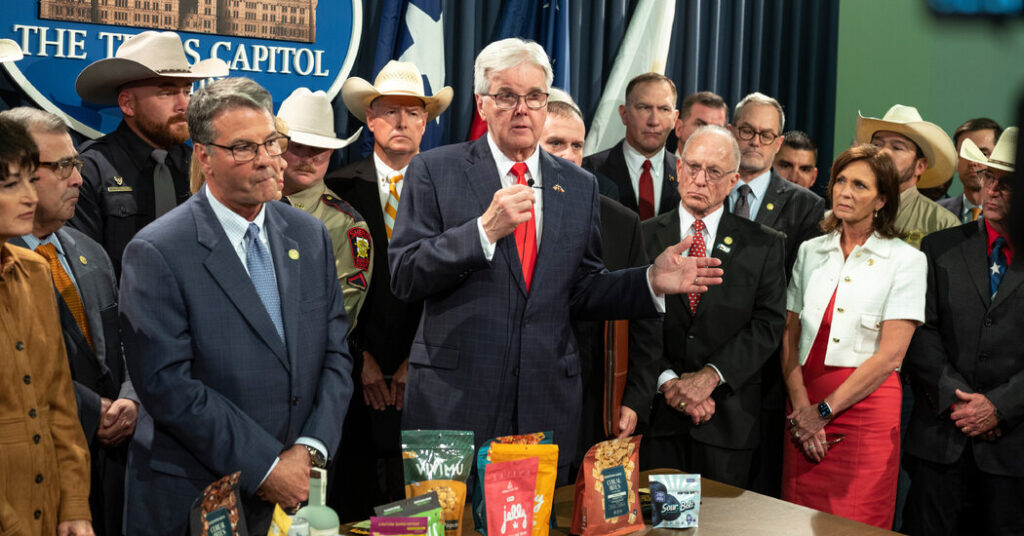
“Come September, all of this will be illegal,” Mr. Patrick said at a news conference last week standing next to an array of T.H.C. lollipops, drinks and cereal bites.
The Legislature also passed new laws to define gender as limited to male and female biological sex, and approved the addition of a statue on the grounds of the State Capitol that would depict a mother with a fetus in tribute to abortion opponents.
Lawmakers additionally required local sheriffs to work with federal immigration agents, and removed legal protections for teachers accused of using “obscene” instructional material.
They also approved a “Make Texas Healthy Again” bill that was backed by supporters of Robert F. Kennedy Jr., the U.S. secretary of health and human services, and opposed by major corporations including Coca-Cola, General Mills and Walmart. The measure requires warning labels on foods that contain a list of chemical and color additives.
The session left Democrats “reeling,” said Gene Wu, a Houston representative who leads the House Democrats. But, he predicted, Republicans would “soon face a reckoning for their choices,” like the ban on T.H.C. products and the private-school voucher program, which he said were opposed by many Texans.
In recent weeks, House Democrats found themselves scrambling to use whatever legislative procedures they could to block at least some Republican measures. But the flurry of measures orchestrated by a unified G.O.P. was too difficult to stop.
“We’re drinking out of a fire hose,” said Representative Trey Martinez Fischer, a San Antonio Democrat.
The top Republican leaders — the speaker, lieutenant governor and Mr. Abbott — even restarted their tradition of regular breakfast meetings, which had stopped during the intraparty acrimony in the last session.
Still, not every conservative priority made it.
Several bills that energy experts said would severely hamper the state’s renewable energy industry and potentially imperil its electricity grid, passed the Texas Senate but stalled in the House. Among them were proposals that would have curtailed solar and wind projects in favor of new natural gas plants. The measures had received some pushback from business groups who worried about potentially higher electricity costs.
Another Republican proposal would have curtailed the flow of abortion drugs from out of state by facilitating lawsuits against drug providers. The bill’s language tried a novel method to circumvent court challenges by asserting that the measure could not be challenged in state court. Any judge violating that section could be sued for damages of at least $100,000.
That measure passed the Senate but did not make it to the House floor.
Then there was the proof-of-citizenship bill.
Across the country this year, about half of all state legislatures had considered some form of proof-of-citizenship legislation, mostly in Republican-led states. Congress has also been weighing a similar federal requirement in a bill known as the Safeguard American Voter Eligibility or S.A.V.E. Act.
“It’s the biggest legislative trend of the year in states in terms of election administration,” said Katy Owens Hubler, associate director for elections and redistricting at the National Conference of State Legislatures.
With the support of Mr. Patrick, the lieutenant governor, the version that passed the Texas Senate would have gone farther than most, election experts said, by retroactively requiring documentary proof of citizenship for voters already registered in the state.
In the end, lawmakers appeared content to settle for a milder measure, passing a proposed amendment to the Texas Constitution to make clear that noncitizens may not vote — something that the State Constitution already prohibits. The proposal must be approved by voters in November.