
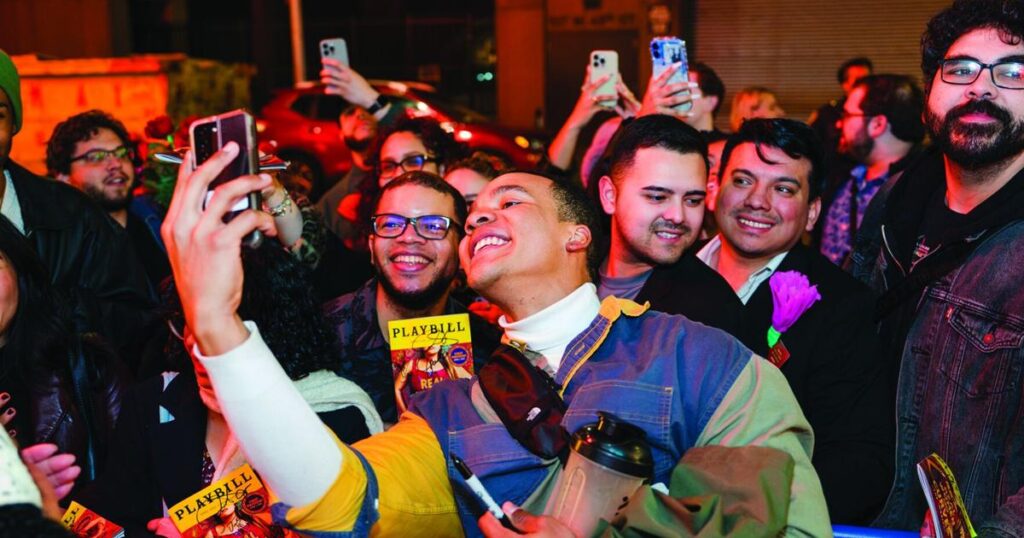
Growing up, Mason D. Reeves frequently performed with Desert Foothills Theater and other Phoenix-area companies. These days, he is appearing on Broadway in the show “Real Women Have Curves.”
The show opened on Broadway on April 27.
It was adapted from a stage play by Josefina López. The musical version features a score by Joy Huerta and Benjamin Velez and a script by Lisa Loomer.
“Real Women Have Curves” also inspired a 2002 film, starring America Ferrera as the main character, Ana.
The musical version centers around Ana, who is the child of undocumented immigrants. She works at a factory, but she dreams of attending college.
“Her sister runs a factory, and the family is afraid for her to leave home because they like having Ana, who’s a citizen, help them handle things around the factory. Throughout the show, it’s a family drama and a community drama about whether she can leave or not and about the things that the women that all work in the factory face together,” Reeves said.
“It’s really a show about sisterhood, community positivity and self-love. I get tacked on as another avenue to see Ana self-actualize and start to love herself and accept herself.”
Although Reeves grew up in Cave Creek, he graduated from Pinnacle High School in Paradise Valley.
“Real Women Have Curves” is Reeves’ Broadway debut.
In production, he portrays Henry, Ana’s love interest. The role of Ana is played by actress Tatianna Córdoba.
He said that he really relates to his character, who is similar to him in many ways.
“What I love about Henry is he’s a really sweet, dorky, quirky guy. He’s super passionate about journalism and super passionate about writing about things that will help make the world a better place. He’s unabashedly passionate about the things that he’s passionate about. He’s super into really quirky, interesting things, like all the different random things that people build in the U.S., things like the giant rubber band ball. He’s interested in why those things exist and why they’re a part of our cultural narratives. He’s a first-generation college kid,” Reeves said.
“He meets Ana along the way. They’re both super passionate about what they’re passionate about… They meet, and there’s an immediate connection. It’s been really fun getting to do it every night because he feels like me. I’m really absurd. I’m passionate about the things I’m passionate about it. I’m not like, ‘I shouldn’t have been goofy right there. It’s embarrassing to be goofy and be yourself.’ I’m like, ‘Nah, I love being myself,’” Reeves said.

The cast of “Real Women Have Curves.”
(Avery Brunkus/Contributor)
Reeves said within the show it is important to balance humor with heart and genuine nature of the story and characters. He has found this to be a challenge in playing Henry, who often acts as the show’s comic relief.
Reeves said the show delves into topics relevant in today’s society.
“I’m grateful that I’m a part of it because in telling the story, it’s hopefully going to help a lot of people think about the things that are happening around them and become more empathetic. It’s a very joyous show. Even with all the heavier things we’re talking about, it’s really about the way that anybody that’s in a difficult place gets by, which is through joy, through community, through laughter, even in the face of these hardships. People come and see the show, and they end up leaving crying, laughing, smiling. They go through a full range of emotions,” Reeves said.
The show is set in 1987 in Los Angeles’ Boyle Heights neighborhood.
“That’s a large immigrant community. It’s been really fun because a lot of people from Boyle Heights have been coming to see the show. There were some people that had Boyle Heights T-shirts on the other day in the lobby. I think it’s a really faithful representation of that community. We’ve got a lot of visual art that are either direct copies of murals that are in Boyle Heights or are just deeply inspired by art that’s on the buildings in Boyle Heights,” Reeves said.
Reeves has been part of “Real Women Have Curves” over the last two years through different stages of its development.
“At first, I was doing what’s called a ‘reading.’ So, we would get the script, sit down and read it for possible producers and investors. Now, I’m all the way here… Pretty much as soon as I got in there and realized what the show was about, I was hooked. I was like, ‘I really want to be a part of this,’ specifically because of all the women that are in the cast. It’s a lot of Latin women that don’t get opportunities to be full characters, especially on Broadway,” Reeves said.
Reeves has had to re-audition every time they have done a new iteration of the show. This has meant doing chemistry reads with different actresses.
Reeves has been acting since he was young.
Reeves recently played Kristoff on a national tour of “Frozen” and was in an Off-Broadway production of “Franklinland.”
He has also been in regional productions of “Anastasia,” “Hair” and “Footloose.”
Mason D. Reeves and Aline Mayagoitia in “Real Women Have Curves.”
(Avery Brunkus/Contributor)
He has played a variety of different roles as an actor.
He has learned skills such as juggling, dance movements such as switch leaps and jump splits and British and Southern accents.
In “Real Women Have Curves,” Reeves speaks some Spanish.
“A lot of the other people in the show have accents, but they’re from various countries. There’s somebody from El Salvador. So, she has a Salvadorian accent. There’s somebody from Guatemala, so she has a Guatemalan accent. Henry, he’s essentially just from LA. The Spanish that he speaks is because he’s in Spanish class in high school, and he’s a good student,” Reeves said.
The cast comes from different parts of the United States and other countries, such as Cuba and Mexico.
Reeves said his fellow cast members have the challenge of speaking in specific accents, such as an Argentinian accent, in both Spanish and English.
Growing up, Reeves’ mother served as the executive director of Desert Foothills Theater. She began enlisting his help for shows when he was in third grade.
“They always needed boys for shows, so she forced me to do the shows. At first, I was a big sports guy, but the more and more I did the shows, the more and more I started falling in love with it,” Reeves said.
He said with Desert Foothills, he really saw his potential as an actor while portraying the Leading Player, a narrator and guide in “Pippin.”
“The show is an abstract journey of this main character named Pippin, as he’s trying to figure out what the meaning of life is. The Leading Player is along with him, showing him and putting him in all of these different situations for him to see and discover the meaning of life.
At the end, you discover that the Leading Player, he’s evil. His desire was to show him that life is empty and that Pippin shouldn’t even try anymore….It was my freshman year of high school. It was really interesting getting into the headspace of this character that throughout the show is putting on this smile and this pizzazz, always trying to play things off and be the show man when in reality he has these more nefarious goals,” Reeves said.
Often throughout the years, Reeves has played dance-heavy roles.
He said having a background doing baseball and soccer helped him.
“I never had formal dance training, but since I played sports, I was really athletic. I think I was able to dance because I was good at moving my feet. I had good hand/eye coordination,” Reeves said.
As his interest in theater grew, he started working with other theaters around the Valley, including Valley Youth Theatre, Spotlight Youth Theatre, Arizona Broadway Theatre, Phoenix Theatre Company, Musical Theatre of Anthem and Actor’s Youth Theatre.
Reeves said he was able to hone different skills through working with a lot of companies.
Being in theater also helped him to find a sense of community and acceptance.
He really started to feel this during a Valley Youth production of “Shrek the Musical” his freshman year of high school.
“I got bullied a lot in middle school. I was one of the only Black kids I knew. It was white kids telling me that I wasn’t Black enough because of what they’d seen on TV and movies. And lots of bullying because I’m a nice guy, and I’m soft and not a jerk… When I was in the theater, in ‘Shrek,’ I was one of the pigs with these two guys. The three of us were just so close, and they were so open, kind and accepting. It was one of the first times I was like, ‘I think theater is also a space that I can exist in without people judging me all the time for things that I have no control over. It’s a place where people are willing to meet me for who I am and willing to share themselves for who they are,’” Reeves said.
Mason D. Reeves