
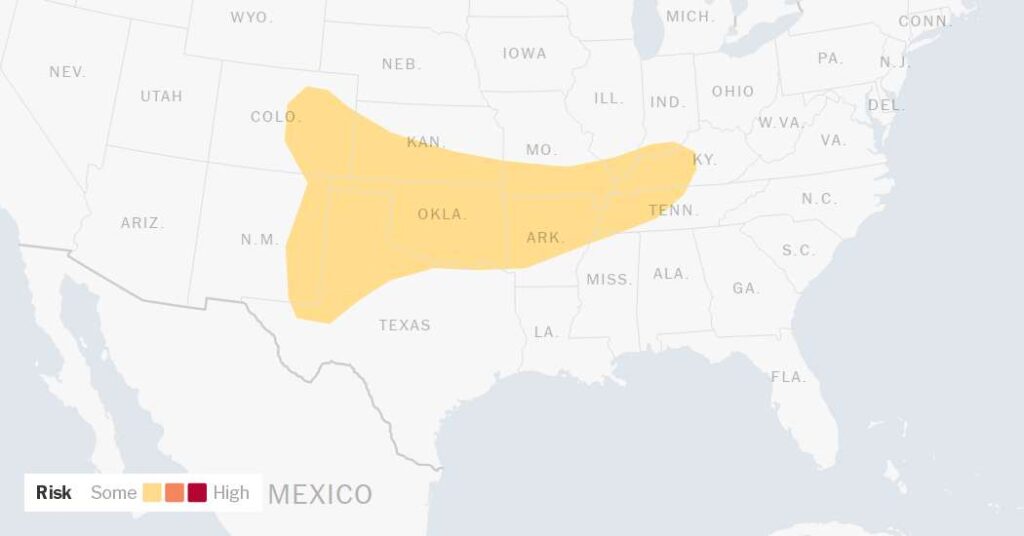
Reported tornadoes struck northwest Texas on Thursday, damaging homes and power lines but missing the city of Lubbock, which remained under a severe thunderstorm and flash flood warning late into the evening.
The severe weather was part of a pattern that was expected to persist from the southern Plains to the Southeast through the weekend, bringing the risk of large hail, damaging winds and flash flooding.
More than 13,000 customers suffered power outages in Lubbock and Hockley counties, according to PowerOutage.us. Tornadoes touched down in several towns, damaging homes in rural communities and causing at least three injuries, said Cole Kirkland, the Hockley County emergency management coordinator.
Scores of homes were damaged by hale and wind in Hockley County, Mr. Kirkland said, and most of the county’s roads were flooded.
At 7:39 p.m. local time, the National Weather Service office in Lubbock issued a tornado warning, describing it as a “life-threatening situation” with hail, and urging people to seek shelter. It was lifted shortly after 8:45 p.m.
A severe thunderstorm warning remained in place in several counties as the storm moved eastward with winds of up to 80 miles per hour and hail as large as softballs, according to the Weather Service.
The continuous severe weather outbreak is being driven by a large and strong storm system moving eastward and interacting with a slow-moving weather front, stretching from the southern Plains through the Ohio Valley.
Jennifer Tate, a meteorologist at the Weather Prediction Center, said that over the coming days, the front is expected to remain nearly stationary. As warm, moist air flows northward into the front, conditions will be favorable for the development of severe thunderstorms.
“That flow coming in from the Gulf, that can bring moisture and instability that are needed to produce those storms,” she said.
The threat of severe weather is expected to continue on Friday, affecting many of the same regions, while also expanding into the Southeast.
“The front is a little more progressive in moving southeastward by Friday, so that’s why the severe weather threat extends farther east,” Ms. Tate said. “But on the western side, like in Texas, it just kind of stalls there, and so that leads to additional rounds of storms.”
In addition to severe thunderstorms, the setup brings a risk of flash flooding, especially in areas already saturated from recent rainfall, where repeated rounds of storms are expected.
“With the storms being slow moving, then there can be multiple rounds of storms affecting the same areas,” Ms. Tate said. “It makes the soils pretty wet and then you get another round and that can lead to more flooding.”
Oklahoma is expected to receive some of the highest rainfall totals.
“Centered over central and northern Oklahoma, we’re predicting over three inches widespread, and then locally higher amounts through Saturday night,” Ms. Tate said. “But even after that there could be more repeated rounds through the weekend.” she added.
The risk for severe storms will continue into the weekend across much of the Southeast, as well as eastern Oklahoma and northeast Texas. The Storm Prediction Center again issued level 2 out of 5 risk for these areas, including parts of the Carolina’s and southwestern Virginia. Damaging wind gusts remain the main concern, especially during Saturday afternoon and evening.
Flash flood risks will also linger, especially across southeastern Oklahoma, Arkansas, northern Mississippi and western Tennessee.
A gradual improvement in conditions is expected early next week, although some storm activity may still continue in the region.