
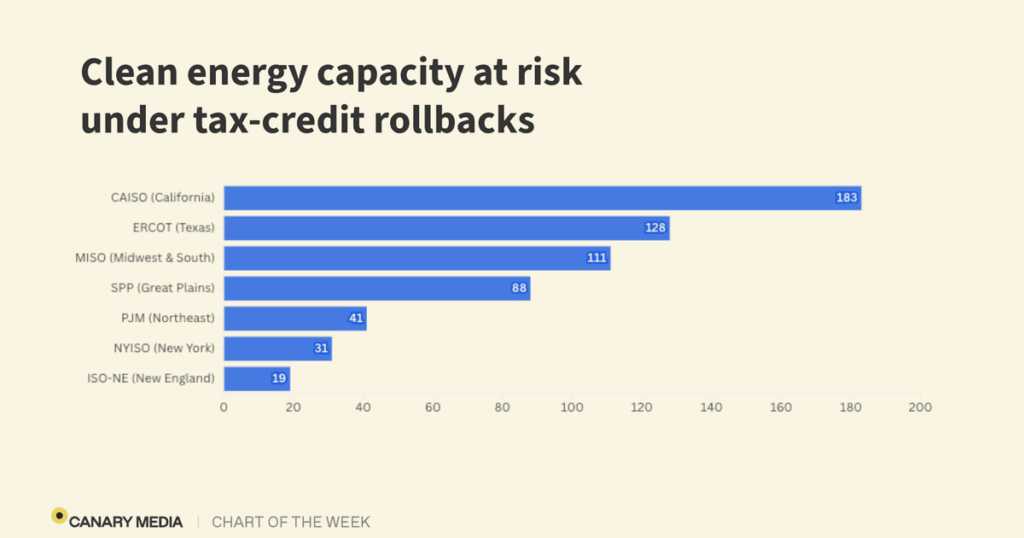
To be fair, the 600-GW figure is based on what’s currently in the interconnection queue, and a good number of those projects won’t get built regardless of the fate of the tax credits. (Projects often drop out of the queue for all kinds of reasons.) But if the bill kneecaps even a fraction of what’s anticipated, it will have serious consequences for the U.S. energy system. For context, the entirety of the U.S. had a generating capacity of around 1,200 gigawatts at the end of 2023.
The current version of the legislation would rapidly phase out federal tax credits that encourage clean energy development. As it stands, developers would be eligible for the tax credit only if their projects begin construction within 60 days of the bill’s passage and if they come online before the end of 2028.
That puts the 318 GW worth of projects planned to be completed in 2029 and later at explicit risk of losing their tax-credit eligibility. It also jeopardizes 2028 projects that either can’t break ground with just two months’ notice or which might hit snags that push their completion into 2029.