
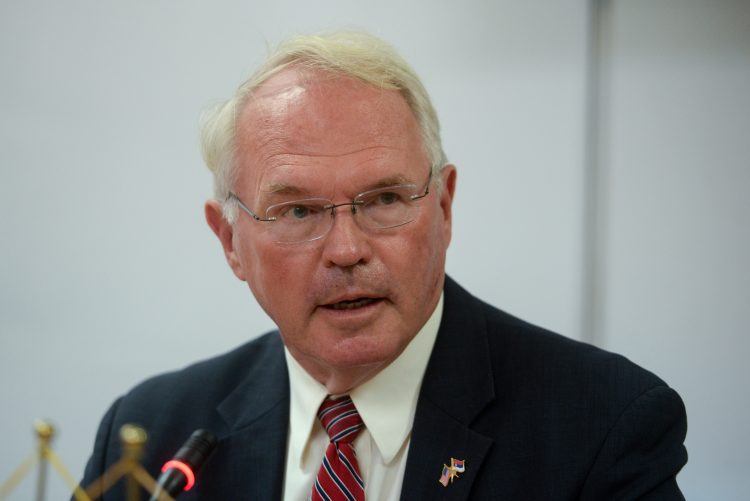
Hill: The US will no longer intervene like it used to – Kosovo and Serbia should solve their own problems

Express newspaper
14/06/2025 9:20
Former US ambassador to Serbia, Christopher Hill, does not expect the US to intervene in resolving problems in the Balkans, including the dispute between Kosovo and Serbia, as it has done in the past.
According to him, this region is not a daily priority for the US and solutions must come from within.
“The Balkans are, of course, unfinished business in Europe, but people in the Balkans need to understand that in other parts of the world, other things are happening. So they shouldn’t expect people to put aside the problems they’re dealing with, whether in Ukraine or the Middle East, and say: OK, Kosovo, we’ll try to help you with this,” Hill says in an interview with Radio Free Europe.
He emphasizes that Kosovo should move forward with the establishment of the Association of Serb-majority Municipalities, says that Serbia also has work to do, but underlines that it is helping Ukraine – the main priority in Europe, according to him.
“The fact that we are trying to manage some of our interests with Serbia does not mean that we are against Kosovo. We have many interests in Kosovo as well,” says Hill.
The EU should be more involved
Radio Free Europe: Ambassador Hill, we are here at GLOBSEC 2025 in Prague, where the main themes are global security and transatlantic responsibility. How do you see the position of the Western Balkans in the broader European strategy and what role can Kosovo play in this context?
Christopher Hill: First of all, I think it’s very clear that the European Union knows that there is some unfinished business, and that this unfinished business is in the Balkans. I think that right now, they [the EU] are evaluating how to define the new members. Should they admit them one by one, or all at once? There are many challenges and, of course, they are also considering the issues of approximation.
I think the European Union really needs to get more involved and finish some unfinished business. I believe we are seeing that now.
Radio Free Europe: Yesterday [June 12], here at GLOBSEC, you said that it is difficult to predict [US President Donald] Trump’s policy, but I will ask again: What kind of approach should Kosovo expect from his second administration?
Christopher Hill: I think there will be an effort by the US to encourage the Balkan countries to start solving their own problems. I think the time when countries came to us or to some Western European country to complain about their neighbors, [is over] and people are tired of that.
And the main point, of course, is that there are other things going on in the world. We are not living in the 1990s anymore. We are in a very different era.
Of course, we understand the issue of Israel, the big problem with Iran, which is enormous, the issue of Gaza… and of course for Europe there is the issue of Ukraine and what we are all doing for Ukraine…
So, I think the time when a Balkan country would come to us to complain about another Balkan country [is over], because people don’t have time for these things anymore. They want to see models of cooperation within the region, and not a country going to some favorite member of the international community and saying: Help us!
Kosovo and all Balkan countries should solve their own problems
Radio Free Europe: The United States has historically been one of Kosovo’s main and strongest allies. Do you expect this to continue, or do you foresee any change in tone or priorities?
Christopher Hill: I think, to some extent, it depends on what the people in Kosovo want to do. I can say that these issues in the Balkans are very complex, but their complexity exceeds people’s interest in understanding them.
If you go to the US and say, “We have all these problems with our neighbors,” people will respond, “Look, everyone has problems, solve them themselves.”
I think the expectations are that – without necessarily having intermediaries every day, without always relying on non-governmental organizations or friends – people will try to solve problems with their close neighbors themselves, because the international community is simply focused on other issues.
I’m not saying that the Balkans are not important. As I said, the Balkans are, of course, unfinished business in Europe, but people in the Balkans need to understand that in other parts of the world, other things are happening. So, they shouldn’t expect people to put aside the problems they’re dealing with, whether in Ukraine or in the Middle East, and say, “Okay, Kosovo, we’ll try to help you with this.”
Kosovo, like all Balkan countries, really needs to take responsibility and solve its own problems.
Symbolic gestures alone are not enough.
Radio Free Europe: Recently, the acting government of Kosovo agreed to temporarily house up to 50 migrants deported from the United States, as part of a third-country resettlement agreement. What does this action indicate about Kosovo’s proximity to American interests?
Christopher Hill: I think this shows that Kosovo has an interest in aligning itself with the US and showing willingness to help it in its challenges.
But I want to emphasize that such symbolic gestures are very important and useful. However, they must be accompanied by a broader approach, which ensures that Kosovo is not on the list of problems.
Radio Free Europe: Are you thinking of something concrete?
Christopher Hill: I don’t have anything concrete in mind, except for the fact that over 25 years have already passed since 1999 and I must say that I find it very disappointing that so little has been achieved during these 25 years.
The US less engaged in the Balkans
Radio Free Europe: Do you expect the United States to have an active role in facilitating the Kosovo-Serbia dialogue, or would it be more effective to let the EU lead?
Christopher Hill: I think the US has been saying for years that this is an issue that, realistically, the Europeans need to resolve. The US has had a special envoy for a number of years, but, in the current circumstances, I would expect a more limited direct engagement, compared to the past.
So I think the idea of the US being fully involved every day in the Balkans is going to change a lot. You will see US business interests in the Balkans, there will be diplomatic activities, no doubt. But I would not expect the US to step in and help solve people’s problems. People will solve their own problems.
Radio Free Europe: You said earlier that the Government of Kosovo bears a large share of responsibility for the lack of progress in the dialogue. What specific actions or decisions were you referring to?
Christopher Hill: When I think about the responsibilities for addressing things, I think of the Agreement towards normalization – the so-called Ohrid Agreement – which I think is a very fair agreement, worked out very carefully with the help of Mr. [Miroslav] Lajcak [former EU envoy for the Kosovo-Serbia dialogue].
And, it is quite disappointing that we fail to understand or reach the point where we agree on the Association of Serb-majority Municipalities, but it is blocked by issues that are more propaganda than real, such as: who signed what, and the like…
We need to see that agreement fully implemented, and part of it is the idea of granting limited autonomy to Serbs in northern Mitrovica. It’s about an association that deals with issues like education and hospitals, topics of that nature.
There are such models all over the world, especially in Europe. And since the then Prime Minister [of Kosovo, Hashim] Thaçi signed it, it had to be implemented.
So, this is an issue, but I’m not saying that only Kosovo has problems. Other countries, including Serbia, have to do their part.
But, specifically, to answer your question, Kosovo should focus on the Association of Serb-majority Municipalities and move forward from there. Serbia is not challenging Kosovo’s territory. In fact, all the people in the Balkans are talking about territory, they are talking about land. But the real problem in the Balkans, which people need to understand, is not land – it is people.
It’s a simple question: Do people in the Balkans want to stay there, or do they want to leave somewhere else? So far, there continues to be a wave of emigration. It’s not a question of land – there is plenty of land. The problem is whether people want to live, work and build their lives in the Balkans.
We are talking about normalization, not mutual recognition.
Radio Free Europe: Do you think Serbia is doing enough [to normalize relations with Kosovo]?
Christopher Hill: I think everyone has a responsibility. But the time when outsiders would say ‘you’re doing enough’ or ‘you’re not doing enough’ [is over] – I won’t get into that debate. I believe everyone knows very well what they should do.
Radio Free Europe: In 2021 you said that mutual recognition between Kosovo and Serbia would unlock Serbia’s European potential…
Christopher Hill: I don’t think I said that. I think someone else said that. We didn’t talk about mutual recognition, we talked about normalization. That’s what’s on the table.
Radio Free Europe: Earlier there was mutual recognition…
Christopher Hill: We are talking about normalization. This has been the EU’s position and we have supported the EU in this.
Radio Free Europe: During your time as ambassador to Serbia…
Christopher Hill: Again, I want to be very clear about this. This is not about slogans… It’s not about who I like and who I don’t. This is about trying to solve the problems. I think the European Union has presented a very serious proposal in Ohrid, and this is the issue on the table that needs to be addressed.
Radio Free Europe: Observers in the region, especially in Kosovo, have seen your approach as very favorable to Serbian President [Aleksandar] Vučić. How would you respond to that?
Christopher Hill: My approach is to act according to the way the US Government wants issues to be handled. We have many interests in Serbia that have nothing to do with Kosovo.
Serbia has helped in the Ukraine issue and we want this cooperation to continue. But the fact that we are trying to manage some of our interests with Serbia does not mean that we are against Kosovo. We have many interests in Kosovo as well.
Therefore, I would be cautious with the idea that the great powers are choosing between countries. We are not interested in that. We want the situation to calm down. We think that the European Union’s approach was right and we would like this approach to be followed.
Serbia is helping Ukraine
Radio Free Europe: If I’m not mistaken, in 2021, you also said that the US should show Serbia that it offers a better alternative to Russia and China. But has this message gotten through? Because we continue to see strong relations between Serbia and these two countries. Also, recently, Vučić was in Moscow…
Christopher Hill: Even later, Vučić was in Ukraine…
Radio Free Europe: Does this mean that his balancing policy is, in fact, successful?
Christopher Hill: You’ll have to ask him yourself. I’m not here to criticize his policies. Nor am I here to criticize Kosovo’s policies.
From the U.S. perspective, we want countries to be helpful on the major issues of our time.
The main issue on the European stage at the moment is Ukraine. Countries that are willing to help Ukraine and cooperate with it are the countries we want to work with.
But, as you know, these are practical issues that we all have to deal with. To make Ukraine a secondary issue in relation to older problems, I think, is wrong and misses the point.
We live in a very dangerous moment in the world and Ukraine is one of those issues that needs to be addressed with the utmost urgency. Serbia is taking some steps in this direction, so, of course, we will work with Serbia.
Radio Free Europe: Were you surprised by Vučić’s visit to Moscow?
Christopher Hill: I’m sorry, it happened after I left. I left Belgrade in January. I think it was predicted by some people. There are several reasons for this.
But, again, I think that’s not what we should be worried about. What we should be worried about is who is helping Ukraine and who is not.
Radio Free Europe: To return to Kosovo… Currently, Kosovo is facing a prolonged institutional vacuum following the elections and is awaiting the formation of a new parliamentary leadership. From your perspective, how damaging is this vacuum – both domestically and for Kosovo’s credibility as an international partner?
Christopher Hill: I would say that everyone has their own politics. We have our politics. Our politics have been very harsh and difficult in recent months. So, I’m not here to criticize Kosovo. They will have to reach an agreement based on what the parties can accept. It’s not easy.
I am not here to criticize Kosovo in this regard. Of course, Kosovo must form a government. There must be stability in the government. But let Kosovo resolve this issue itself. It is not my job to deal with this or express my opinions on this.