
In the NB8++ format, the Baltic states and Nordic countries Denmark, Estonia, Finland, Iceland, Latvia, Lithuania, Norway, and Sweden are joined by France, Germany, the Netherlands, Poland, and the United Kingdom.
According to a release from the Ministry, Lasis “underlined the need to preserve and strengthen the integrity of the UN Convention on the Law of the Sea and to ensure its uniform interpretation and respect for international maritime regulations and standards.”
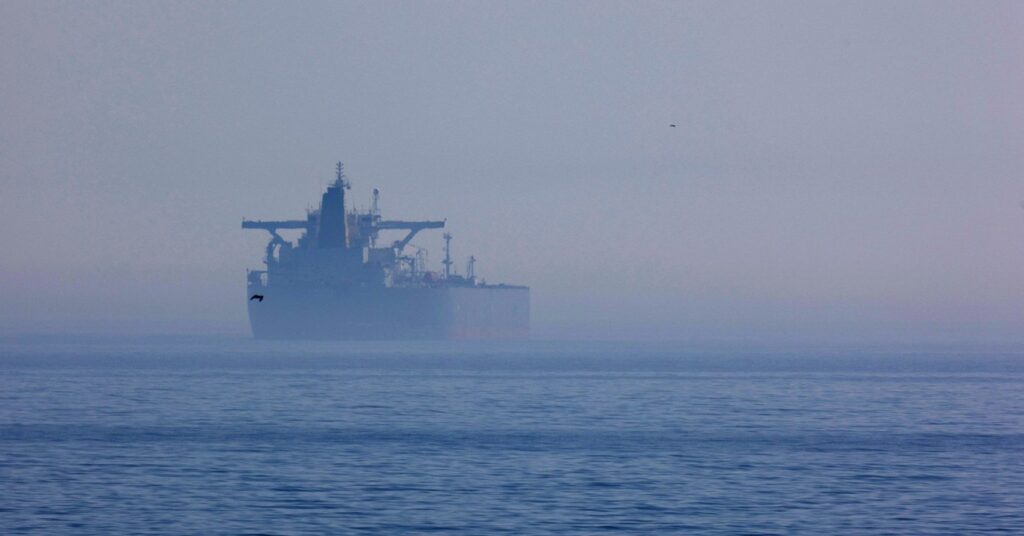
The participants adopted an NB8++ statement on joint actions to further counter the shadow fleet under international law, which is reproduced below in full. However, the statement is very short on specifics, and simply outlines the nature of the threat, along with a promise to “compile a common set of guidelines.”
Joint Actions to Further Counter the Shadow Fleet
We, the Foreign Ministers and government representatives of Belgium, Denmark, Estonia, Finland, France, Germany, Iceland, Latvia, Lithuania, the Netherlands, Norway, Poland, Sweden, and the United Kingdom have met today to address the challenge posed by the Russian shadow fleet. We call for further joint and coordinated action to effectively address Russian attempts to circumvent international sanctions.
Russia’s destabilising actions have strengthened our resolve to protect maritime security, safety, the marine environment and freedom of navigation in accordance with international law. We are particularly concerned about stateless vessels and falsely flagged vessels. Stateless vessels, including those falsely claiming to fly a flag, do not have a responsible flag state and are not entitled to rights under the United Nations Convention on the Law of the Sea (UNCLOS), including freedom of navigation. If vessels fail to fly a valid flag in the Baltic Sea and the North Sea, we will take appropriate action within international law.
Today, we have agreed to further strengthen our cooperation and ensure a joint and coordinated approach by our national authorities to address Russia’s shadow fleet. We intend to compile a common set of guidelines in line with international law to promote responsible behaviour at sea, strengthen compliance with international law, and ensure transparency across maritime operations.
We recall that the risks posed by the shadow fleet, including potential environmental damage as well as risks to maritime safety and security, the integrity of international seaborne trade, critical undersea infrastructure and respect for international maritime rules and standards, extend far beyond the Baltic and North Seas and could have global impact. We call on others to join our efforts.
Select text and press Ctrl+Enter to send a suggested correction to the editor
Select text and press Report a mistake to send a suggested correction to the editor
Tell us about a mistake