
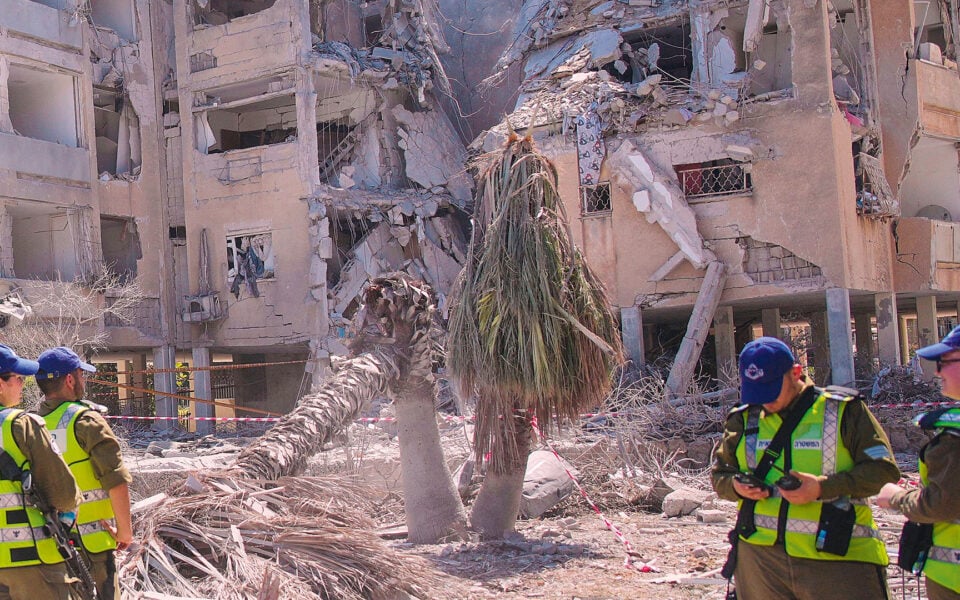
Israeli security forces in front of a building hit by Iranian missiles in the Holon area near Tel Aviv. Oil and natural gas prices surged at the outset of the conflict, prompting fears of prolonged inflation. [AP]
The intensity and duration of the Israel-Iran conflict will be critical in determining its impact on the Greek economy, economists warn, citing risks of stagflation and broader geopolitical instability.
Bank of Greece Governor Yannis Stournaras highlights potential stagflationary effects – higher inflation paired with slower growth – as key concerns.
Oil and natural gas prices surged at the outset of the conflict, prompting fears of prolonged inflation. While Brent crude has since eased to $76.92 a barrel, gasoline prices in Greece have already risen, and a potential closure of the Strait of Hormuz – vital for 20% of global oil shipments – remains a major threat.
Energy market disruptions could double their impact on inflation and growth if sustained for six months, Stournaras notes.
National Economy and Finance Minister Kyriakos Pierrakakis said Greece enters this crisis from a position of increased resilience, citing strong fiscal performance, credit upgrades, and falling debt levels. Still, he warned that deeper escalation could have global consequences, with no economy left untouched.
Beyond energy, analysts point to heightened uncertainty affecting trade, shipping, and investment. Nikos Vettas, the General Director of the Foundation for Economic and Industrial Research (ΙΟΒΕ) and a Professor of Economics at the Athens University of Economics and Business, notes that uncertainty is weighing on financing costs and capital markets, with implications for foreign direct investment – vital for Greece’s growth momentum.
Shipping is also at risk, especially deep-sea trade routes between Asia and Europe. Disruptions could drive commodity prices higher and delay supply chains.
The outlook for tourism, a key sector, is another concern: over one million Israeli tourists were expected to travel to Greece in 2025, up from 620,000 in 2024, generating revenues of €400 million. The broader decline in regional stability could significantly affect arrivals and revenues.
Eurobank chief economist Tasos Anastasatos notes that while escalation could hurt trade, investment, and inflation, a de-escalation could benefit Greece, positioning it as a relatively stable destination.