
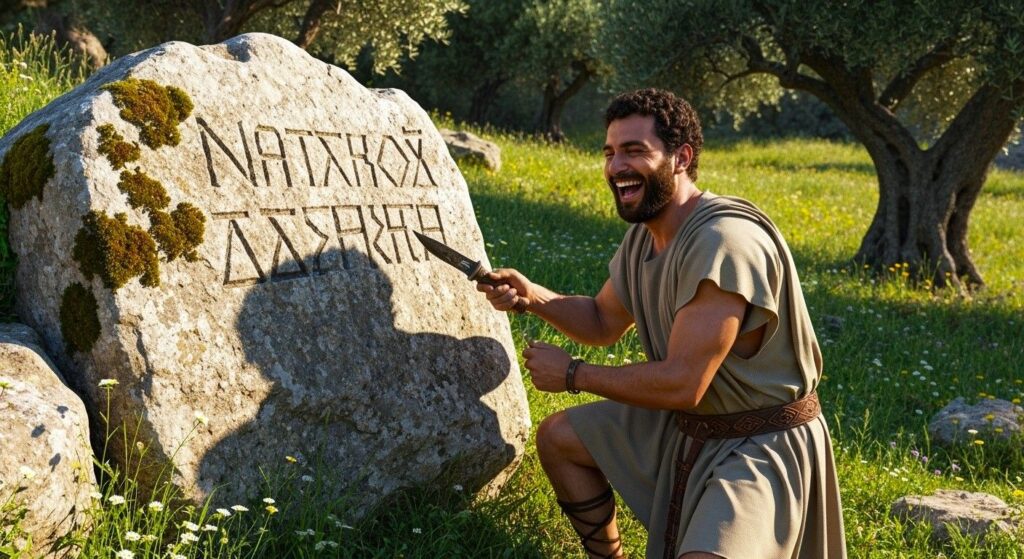
From time immemorial, humans have been depicting naughty images in conspicuous places, often in the form of doodling and graffiti, and the ancient Romans were no different. If you’ve ever been to the eternal city of Rome, you may have noticed it’s a place full of modern graffiti today; it’s a hallmark of the city and is something that the area is known for. Of course, this practice goes all the way back to ancient times, with the Ancient Romans producing countless lewd depictions of human genitals, fornication, and religious sacrilege in their graffiti art.
Related
New Frescoes Of Zeus, Helen Of Troy, And Apollo Discovered In Pompeii Have Archaeologists Gripped
Recently, the world got a rare treat: new frescoes were unearthed from Pompeii that show mythological scenes from the Trojan War Epic.
Sure, many people know that the Romans are famous for their hilarious graffiti (like the funny samples found at Pompeii), but we can’t leave the Ancient Greeks out of the conversation, either; they produced their own fair share of graffiti, too. In fact, in 2014, a rare epigraphic find on a remote Greek island made headlines for its funny, but simultaneously informative, lewd depiction and inscription. This depiction of two phalli and an inscription really shows us that the ancient folk from 2,500 years ago weren’t all that different from us today in terms of immaturity.
The Epi-graphic Find On The Island Of Astypalaia
In 2014, archaeologist Andreas Vlachopoulos, a specialist in prehistoric archaeology at the University of Ioannina, was doing fieldwork on Astypalaia (one of Greece’s many alternative islands, other than its famous touristy ones) when he made a discovery that was both hilarious and informative. As he was walking near the Bay of Vathy on the island’s northwest tip, he noticed some graffiti carved into the rocky peninsula.
It wasn’t just any graffiti, though. These two graffiti were ancient…and they were racy! Normally, when pieces of graffiti from ancient times are found on the island, they depict maritime themes. Graffiti showcasing oared ships and spirals had been found on the island before, but never had anything quite like these adult-themed depictions been discovered on Astypalaia.
Location Found:
Astypalaia
Discoverer:
Andreas Vlachopoulos
What Is The Graffiti?
Two phalli over the Greek name Dion, and a sentence that reads “Nikasitimos was having intercourse with Timiona.”
The first inscription was a sentence in Ancient Greek, which read: Νικασίτιμος οἶφε Τιμίονα (Nikasitimos oiphe Timiona). In English, this translates to: “Nikasitimos was having intercourse with Timiona” or “Nikasitimos was here mounting Timiona.” This inscription dates to the mid-6th century BCE. A second graffito, dated to around the 5th century BCE, showed two phalli drawn beneath the Greek name Dion (ΔΙΟΝ).
Significance Of The Erotic Graffiti Found On Astypalaia

Shutterstock
Astypalaia Island, Dodecanese, Greece
After these raunchy inscriptions were discovered, Vlachopoulos returned with a team from the University of Ioannina, bringing with him topographers, photographers, and conservationists. Out of the two, archaeologists had much to glean, but the Greek sentence from the 6th century BCE was the most intriguing. This was for multiple reasons.
Firstly, according to Vlachopoulos, both individuals mentioned in the inscription—Nikasitimos and Timiona—were male. In the ancient Mediterranean world, relationships or attractions between men were considered a normal part of life. However, they understood and described these relationships quite differently from how we do today. Rather than viewing them as a matter of personal identity or self-expression, the Greeks interpreted all forms of attraction—regardless of gender—in terms of social roles and power dynamics.
In Ancient Mediterranean cultures, like Greece and Rome, stigmas around sex had more to do with misogyny than homophobia. In the cases of male-male relationships in ancient Greek society, there could be social stigma, not necessarily due to the same-gender nature of the relationship, but rather due to perceptions tied to social roles. Specifically, being in a more passive or traditionally “feminine” role was often viewed negatively. If, hypothetically, Nikasitimos and Timiona’s relationship had become known to those around them—such as family, neighbors, or friends—Timiona may have faced more social judgment, as the one perceived to have occupied the less dominant role in the relationship.
Secondly, what made this sentence so interesting to Vlachopoulos was the verb tense used for the word οἶφε—imperfect active indicative third-person singular. This verb choice implies that the action was ongoing and continuous; it happened repeatedly over a long period of time.
“By using the verb in the past continuous [tense],” Vlachopoulos told The Guardian, “it clearly says that these two men were making love over a long period of time, emphasizing the sexual act in a way that is highly unusual in erotic artwork.”
One can only wonder about the saucy details of that bit of ongoing ancient gossip! Still, taking all the inscriptions and drawings as a whole, Vlachopoulos connected the graffiti with not only sexual desire, but triumph through the act of intercourse. The large letters and the sizable phallic drawings communicated to Vlachopoulos that the people who made the graffiti were very proud of their desire and felt empowered through it. “They claimed their own space in large letters that not only expressed sexual desire but talked about the act of sex itself,” he said in the same interview.
Related
The World’s Oldest Customer Complaint Has Gone Viral 4,000 Years After It Was Written
Think Karens and Yelp complaints are a relatively new thing? This ancient discovery proves humans have always loved to complain.
To us today, all of this can feel rather technical and heady. “The Ancient Mediterraneans understood sex to mean ‘what!?'”, you might be wondering. Power? Verb choices? While all of these aspects are important for researchers, the ultimate takeaway is that ancient humans were still humans, just like we are today. They have all the complexities we have, all the cultural caveats to navigate, while simultaneously having the same desire for jokes and for intimate moments that we do, too.
What “Masculinity” Meant In Ancient Mediterranean Times
One of the many things history books don’t often tell you about Ancient Rome and other Ancient Mediterranean cultures is that masculinity didn’t equal maleness. The reason male-male relations were considered okay for the dominant partner and not okay for the passive partner was due to the cultural mindset. You weren’t a man just because you had male body parts. What made you a man was a mix of your social status, your character, and your deeds.
Related
Experts Have Discovered Something Strange About Ancient Egypt’s Elite
A new study published in 2024 has revealed that Old Kingdom Egypt’s scribes had work-related osteoarthritis that can still be seen in their bones.
For example, a male human who was a slave was not a man in these terms. Some Mediterranean cultures even viewed non-citizens as not being men in the full social sense. Cultural norms linked passivity in intimate relationships with lower social standing, often associating it with women or enslaved people. Therefore, it was considered inappropriate or diminishing for a free male citizen to take on a passive role. On the other hand, being in the dominant position was not stigmatized, regardless of the partner’s identity or status.
This is also why female homosexuality can be so hard to identify in the Ancient Mediterranean. Examples exist, of course—Sappho is one of the most famous poets ever, after all—but these ancient cultures often had a hard time grasping female same-sex attraction because the dynamics of penetration weren’t equally at play since neither party had male reproductive anatomy. When lesbianism was encountered by men, such as in Martial’s Epigrams 7.67, it was often explained within the context of women behaving as men.
Graffiti And Literacy In The Ancient World
The raunchy ancient graffiti found on Astypalaia Island is more than just lewd and funny: it also gives archaeologists important insights into literacy in the Ancient World. An epigrapher named Angelos Matthaiou examined the graffiti and had crucial insights to share. The writing of Nikasitimos was clearly done well. This suggested to Matthaiou that the writer had been professionally trained in the skill.
In today’s world, we’re so used to just reading a book or writing down a paragraph that we forget what a rare skill reading and writing have been over the course of human history. Out of all the humans who have ever lived, only a small portion of us could read and write anything at all, let alone be fully literate. During the time when these graffiti were made, these were important and somewhat rare skills.

Related
The Oldest “Map Of America” Is Mysteriously Accurate & Experts Still Can’t Explain Its Precision
What’s the oldest map of America? This particular one may win the points for the most ancient, but its accuracy is stunning and puzzling to experts.
For archaeologists and ancient historians, graffiti isn’t just important because it shows a funny side of daily ancient life. It’s also vitally important because it showcases literacy in the ancient world. Graffiti gives historians a window into the way that people in ancient times used, formulated, and thought about writing.