
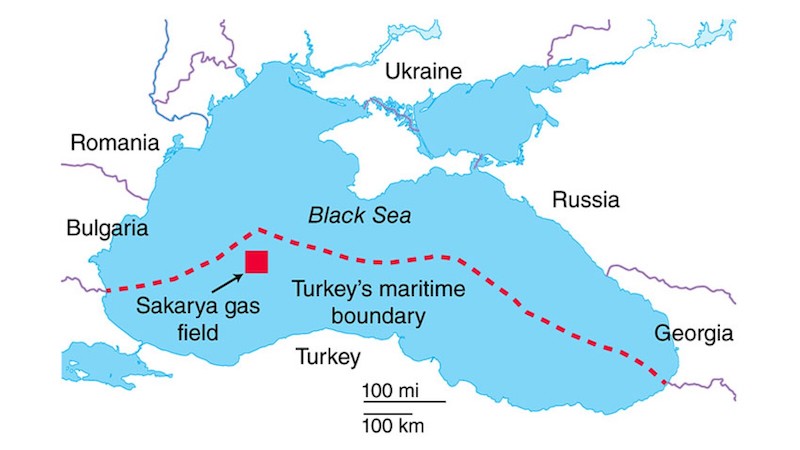
Turkey’s natural gas exploration and production efforts in the Black Sea have become a cornerstone of its energy policy in recent years. These activities aim not only to reduce energy imports but also to position Turkey as a regional energy player. Below is an overview of the project’s current status, technical details, and future projections.
1. Sakarya Gas Field and Key Discoveries
In 2020, Türkiye Petrolleri Anonim Ortaklığı (TPAO) discovered 540 billion cubic meters (bcm) of natural gas in the Sakarya Gas Field, located in the western Black Sea, marking Turkey’s largest natural gas reserve to date[^1].
- Location: Approximately 170 km offshore, at a depth of 2,100 meters (ultra-deep water).
- Reserve Updates: Seismic analyses in 2023 indicated potential reserves of 710 bcm, with estimates reaching 785 bcm by 2025[^2].
- Additional Discoveries: Further reserves were identified in the Amasra-1, Türkali-1, and Çaycuma-1 wells. Most recently, the Abdülhamid Han drilling vessel discovered 75 bcm in the Göktepe-3 well, increasing the total volume[^3].
2. Production Phases and Capacity Growth
- Phase 1 (2023): First gas reached the Filyos Processing Facility on April 20, 2023, with an initial daily output of 4 million m³[^4].
- 2024 Developments: Production capacity rose to 9.5 million m³ per day.
- Phase 2 (2026 Target): Aims for 40 million m³ daily (~15 bcm annually).
- Phase 3 (2028 Target): Plans to increase capacity to 60 million m³ per day[^5].
3. Technological Infrastructure and Offshore Capabilities
Turkey has built a robust national offshore fleet, including four drilling vessels (Fatih, Yavuz, Kanuni, Abdülhamid Han) and two seismic research vessels[^6]. Additionally, a floating production/storage (FPSO) vessel is planned to enable offshore production without traditional platforms.
TPAO has partnered with global engineering firms like Schlumberger and Subsea7 to access advanced technology[^7].
4. Economic Impacts and Financial Outlook
The project’s total investment is estimated to exceed $10 billion[^8]. In 2023, Turkey spent approximately $96 billion on energy imports, and Black Sea gas could reduce this by up to 30%[^9]. The Göktepe-3 reserve is estimated to have a potential market value of about $30 billion[^10].
5. Future Projections and Strategic Goals
TPAO plans to continue drilling off Zonguldak, Kastamonu, and Sinop, with claims that total reserves could reach 1 trillion m³[^11]. The Filyos Natural Gas Processing Facility has the potential to serve domestic consumption and future exports to the Balkans and Eastern Europe.
In terms of energy diplomacy, Turkey’s role as both a producer and transit country strengthens its geopolitical position[^12].
6. Environmental and Sustainability Risks
The Black Sea’s fragile marine ecosystem requires stringent environmental oversight during deep-sea drilling and gas transport operations. Risks such as leaks or explosions pose significant threats to ecological balance[^13].
General Assessment
- Turkey’s Black Sea gas initiative is a strategic turning point for energy security.
- As of 2024, daily production stands at 9.5 million m³, with a target of 60 million m³ by 2028.
- Sustainability hinges on transparency, environmental responsibility, and investment in local technology.
- In the long term, Black Sea gas will contribute to reducing Turkey’s current account deficit and advancing its vision as an energy hub.
References
[^1]: T.C. Ministry of Energy and Natural Resources, 2020 Press Releases
[^2]: DeGolyer & MacNaughton Turkey Report, May 2025
[^3]: TPAO Official Website, 2025 Göktepe-3 Statement
[^4]: Anadolu Agency, “Black Sea Gas Reaches Filyos,” April 20, 2023
[^5]: Bloomberg HT, “Black Sea Gas Production Timeline,” 2024
[^6]: SETA, “Black Sea Gas in Turkey’s Energy Strategy,” 2023
[^7]: Offshore Engineer Magazine, “Turkey Partners with Subsea 7,” 2023
[^8]: Dünya Newspaper, “Black Sea Gas Investment Expenditures,” January 2024
[^9]: TÜİK, 2023 Energy Import Data
[^10]: Energy IQ, “Economic Value of Göktepe-3 Reserve,” 2025
[^11]: NTV, “Black Sea New Discovery Target: 1 Trillion m³,” March 2025
[^12]: Foreign Policy Journal, “Turkey’s Role in Post-Russia Gas Security,” 2024
[^13]: Greenpeace Turkey, “Energy and Ecological Balance in the Black Sea,” 2023