
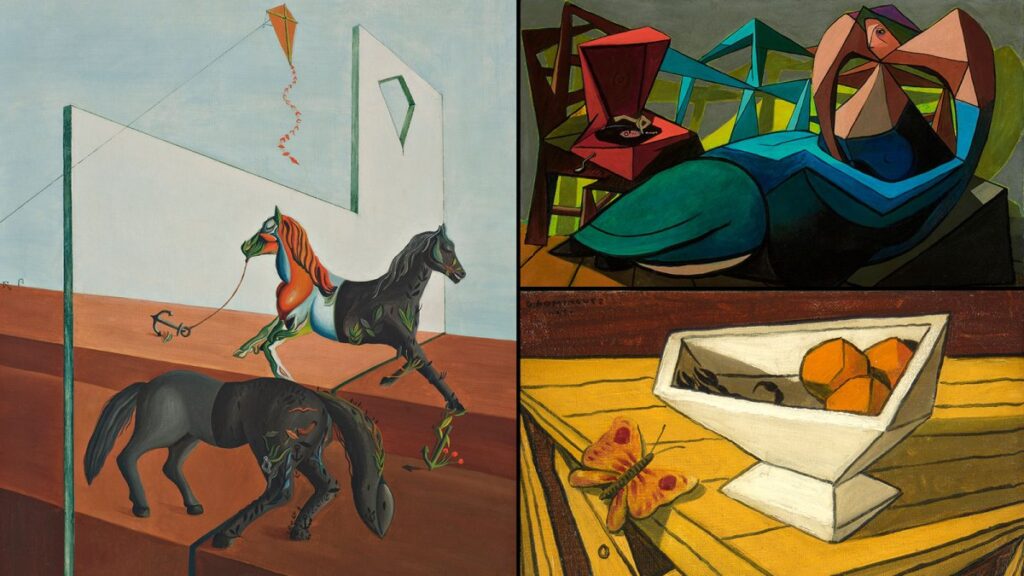
For decades, the Spanish surrealist painter Óscar Domínguez was reputed to be the “wildest and woolliest” of Paris’s artists.
But a hot night of heavy drinking in 1938 in his Montparnasse studio proved fateful. He accidentally blinded the Romanian painter Victor Brauner in one eye when he threw a glass in defence of another artist. The affray contributed to the breakup of the surrealist group.
Such was Domínguez’s bohemian cavorting that his “excesses” overshadowed his art. So argues Isidro Hernández, the curator of an exhibition in Malaga that seeks to restore Domínguez to his “rightful place” alongside Joan Miró and Salvador Dalí as one of the outstanding Spanish luminaries of the movement.
Domínguez may have agreed, but it was carousing that first liberated him to pursue painting. The son of a wealthy Canary Islands banana plantation owner, he arrived in Paris in 1925 at the age of 19 to sell his father’s produce. “I went on a binge for three months,” he recalled. “Naturally, he fired me.”
His father gave him an allowance, however, to copy the old masters in the Louvre, setting him on course for an artistic career that took off after he befriended André Breton, the main theoretician of surrealism, and more significantly, Pablo Picasso.
The exhibition, titled Óscar Domínguez, which showcases 100 works at the Museo Picasso Málaga until October 13, charts the artist’s changing styles before his alcohol-related descent into illness and his suicide, aged 51, in 1957.
Born on Tenerife, Domínguez was one of the earliest pioneers of surrealism. In about 1935 he set up his first studio in Montmartre, where he lived with Roma Damska, a Polish pianist. At the time he attended the surrealist group’s meetings at the Café de la Place Blanche, where he met Breton, Dalí, Yves Tanguy, Marcel Jean and Max Ernst, who were influenced by his work.
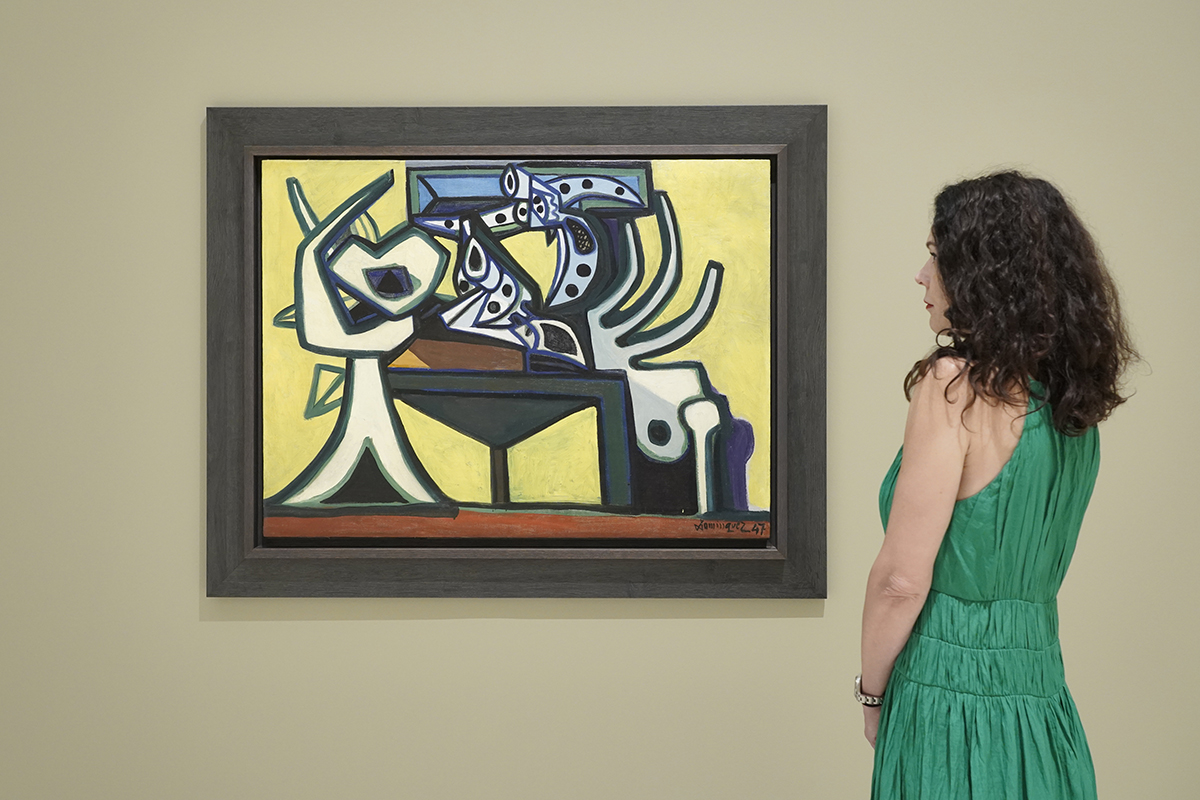
The exhibition at Museo Picasso Málaga runs until October 13 and features 100 works
MPM JESUSDOMINGUEZ.COM
“The problem is that his excesses damaged the image of him and clouded the view of a painter whose work is characterised by light, vitality, invention and a bold and experimental style,” Hernández said. “I think we should remember people for the masterpieces they were able to create and tone down the aspects that distort that legacy.”
The exhibition underscores the inspiration that Domínguez drew from the “primitive” landscape of his native Canary Islands, how his friendship with Picasso led them to help the Resistance in Nazi-occupied Paris, and his contribution to surrealism.
“The black sand beaches, ancient dragon trees and seas of clouds that embrace the mountain peaks of the Canary Islands forged an imagery that remained persistently and symbolically present in his work, distinguishing it from other manifestations of surrealism,” Hernández said.

La Cámara Oscura,1943
PRESS HANDOUT
He added: “The dragon tree characteristic of the Canary Islands is present in Domínguez’s paintings as a totem and a symbol, while the seas of clouds take on a metaphysical quality, inviting us to see them as suspended midway between the real and the fantastical.”
Domínguez’s Portrait of Rome, which features a dragon tree and was sold in 2014 for close to $1.5 million at Christie’s in London, dates from 1933, before he came into contact with the Parisian group of surrealists. Breton nicknamed him the “Dragonnier des Canaries”, in part referring to his physical bulk.
His relationship with Picasso, whom he regarded as “the most sensational man of the time”, was a “father-son one”, Hernández said. Picasso, who was 25 years older than Domínguez, influenced the younger man’s works, as evident in his bullfighting series. Picasso had a weakness, an art critic wrote, “for this unpolished trick — with gigantic, disproportionate hidalgo head, adorned with small moustaches, who also wears a heavy plush coat — but is attractive and of a robust vitality”.
• How Picasso revived Malaga’s art scene —from beyond the grave
Alongside Picasso, Domínguez became an active figure in Paris within the clandestine networks of artistic and intellectual resistance to Nazism. He held an exhibition which prompted a Nazi critic to write: “How is that this madman is allowed to move freely? Why don’t they arrest this lunatic?”
He was one of the artists who copied works by other painters, especially Picasso, to finance the clandestine and anti-fascist activities of the La Main à Plume group. The risks were clear: Damska was shot while spying during the Nazi occupation of Paris.
Some suggest that Domínguez made copies of Picasso’s works and then sold them to the Nazis and pocketed the cash. An irate German officer asked Picasso to check if the painting he had bought from Domínguez was an original. “But of course I did this painting, do you want me to sign it again?” replied Picasso.
• Going, going, gone: have millennials killed the art market?
Domínguez’s most noted contribution to surrealism was the invention of “decalcomania”, a technique which involves pressing paint between sheets of paper, “which allowed him to represent the lava shores of his land”, Hernández said.
“Instead of [for] his excesses, he should be remembered for works like Le dimanche o Rut marin [1935],” Hernández said. “His painting seeks to give meaning to the exercise of creative freedom, understanding art and life as a single impulse in which chance, desire, dark humour and the irrational go hand in hand.”
Oscar Domínguez runs at Museo Picasso Málaga until October 13.