
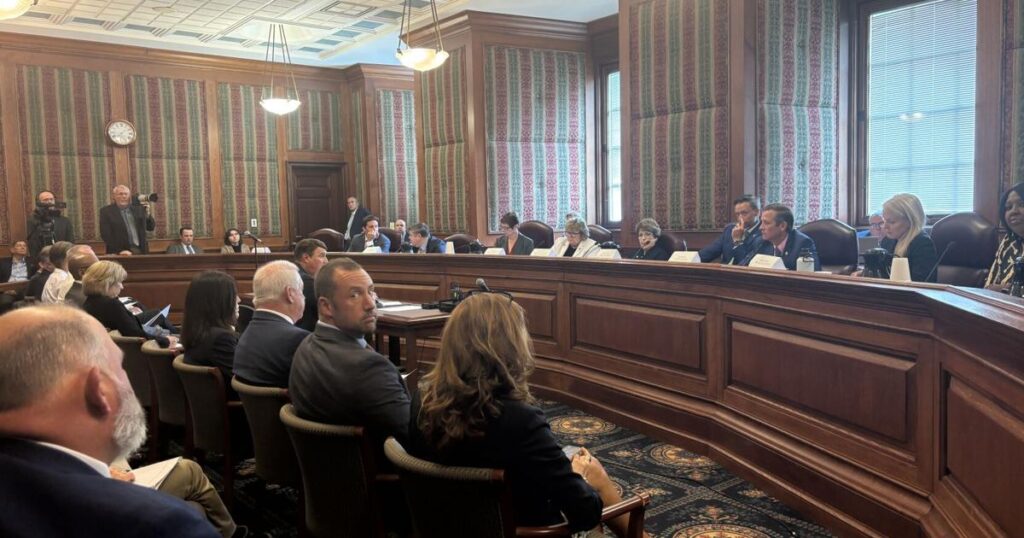
The Missouri Senate Insurance and Banking Committee held a hearing Monday afternoon regarding the failed contract negotiations between MU Health Care and Anthem Blue Cross Blue Shield. This has left nearly 90,000 patients without in-network access to their doctors.
JEFFERSON CITY — The Missouri Senate Insurance and Banking Committee held a hearing Monday afternoon regarding the failed contract negotiations between MU Health Care and Anthem Blue Cross Blue Shield. This has left nearly 90,000 patients without in-network access to their doctors.
The hearing, held at the Missouri State Capitol, gave representatives from both Anthem and MU Health Care the chance to speak about the dispute, which began when the two sides failed to reach a deal by April 1.
“The reason we are here is that in a yea r… they actually haven’t negotiated. Anthem has refused to negotiate,” MU Health Care CEO Ric Ransom said.
Testimonies were tense.
The first senate committee room was packed, with overflow attendees listening from cell phones in the second committee room and some even waiting in the hallways.
“MU … Mr. Ransom has said some things here that we just flat out disagree with, I’m not gonna go point by point,” said Rich Novak, president of commercial markets for Elevance Health.
The dispute revolves around reimbursement rates. MU Health Care requested an increase in the rates it receives from Anthem for services, citing inflation and rising operational costs. Anthem said that the increase MU Health Care is demanding is too steep and would ultimately drive up costs for consumers.
“If it’s not affordable, it’s not accessible. If you can’t afford the insurance … what good is it?” Novak said.
Ransom said the increases were necessary for MU Health Care’s operations, its position as a nonprofit organization and as a “teaching hospital.”
“Over the last three years, our total operating expenses have increased about 7% a year. MU Health Care is the largest provider of care in central Missouri. There has been relentless pressure on health care systems in rural Missouri. We are caring for people in time in a moment where it’s really needed,” Ransom said.
The failed negotiations have disrupted care for tens of thousands of Anthem-insured patients who previously used MU Health Care facilities. Patients now face paying out-of-network prices, switching providers or traveling long distances for care.
The negotiations follow more than reimbursement rates. MU Health Care said the two sides have never been close to an agreement. In response, Anthem Blue Cross Blue Shield proposed an offer to the state Senate without showing the proposal to MU Health Care.
“Anthem today, right here and now, will take the existing policy as is — contract language — and we are willing to agree to a 3-year increase where each year the increase is one full percentage point higher than the CPI,” Novak said.
After Novak’s testimony, KOMU 8 spoke with MU Health Care officials who said Novak’s offer felt “performative” and that it didn’t make sense how Anthem had an offer ready after “not negotiating with (MU Health Care) for a year.” They also said they were happy to hear the offer, but won’t believe it until they see the physical draft.
“At days end, we’re not really here to talk about my company’s business model. We are really here to talk about individuals, real people with medical needs who have been displaced since April 1,” Novak said.
Protesters at the hearing Monday said the breakdown in negotiations is already putting a burden on working Missourians.
“The thing I really want to stress is that when these two joint giant corporations fight, it’s not one or the other that suffers,” said Luke Fennewald, a union organizer at LiUNA Local 955. “It’s regular people like me and you.”
Fennewald said the fallout from the dispute is hitting union members especially hard, many of whom rely on MU Health Care for primary treatment through their Anthem plans.
Lawmakers met Monday to hear both sides of the contract dispute cutting off 90,000 patients from in-network care.
Others shared stories for their family members and friends who couldn’t be at the hearing. Some described having to delay necessary procedures, while others expressed fear about losing access to trusted doctors in the middle of treatment.
“We are looking at an $87 billion corporation that is leveraging its power against a relatively limited regional health plan,” said Ed Weisvart, a doctor who spoke to KOMU 8 News. “The large corporation can’t lose, unless we compel them to negotiate.”
Neither organization could say exactly what it would take for them to reach a deal or how long it could be until then. As the debate continues, patients, providers and policymakers alike are urging both sides to return to the negotiating table.
With no resolution in sight, nearly 90,000 Missourians remain waiting for answers.