
While the world follows complex global crises in the Middle East and Ukraine, US President Donald Trump has, at least momentarily, brought the issue of Kosovo back into the spotlight by recently declaring that it was he who, during his first term, prevented a war from breaking out in the Balkans.
Drawing a parallel between the conflict between Belgrade and Pristina and the long-standing tensions between Iran and Israel, Trump highlighted his “peacemaker role” in resolving other international disputes as well, such as negotiations between India and Pakistan or Egypt and Ethiopia. It is no surprise, then, that in a recent interview for Focus News he said that he has “earned the Nobel Peace Prize several times already,” citing, among other things, his involvement in resolving the Serbia-Kosovo conflict.
Political analysts, such as Charles Kupchan from the Council on Foreign Relations, warn that Donald Trump is essentially attempting to capitalise on global uncertainty and long-standing Balkan tensions to position himself as an “indispensable negotiator.” However, the question arises as to how realistic his rhetoric is under the current circumstances, given that the “dialogue” between Belgrade and Pristina is practically non-existent, and whether his renewed mention of Kosovo is merely one of the steps he is taking to secure an “easy public victory.”
The US President is currently facing a comprehensive crisis on multiple fronts – the escalation of wars in Ukraine and the Middle East, trade negotiations with China and the EU, as well as domestic tensions fuelled by street violence and deep political polarisation in the United States – all of which indicate that his political team is operating with limited capacity. In such an environment, the dialogue between Belgrade and Pristina is certainly not one of the President’s priorities, but it does present a convenient “backup front,” or a potential space for a symbolic foreign policy win at a time when tangible results are lacking.
From the start of his campaign, Donald Trump has promised that, unlike Biden, he would end the war in Ukraine “within 24 hours,” reach a “historic agreement” between Israel and the Arab world, and use his authority and negotiating skills to prevent further destabilisation in the Middle East. However, these promises have yet to materialise: the war in Ukraine is entering its third year, and the Israeli-Palestinian conflict is escalating into a regional crisis. Despite numerous claims of having “secret plans,” Trump has yet to present a single concrete mechanism that could bring about a “turnaround.”
In one of his many promises regarding the situation between Israel and Iran, Trump mentioned Serbia and Kosovo on his social media platform Truth Social: “During my first term, Serbia and Kosovo were clashing heavily, as they had been for decades, and this long-standing conflict was on the brink of war. I stopped it. Biden has damaged the long-term prospects with some very foolish decisions, but I will fix it again!” the US president stated.
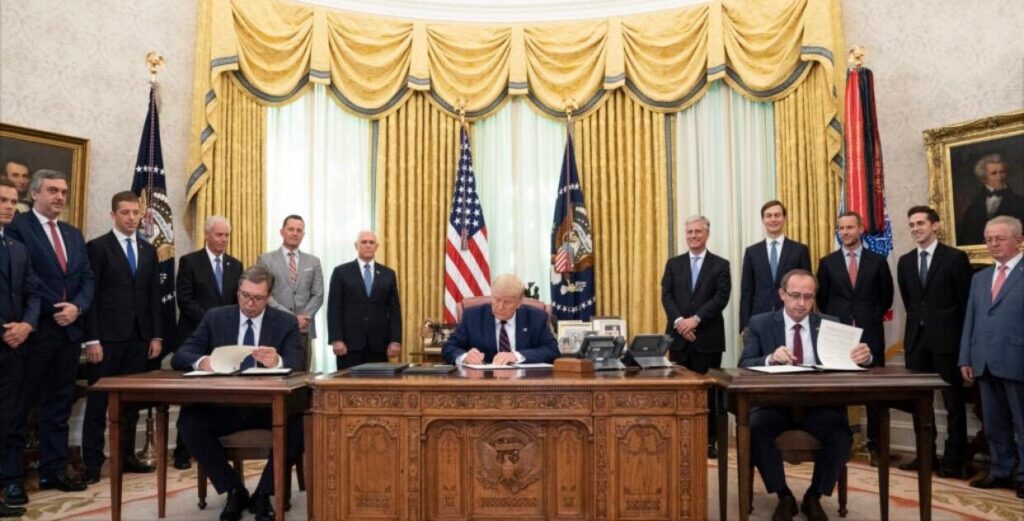
During his first term, Trump attempted to position himself as a key mediator in the dialogue between Belgrade and Pristina, portraying himself as a leader who could “seal the deal” that had been postponed for decades. When Serbian President Aleksandar Vučić and then Prime Minister of Kosovo Avdullah Hoti signed the so-called “Washington Agreement” at the White House on 4 September 2020, Trump presented it as a “historic step” towards normalisation of relations.
“We have recently been working on resolving the Belgrade-Pristina issue”
Yesterday, Trump again stated that his administration had in recent weeks been working on resolving various global conflicts, including the issue of relations between Belgrade and Pristina. “In the last few weeks, we’ve been addressing India and Pakistan, Kosovo and Serbia. We also got involved in Congo and Rwanda – that was a brutal war that went on for a long time. We did two more things on top of that. Nobody has ever done anything like it,” Trump said during a press briefing at the NATO leaders’ summit in The Hague, broadcast by CNBS television.
Previously, Trump stated he believes he deserves to receive multiple Nobel Peace Prizes, partly for his engagement in the Serbia-Kosovo issue.
“I should have received the Nobel Peace Prize for Rwanda – and did you see the case of Congo? You could say Serbia and Kosovo. You could name many such cases. The biggest are India and Pakistan. I should have won the Nobel four or five times,” Trump told Fox News.
Political scientist Ognjen Gogić told NIN that the signing of the Washington Agreement did not lead to any visible progress in the Belgrade-Pristina dialogue, but that Trump’s recent remarks are aimed at simultaneously highlighting Biden’s foreign policy weaknesses and reinforcing his own image as a “skilled negotiator.”
“There are two reasons for reviving this topic. First, because it’s a currently relevant issue – or at least he knows it is. And second, because he sees it as his success. For him, it’s a chance to re-enter the narrative with a purpose he knows. I interpret this as a signal of renewed engagement, at least minimal, which at the outset I consider good news for Serbia, since he has a different attitude towards Serbia compared to Biden. On the other hand, no one in Pristina welcomed Trump’s comments on Kosovo,” Gogić said, adding that this move by Trump is “his method for calming or managing the current situation” in Kosovo.
New ambassador, old expectations
Considering that the Belgrade-Pristina dialogue is practically frozen – with Belgrade frequently accusing Pristina of unilateral actions, while Kosovo’s authorities continue to ignore calls to establish the Community of Serb Municipalities – the question arises as to what impact Trump’s move could realistically have, and whether it is merely a reaction to the current state of affairs.
“The Kosovo Trump refers to in this context, aside from the parallel he wanted to draw, should not be interpreted in any other way than as a signal of continuity from his previous administration, as suggested by the selection of key envoys in the State Department from both sides. What could slightly shift the dynamics is the anticipated formal appointment of a new ambassador who is soon to arrive in Belgrade. With this, Trump – given his policy – could influence regional normalisation through enhanced economic cooperation,” said Petar Donić, a researcher at the organisation Novi Treći Put.
(NIN, 27.06.2025)
https://www.nin.rs/politika/vesti/81012/kosovo-kao-politicki-alat-trampov-povratak-na-balkan