
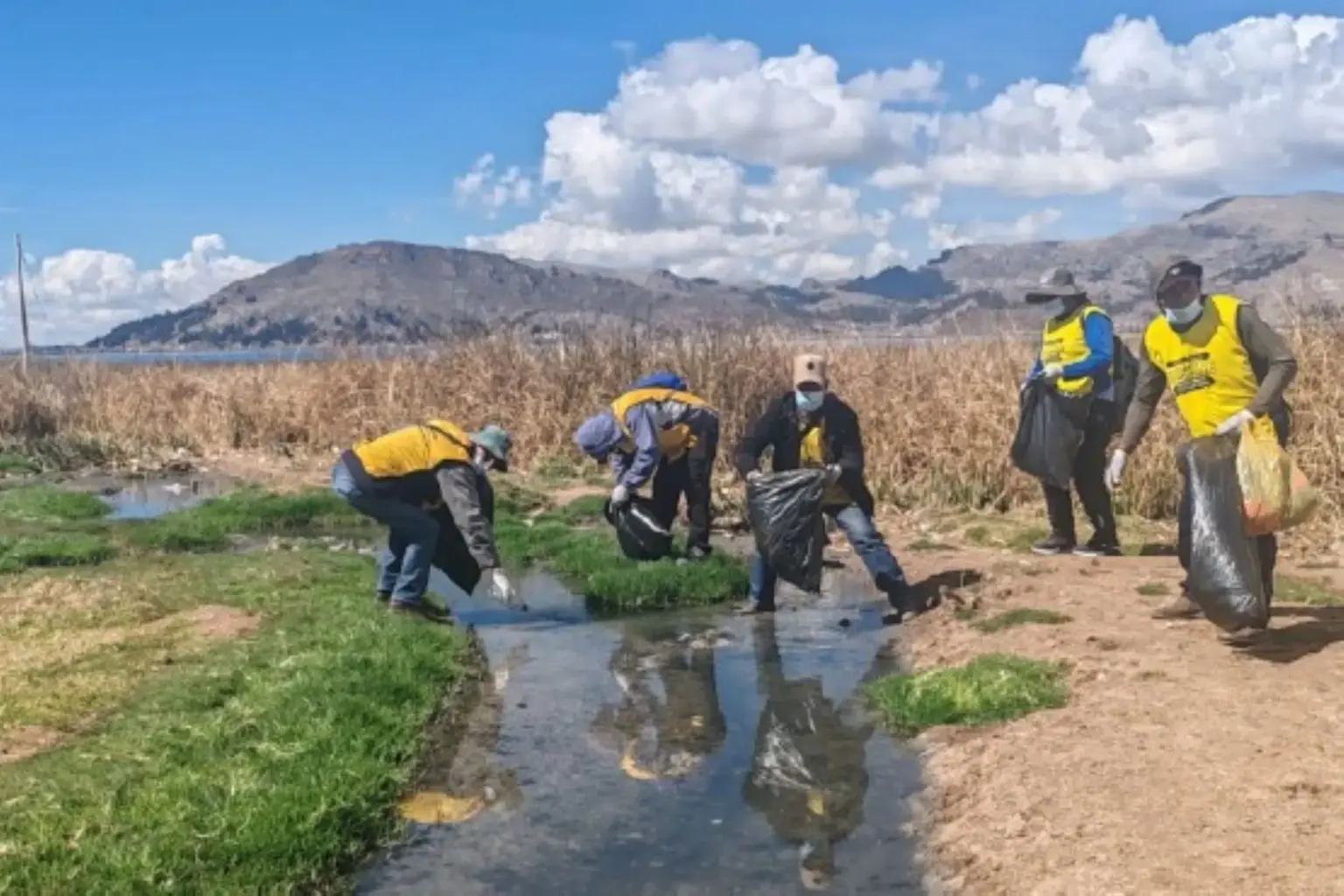
In the city of Puno, in the southeast of Peru, more than a hundred people sentenced to community service participated in an intensive cleaning day of the inner bay of Lake Titicaca.
It was part of the institutional program “Integrate into your Community”, promoted by the National Penitentiary Institute (INPE) through the Free Environment Establishment of the High Plateau Regional Office.
The activity, which constitutes the second intervention of this kind this year, included tasks of waste collection, weed removal, and maintenance of green areas in sectors affected by pollution.
The work was coordinated with the support of the Provincial Municipality of Puno, the Special Binational Lake Titicaca Project, the National Water Authority, and representatives from the population centers of Salcedo and Jayllihuaya, among other entities.
Environmental crisis in the bay of Puno: pollution, drought, and ecosystemic risk
The Lake Titicaca, shared by Peru and Bolivia and considered one of the main fresh water reserves in South America, is facing a serious environmental crisis. In the Peruvian case, the bay of Puno has been identified as one of the most critical points due to:
- The daily discharge of untreated sewage
- The discharge of urban and industrial waste carried by rivers like the Coata
- The proliferation of toxic microalgae and the decrease in oxygen in deep zones
According to data from the Autonomous Binational Authority of Lake Titicaca (ALT), 85% of endemic fish species are at risk of disappearing.
In addition, there is a sustained decrease in the water level, the result of prolonged droughts and increased temperatures associated with climate change, which directly jeopardizes the livelihoods of fishing, farming, and livestock communities.
A gesture of mitigation amid a structural problem
Although cleaning actions are specific, authorities emphasize their value as a tool to:
- Promote the social reintegration of individuals with community sentences
- Involve local institutions and populations in environmental care
- Reduce visible impacts of accumulated waste, especially in areas of high ecological and touristic value
However, experts and entities like ALT warn that rescuing the lake will require sustained investments and structural binational coordination, given the accumulated deterioration in recent decades.
Lake Titicaca: history, landscape, and environmental threat
Located at over 3,800 meters above sea level, Titicaca is considered the highest navigable lake on the planet and one of the most important water ecosystems in the Andes.
Its natural environment, surrounded by mountains reflecting in still crystalline waters, has been revered by pre-Hispanic civilizations such as the Tiwanaku and Incas, who left valuable archaeological remains on its shores and islands.
However, the accumulated effects of environmental deterioration, combined with human pressure, threaten both its biodiversity and the cultural and touristic value that distinguishes it.
Cover photo: Andina