Oil prices made a modest recovery as June closed and July began, giving investors something to watch after weeks of sharp ups and downs. West Texas Intermediate (WTI) crude rose by $1.68, or about 2.5%, to end at $67.20 per barrel, reflecting a market that shifted from bearish to cautiously optimistic.
Middle East Tensions Ease, but Risks Remain
One of the main reasons for the recent swings in oil prices was the tension between Israel and Iran. In June, Israel launched air strikes on Iranian nuclear sites, a rare move that raised concerns about oil supply disruptions, given that Iran exports around 2.6 million barrels of oil per day.
This conflict pushed oil prices up earlier in June, but things changed quickly after a ceasefire was announced on June 24. Prices fell sharply, dropping about 6% in a single day, as investors hoped that oil shipments through the Strait of Hormuz—a key route for global oil flows—would remain safe.
However, the peace was fragile. By the end of June, new accusations of ceasefire violations and Iran’s decision to stop cooperating with UN nuclear inspectors reintroduced uncertainty, reminding investors that Middle East tensions can flare up again and impact supply at any time.
OPEC+ Pumps More Oil, While U.S. Producers Pull Back
In a move that surprised many, OPEC+ (a group of major oil-producing countries) decided to increase production sooner than planned, adding more oil to a market that already had ample supply.…
Oil prices made a modest recovery as June closed and July began, giving investors something to watch after weeks of sharp ups and downs. West Texas Intermediate (WTI) crude rose by $1.68, or about 2.5%, to end at $67.20 per barrel, reflecting a market that shifted from bearish to cautiously optimistic.
Middle East Tensions Ease, but Risks Remain
One of the main reasons for the recent swings in oil prices was the tension between Israel and Iran. In June, Israel launched air strikes on Iranian nuclear sites, a rare move that raised concerns about oil supply disruptions, given that Iran exports around 2.6 million barrels of oil per day.
This conflict pushed oil prices up earlier in June, but things changed quickly after a ceasefire was announced on June 24. Prices fell sharply, dropping about 6% in a single day, as investors hoped that oil shipments through the Strait of Hormuz—a key route for global oil flows—would remain safe.
However, the peace was fragile. By the end of June, new accusations of ceasefire violations and Iran’s decision to stop cooperating with UN nuclear inspectors reintroduced uncertainty, reminding investors that Middle East tensions can flare up again and impact supply at any time.
OPEC+ Pumps More Oil, While U.S. Producers Pull Back
In a move that surprised many, OPEC+ (a group of major oil-producing countries) decided to increase production sooner than planned, adding more oil to a market that already had ample supply. This extra oil put some downward pressure on prices.
Meanwhile, American oil producers moved in the opposite direction. Lower oil prices made drilling less attractive, leading many U.S. shale companies to cut spending by up to 9% and reduce the number of active drilling rigs. This was the second consecutive month where forecasts for U.S. oil output were lowered.
These two opposing moves—more oil from OPEC+ and less drilling in the U.S.—largely balanced each other out, leaving investors to focus on demand trends and geopolitical developments for clearer signals.
Unexpected Inventory Build Surprises Investors
Investors expecting summer demand to lower U.S. oil inventories were caught off guard when the Energy Information Administration (EIA) reported a surprise build of 3.85 million barrels for the week ending June 27. This increase was unexpected, especially since inventories had been falling in previous weeks.
More oil in storage often signals that either demand is weaker than expected or supply is stronger than the market can absorb, raising concerns about potential price weakness if this trend continues.
Summer Travel Demand Offers a Silver Lining
The summer driving season, however, provided some much-needed good news. As Americans hit the road for vacations and the July 4 holiday, gasoline demand surged, reaching its highest level since late 2021. This rise in gasoline consumption meant refineries needed to process more crude oil, supporting oil prices during a period when other factors were weighing them down.
The summer months typically bring increased travel, and with gas prices still lower than in recent years, consumers did not hesitate to take advantage, helping to provide a floor for crude demand.
Trade Tensions and China’s Role Add Complexity
Global trade issues also played a role in shaping oil market sentiment. Ongoing uncertainty about U.S. tariffs and trade disputes, including the decision to block American ethane exports to China, added a layer of complexity for investors trying to gauge the strength of future oil demand.
China remains a critical player in the oil market as the world’s largest importer. Although there were earlier concerns about slower Chinese oil consumption, China continued buying oil, including from Iran, despite international sanctions. President Trump’s comments allowing China to continue these purchases helped ease concerns about potential disruptions in supply.
Still, the outlook for Chinese oil demand growth remains more subdued, reflecting broader economic caution that could impact how much oil China and the world will need in the months ahead.
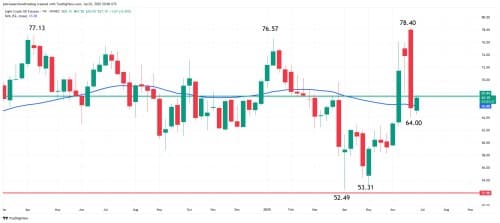
Weekly Light Crude Oil Futures
Trend Indicator Analysis
The main trend is up according to the weekly swing chart. Despite the steep sell-off and the potentially bearish closing price reversal top the previous week, this week’s price action suggests the presence of buyers.
The close above the 52-week moving average at $65.88 indicates buyers are defending against another steep sell-off. However, the inability to overcome the long-term pivot at $67.44 indicates there is not enough bullish pressure at this time to drive the market higher. Essentially, traders are awaiting a fresh catalyst to drive the volatility.
Weekly Technical Forecast
The direction of the Weekly Light Crude Oil Futures market the week ending July 11 is likely to be determined by trader reaction to $67.44 and $64.00. The pivotal indicator will be the 52-week moving average, currently at $65.88.
Bullish Scenario
A sustained move over $67.44 will signal the presence of buyers. If this creates enough upside momentum, we could see a near-term rally into a minor pivot at $71.20. The major upside target is the resistance zone at $78.40 to $82.31.
Bearish Scenario
A sustained move under $64.00 will indicate the return of sellers. If it generates enough downside momentum, we could witness the start of a prolonged down move into the support zone at $53.31 to $51.98.
Looking Ahead: Oil Market Faces a Balancing Act
The modest gain in oil prices over the past week reflects a market trying to balance competing forces: the ongoing risks in the Middle East, higher summer gasoline demand, and shifts in supply from OPEC+ and U.S. shale producers.
For investors, the current environment suggests that while there is potential for upward price moves if geopolitical tensions worsen or if demand continues to outpace supply, there are also risks from high inventory levels and uncertain global economic growth.
As we move deeper into summer, much will depend on whether the ceasefire between Israel and Iran holds, how strong gasoline demand remains, and whether U.S. production continues to slow. These factors will shape the next moves in oil prices, making this a market that remains sensitive to news headlines and demand signals.
Technically, reaction to the 52-week moving average at $65.88 and the long-term pivot at $67.44 should set the tone for the week.