
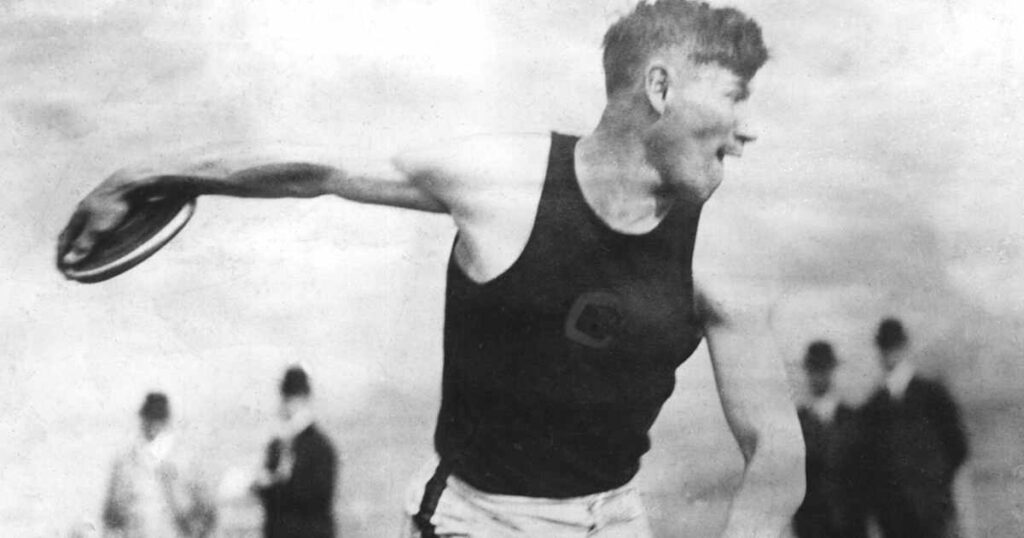
The Carlisle Indian Industrial School was the first such boarding school in the country funded and operated by the U.S. government. Its founder, Richard Henry Pratt, a U.S. Army officer, adapted harsh techniques he had used to “reform” Indian prisoners of war. In a now-famous 1892 address to the National Conference of Charities and Corrections, he summed up his assimilationist philosophy with the chilling phrase: “Kill the Indian in him, and save the man.”
Jim Thorpe’s Early Life
Born in Indian Territory near the town of Prague, Oklahoma, in 1887, James Francis Thorpe descended directly from famed Sac and Fox Chief Black Hawk. The future athlete had a twin brother and parents of mixed Native and European descent. Thorpe’s Native name, Wa-Tho-Huk, translated to Bright Path—or more specifically, “Bright path the lightning makes as it goes across the sky.”
Thorpe attended three Indian boarding schools in his life: the Sac and Fox Agency School in Oklahoma, the Haskell Indian Nations University in Lawrence, Kansas, and ultimately, the Carlisle Indian Industrial School in Carlisle, Pennsylvania.
One of the central traumas of Thorpe’s life came when attending the Sac and Fox Indian Agency School with his 9-year-old brother Charlie, who contracted pneumonia and died. Grief-stricken, Thorpe began running away from school—a pattern reflecting both his deep sense of loss and his resistance to the harsh institutions.
Thorpe at Carlisle
In 1904, 16-year-old Thorpe arrived at Carlisle. His report card for the first few years lists assessments ranging from “fair” to “very good” in his academic, industrial and dormitory life. Under “special remarks,” there is a single word: “deserter.”
“Carlisle students were shipped out for ‘outings’ where they worked essentially as indentured servants for area farmers,” says Maraniss. “He ran away from those twice.”
In what became a legendary—and life-changing—moment, three years into his Carlisle tenure, Thorpe observed the varsity track athletes practicing the high jump. Borrowing some track shoes, Thorpe easily cleared the 5-foot, 9-inch-high pole—while still dressed in overalls and a dress shirt—and broke the school record.
The school’s athletic director Glenn “Pop” Warner immediately recruited him for the track team. Later, Thorpe pressed Warner to let him play football as well. Thorpe overcame his coach’s considerable resistance after proving he could elude 30 players in an open-field drill—twice.