
![How fast would a rotating space station need to spin to simulate Earth gravity?[OC]](https://www.byteseu.com/wp-content/uploads/2025/07/n4pprjnmrkbf1-1536x874.jpeg "How fast would a rotating space station need to spin to simulate Earth gravity?[OC]")
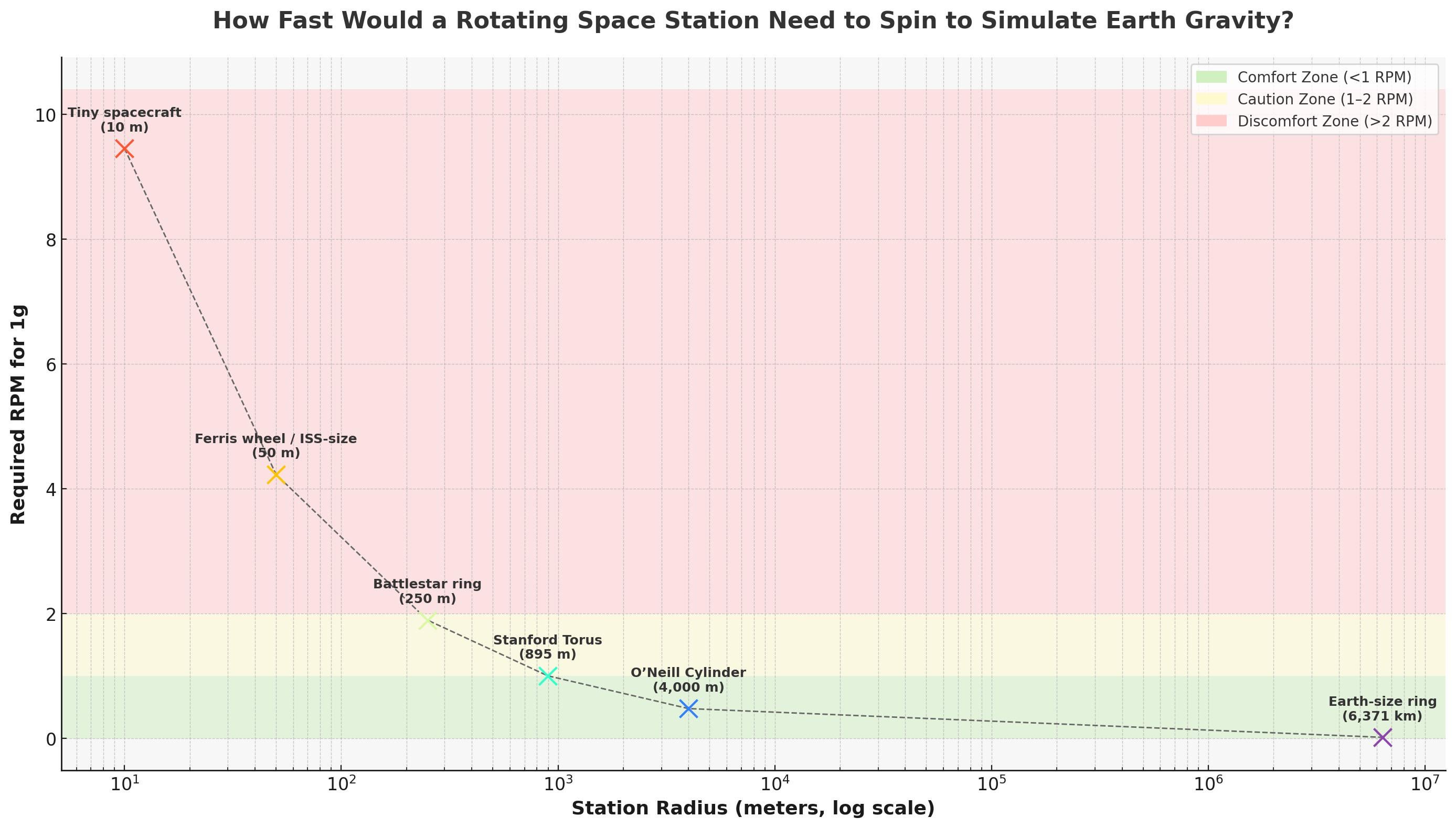
Graph shows the RPM required to create Earth-like gravity, based on the radius of the station. I used a log scale for radius to show everything from 10-meters to planet-sized rings.
A station the size of the ISS would need to rotate 4+ times per minute, which would be physically uncomfortable for long-term habitation.
The comfort zone for humans appears around 900m to 4km radius, where rotation rates stay under 1 RPM.
A ring the size of Earth only needs 0.012 RPM—or one rotation every 85 minutes.
Posted by towertwelve
10 Comments
Pretty sure they tested this on the ground with a rotating capsule and everyone was violently sick.
I would be interested in seeing Babylon 5 or any of the Earth Alliance ships with spinning sections included on this chart…
Any science behind the colors limits ?
Given that negative rotation isn’t possible, aligning O rpm with the origin would make this easier to read.
It should be fine as long as you block out the windows right? Only acceleration matters
> physically uncomfortable for long-term habitation
Given they had physical windows. Replace windows with high res displays and recalculate.
Interesting graph, OP. One little side note is that a rotating station wouldn’t necessarily have to be in the shape of a ring. You could have a barbell-shaped station, which might be advantageous because you can have a longer radius with less construction material compared to a ring.
So 17 rotations per day would be enough for a ring with the radius of Earth. As Earth does one rotation a day, does that mean that at the equator is 1/17 less than at the poles?
For short term trips, like a week or two stay, is full Earth gravity needed?
I would guess even a low amount of gravity would feel much more comfortable than zero g and would help the body function as usual. I’d imagine space stations with Martian (~1/3g) and Lunar (~1/6g) will be common in the future.
So we need to build a 1-mile diameter ring station…
… IN SPACE!!