
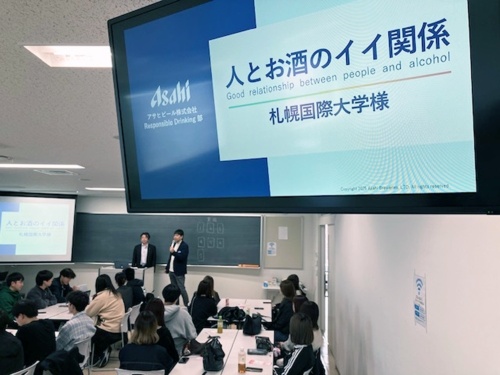
Asahi GHD has held workshops on responsible drinking at several universities
Consumer demands on companies are constantly evolving. The expectation goes beyond simply improving product features and services. Customers also examine very closely how companies engage with social issues, asking questions along the lines of – “Are companies contributing to the resolution of problems confronting society today such as environmental damage and human rights? Are corporate activities moving the world in a positive direction?” Consumers wish to know how and what kind of better future businesses plan to make a reality. Only by exceeding these customer expectations can businesses accelerate the realization of a sustainable society.
Creating Everywhere Everyone Can Enjoy Drinking Whatever They Like
“What is alcohol?” “What is essential for university students to know about drinking alcohol?”

The Smart Drinking logo suggests a variety of ways to drink
In mid-April, Sapporo International University’s Department of Tourism held a workshop on “Good Relationships between People and Alcohol.” The seminar aimed to encourage third- and fourth-year students over the age of 20 (the legal drinking age in Japan) to consider how to create a bar-style party that both drinkers and non-drinkers of alcohol beverages can enjoy, something known as – “smart drinking.” During this time of year, when invitations to drink socially increase due to gatherings such as welcome parties for new students and job hunting, alcohol drinks makers wanted to encourage students to think about consuming in moderation. The workshop began with an alcohol patch test – used to check for allergies or intolerance to the substance – to help participants understand their own body chemistry, followed by discussions about how to respond to this information conducted through a role-play dinner party.
The event was led by employees from Asahi Breweries Ltd.’s Planning and Support Headquarters Responsible Drinking Division. They explained various case studies demonstrating subjects including “the amount of alcohol that increases risk,” “economic losses and impacts caused by excessive drinking,” and “alcohol-related harassment.” These explanations were followed by discussions during which students were asked to share their impressions. The goal was to promote “a free way of drinking that allows everyone to enjoy themselves, whether they drink alcohol or not.” Associate Professor Tatsuya Fujisaki from the tourism school said, “The students’ deepened their understanding of alcohol through the various examples and case studies presented.” Meanwhile, the students commented that there were several points to be mindful of when drinking.
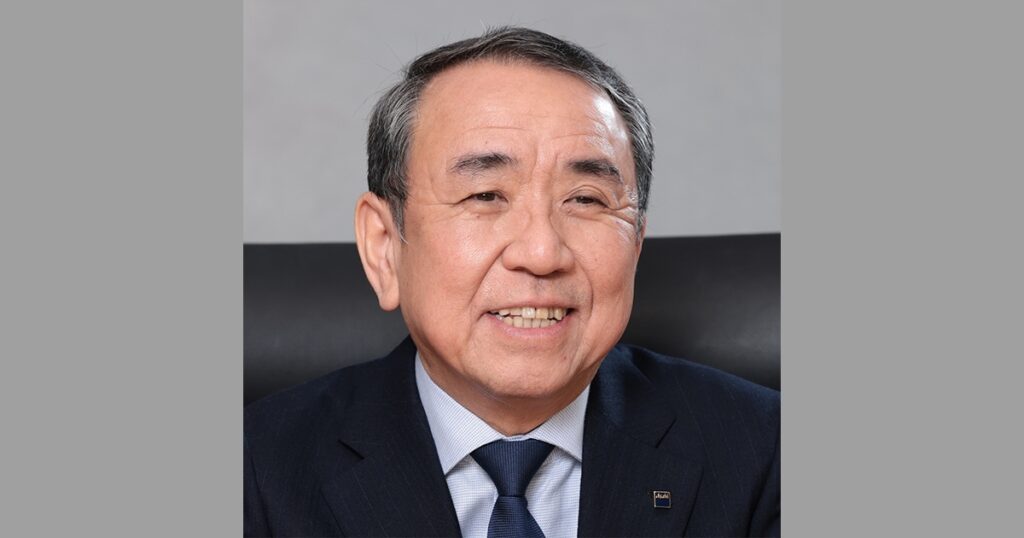
Asahi Group Holdings Ltd. (Asahi GHD) is expanding its business worldwide by leveraging its extensive expertise in alcohol and non-alcohol beverages, including beer and whiskey. Issues such as the environment, health, human rights, as well as diversity, equity, and inclusion (DE&I) are now a high priority, and in order to enhance their own social value, companies must now pay close attention to them. Asahi GHD President Atsushi Katsuki said, “We must pursue these activities as naturally as we breathe. We must make these considerations everyday matters.” Fostering a culture of smart drinking is part of this effort. Through offering consumers products that enable smart drinking, Asahi GHD aims to create corporate value and customer satisfaction.
Today, increasingly complex social issues are receiving more attention. Asahi GHD has set the ambitious goal of achieving net-zero greenhouse gas emissions by 2040. To ensure this happens, the Group launched its Sustainability Innovation Program last October. Asahi set out to administer the program in collaboration with external partners, including startups and organizations that promote sustainability. The program received over 260 applications from 48 countries, and nine partner companies were selected in May. The fields of collaboration include sustainable agriculture and raw materials, renewable energy and energy efficiency, together with sustainable packaging and the circular economy.
Asahi GHD is committed to achieving global sustainability by renewing its governance structure and instituting company-wide initiatives to create corporate and social value.
We Are Cultivating Sustainability Unique to Japan

Atsushi Katsuki
President and Group CEO
Asahi Group Holdings Ltd.
As long as companies continue to rely on the blessings of nature for their business activities, we will not be able to continue our business activities if the Earth is not treated sustainably. Regulations and protections for the world environment vary in strictness depending on the country or region, but regardless of those policy choices, it is impossible for Asahi GHD, a global operation, to weaken its sustainability initiatives.
Many companies aim to achieve net-zero greenhouse gas emissions across their entire supply chains by 2050. However, considering the previously mentioned global circumstances in connection with Asahi Group activities, we have brought forward our target for net zero GHG emissions for Scope 1,2, and 3, to 2040. The vision actively promotes various initiatives to achieve these goals. To ensure alignment with the Paris Agreement and its science-based approach, our net zero targets have been approved by the Science Based Targets initiative (SBTi).
Although this is an extremely challenging objective, we believe it is possible if we work hard. We will promote the integration of management and net-zero activities by working sustainability target indicators into all our businesses and monitoring their progress.
To hasten our sustainability management efforts, we established Asahi Global Procurement Pte. Ltd. This was our first global procurement base in Singapore, and began operations in January of last year. Our companies operate in Japan, Europe, Oceania, and Southeast Asia, and so Singapore is one of our major supply chain hubs. Just one year after initiating our global procurement system, we have achieved cost savings of over $100 million (approximately 14.5 billion yen), surpassing our goals. Centralizing procurement has strengthened relationships with our suppliers, as well as enabling us to respond more flexibly to enhanced risk management, improved procurement quality, and due diligence issues around human rights.
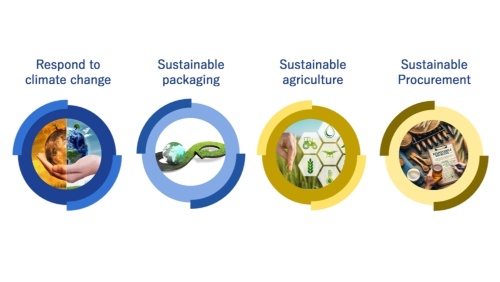
Majors Initiatives at Procurement Hub in Singapore, Asahi Global Procurement Pte. Ltd.
[Click for an enlarged image]
It is said that there are 40,000 companies in Japan that have been in business for more than 100 years. Isn’t that what sustainability is about? I believe those businesses that have been in operation for so long are truly sustainable. It is because they have earned the trust of customers that these enterprises have been able to succeed in business for so long. I want to actively revere this unique aspect of Japan’s business world. In this same spirit, we will build an Asahi Group that thrives on society’s deepest trust.