
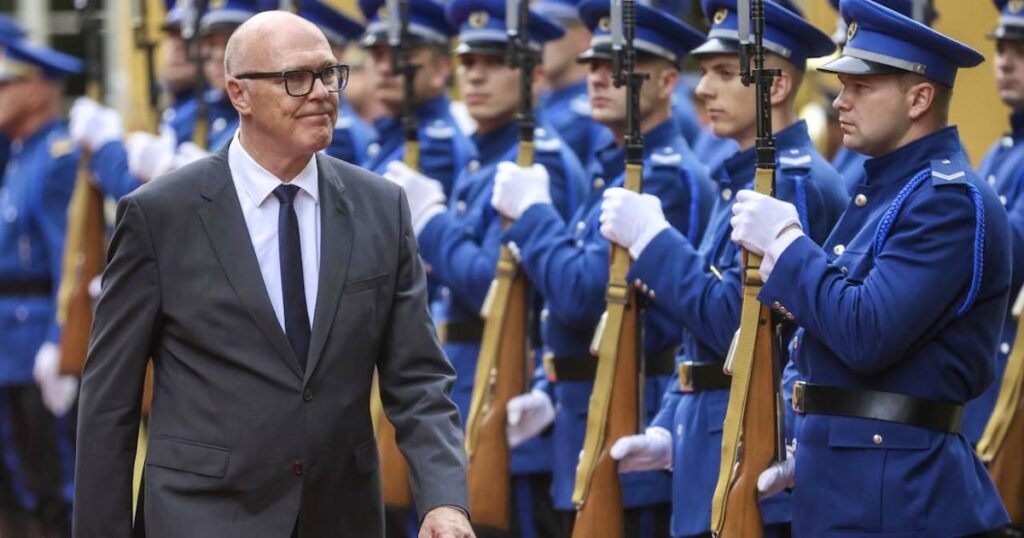
Federal Councillor Martin Pfister at a reception in Sarajevo, the capital of Bosnia and Herzegovina.
Keystone
Following a visit to the troops in Kosovo, Federal Councillor Martin Pfister emphasized the importance of Swisscoy. He is convinced that the security situation in the country is still too unstable to refrain from deploying troops, he told Keystone-SDA.
He had visited the Swisscoy troops and gained a general overview of the security situation. “I am fascinated by their great commitment, which is an important contribution to the region,” said Pfister. Swisscoy’s mandate runs until the end of 2026, and the Federal Council is preparing to extend it until 2027, Pfister continued. Ultimately, Parliament would have to decide on this.
The Swisscoy contingent currently comprises up to 215 members of the armed forces. It was increased by 20 people a year ago. Recruitment is challenging, says Pfister. However, people can be found and the corresponding contingents can be filled.
In Mitrovica in the north of Kosovo, the Swisscoy Liaison and Monitoring Team (LMT) responsible for the region was scheduled to visit, among other things. The head of the Federal Department of Defense, Civil Protection and Sport (DDPS) also visited Bosnia and Herzegovina as well as Kosovo on Monday and Tuesday.
The aim of the two-day working visit was to find out about the security situation and Switzerland’s role in peace-building missions. Switzerland’s commitment in the Western Balkans is an important part of international cooperation in Europe, wrote the DDPS. In addition to visiting members of the Swiss Armed Forces, Pfister also held bilateral talks in both countries.
Stability also important for Switzerland
According to the DDPS, stability in this region is of great interest to Switzerland in terms of security, economic and migration policy. Since 1999, Switzerland has been involved in Kosovo with a military contingent of up to 215 members of the armed forces (Swisscoy) in the Kosovo Force (KFOR), which is led by NATO. Since 2004, it has also been involved in the EU-led ALTHEA mission of the European Union Force (EUFOR) in Bosnia and Herzegovina with up to 20 members of the armed forces.