
NEWS ANALYSIS: Norwegian government leaders were braced for higher tariffs on exports to the US this week, after its unpredictable president Donald Trump continues to break internationally agreed trade rules built up over decades. Then came news that Norway has been spared, at least for now.
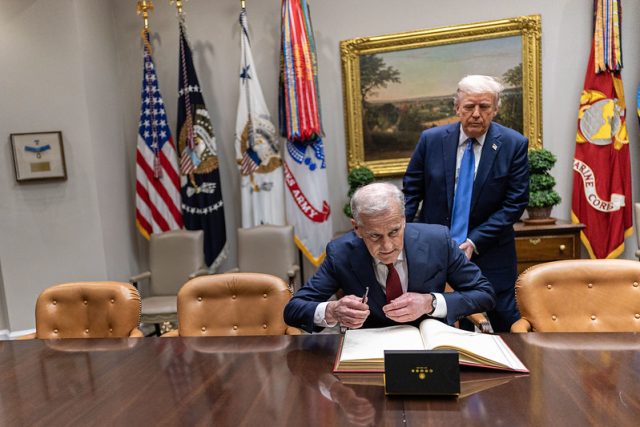 Norwegian Prime Minister Jonas Gahr Støre, shown here during a meeting with US President Donald Trump at the White House this spring, has called Trump’s threatened tariffs against the EU and Norway “dramatic” and “bad for the economy in our part of the world.” PHOTO: Daniel Sannum Lauten/Pool/TV2/Statsministerens kontor
“Norway hasn’t received a letter (from Trump) about any new tariff levels, which have now been postponed until August 1,” Norway’s trade minister Cecilie Myrseth of the Labour Party announced on Tuesday. “That doesn’t mean there won’t be an increase before that date.”
Myrseth added that the government will “continue our conversations with the US on trade and stronger economic cooperation” in the meantime. Norway and most other European countries face new customs duties that will raise the price of all goods exported to the US of at least 10-15 percent.
Norway is not a member of the EU but has so far worked to ally itself with the EU, which has indicated it will respond to any new US tariff with a reciprocal tariff (called toll in Norwegian, but not to be confused with the English “toll.”) Trump claimed on Tuesday that the EU will get its own letter regarding export tariffs to the US later this week.
Trump, meanwhile, has been widely viewed in Norway as trying to scare most countries into negotiating bilateral trade deals with the US instead of abiding by the international trade rules already in place. Norway has always been in favour of a rules-based world and seems more comfortable latching on to the EU’s efforts to do the same. That comes at the risk of getting hit with even higher tariffs since Trump often views Europe as more of a threat than an ally.
Norway’s trade balance with the US, meanwhile, can appear favourable to the US given Norwegian defense spending in the US and relatively low exports of other goods. Seafood, especially Norwegian salmon, makes up a large chunk of exports to the US, but raising the price of a product that’s popular in the US because of new high tariffs may not be popular among Trump’s own voters, either.
Norwegian Prime Minister Jonas Gahr Støre, who has met with Trump on several occasions, has branded Trump’s threats in May of a 50 percent punitive tariff on the EU as “dramatic” and “bad for the economy in our part of the world.” Trump is believed to have been attempting a “divide and conquer” technique against the EU as a means of forcing through bilateral deals with EU members.
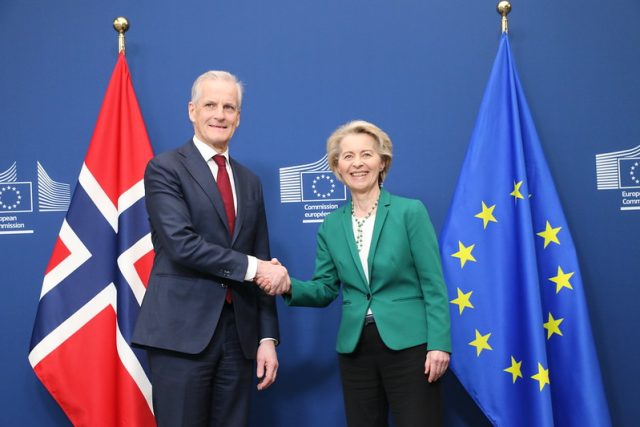 Norway’s prime minister has long had good relations with the EU and its leader, Ursula von der Leyen, like here at a recent meeting in Brussels. PHOTO: Den norske EU-delegasjonen
Norway’s leading financial and business newspaper Dagens Næringsliv (DN) editorialized recently that it’s best for Norway to stand together with the EU in the event of an all-out trade war with the US. The EU is Norway’s most important market and trade partner, not least for Norway’s gas and seafood, and together larger than the US in terms of population and the economy.
It may even be time, according to DN, “to get out the trade bazooka” that would cause trouble for US companies if Trump persists with his tariff threats. Elements of the EU’s so-called “bazooka” could, for example, prevent US firms from bidding for public contracts or even banning their operations within the EU or its trade partners Norway, Iceland, Switzerland and Liechenstein.
Many Norwegian companies have been preparing offensive strikes in the event of new high US tariffs, like moving storage and production operations. “We have to stop talking about how crazy he (Trump) is and rather think about what his next move will be,” one business consulting firm that’s advising Norwegian clients told DN.
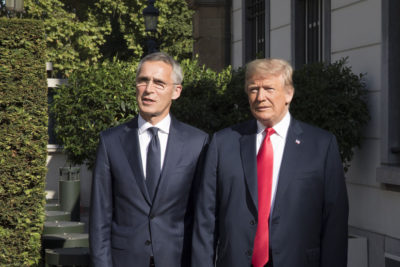 Norwegian Finance Minister Jens Stoltenberg has maintained good relations with Trump, also after this photo was taken when Stoltenberg still led NATO. PHOTO: NATO
Norwegian government officials including Finance Minister Jens Stoltenberg, the former NATO chief who managed to get along well with Trump, did open up for direct negotiations with the US in June. The “conversation” his government colleague Myrseth referred to on Tuesday has since gone on with, for example, Trump adviser Jamieson Greer, who warned last month of a 15 percent tariff from July 9.
That’s not about to happen now. Stoltenberg also stresses the importance of trade with the EU and how Norway is bound by its own trade agreement with the EU that prohibits Norway from offering to import, for example, any genetically modified food from the US or other food that doesn’t comply with EU standards. The food issue is thorny for Norway, meanwhile, because of its own high tariffs against food imports to protect Norwegian agriculture.
It can thus seem unlikely that Norway will cut its own deal with Trump’s US, like the UK recently did, but Norway is keeping its options open. The UK is no longer a member of the EU and while Norway never has been, its relations with the EU are tighter and more important than they’ve ever been. There’s also the chance that Trump will chicken out again with his trade threats against his own NATO allies.
NewsinEnglish.no/Nina Berglund