

For most Americans, the daily ritual of drinking their daily cup of coffee or tea is second nature. However, new research reveals that hot drinks delivered in to-go beverage cups contain surprising contaminants in the form of microplastics.
Fortunately, experts are working on solutions to reduce exposure to microplastics – which have been linked to a variety of health problems – while promoting safer alternatives.
Claudia Pratesi, PhD, assistant professor at The University of New Mexico College of Population Health, addresses the hazards associated with microplastic intake through food and beverages in her undergraduate and graduate Environmental and Occupational Health courses.
“Because of their low cost, plastics and the thousands of chemicals added to plastics, have made it into our environment, our food system and into our bodies,” she said. “Plastics are everywhere, and in the absence of policies, we need to stay educated and advocate for change.”
Recent studies have uncovered evidence that disposable beverage containers release thousands of plastic particles into hot beverages, adding to concerns about plastic accumulation in human tissues. Research from China Jiliang University reveals that a single hot beverage might contain thousands of microscopic plastic particles, with concentrations varying by cup type and temperature.
Testing of 90 commercial disposable cups showed substantial plastic debris release, with polyethylene-coated paper cups releasing 675 to 5,984 particles per liter, researchers found.
Scientists at the Indian Institute of Technology Kharagpur published research estimating that the average person could consume approximately 0.03 milligrams of plastic debris per kilogram of body weight daily through single-use cups. Over a lifetime this equates to roughly 54 grams (1/4 cup) of microplastic exposure.
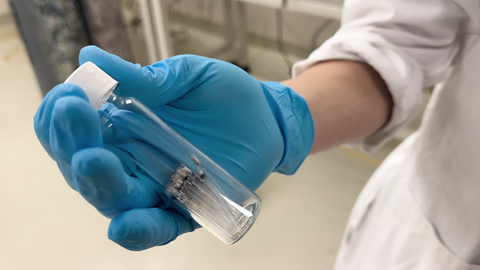
Microplastic samples after undergoing destructive analysis in the UNM College of Pharmacy lab.
These findings take on new significance given recent discoveries from UNM, where researchers found microplastics accumulating in human brain tissue at concentrations of 4,800 micrograms per gram, significantly higher than levels found in other organs like the liver and kidney.
Additionally, recent work by Elaine Bearer, MD, PhD, and her team at the UNM Alzheimer’s Disease Research Center identified microplastics in brain tissue from dementia patients after she noticed unusual brown particles that couldn’t be identified with standard methods.
Working with Matthew Campen, PhD, at the UNM College of Pharmacy and Natalie Adolphi, PhD, an the UNM School of Medicine Pathology Department, she found brain samples from Alzheimer’s and Binswanger’s disease patients contained about 20 grams of plastic, far more than in non-dementia individuals. The findings raise questions about whether plastic particles might contribute to dementia.
Potential concerns with coffee capsules and pods used to make beverages have been noted as well.
A University of Connecticut study found that these convenient brewing systems may release estrogenic chemicals into hot beverages. The high temperatures and pressure used in pod systems were shown to release other chemicals, like benzophenone, bisphenol A (BPA), and other compounds from plastic components into the coffee.
While the detected levels fall within current safety guidelines, these findings suggest that the choice of brewing method might influence daily exposure to potentially harmful substances while pointing toward practical solutions that individuals and communities can implement.
For example, many cafés now offer discounts for customers who bring reusable cups, and manufacturers are developing compostable alternatives made from plant-based materials that break down naturally without releasing microplastics.

Because of their low cost, plastics and the thousands of chemicals added to plastics, have made it into our environment, our food system and into our bodies. Plastics are everywhere and in the absence of policies, we need to stay educated, and advocate for change.
– Claudia Pratesi, PhD, Assistant Professor, UNM College of Population Health
Pratesi meanwhile stresses the need for major policy changes to curtail the continued release of microplastics and per-and polyfluoroalkyl substances (PFAS)—which is group of man-made chemicals found in a lot of widely-used consumer products—into the environment.
“Health issues related to microplastics and PFAS will not disappear on their own, and the health burden will only be exacerbated unless we work toward implementing legislative change,” she said. “More educational efforts are needed so the public can better understand the health risks associated with these contaminants.”