
Professor Shaun Anderson arrived at the UNC Hussman School of Journalism and Media last year eager to combine his ongoing work at the intersection of sports and social responsibility with Carolina’s legacy in athletics and research.
“Honestly, it was a no-brainer for me,” he said. “To have a position that is zeroing in on this phenomenon where we’re seeing athletes really lead a charge for social change? I was like, ‘Absolutely, I have to go and get this.’”
As UNC Hussman’s Knight Chair in Sports, Race and Media, his goal is to engage students with industry partners to connect sports and social activism.
“Shaun Anderson brings a powerful new dimension to UNC Hussman’s strengths in the sports communication field,” said Raul Reis, dean of the school. “He combines the best of both worlds of engaged scholarship and public service to deliver top-level learning experiences for his students.”
Global game plan
Anderson’s expertise in sports and social responsibility is in high demand internationally. In Sri Lanka, he advises national leaders on how to build sport tourism and justice-based initiatives with support from the U.S. Embassy. In Indonesia, he serves as an adviser to the Center for Sport Communication at Sunan Kalijaga State Islamic University in Yogyakarta.
In Kenya, he connected with CFK Africa, a non-governmental organization co-founded by a UNC alum that encourages youth development through a community-based approach.
“It was initially just a conversation with their director of communication that turned into, ‘Hey, maybe we should do this project with the class,’” Anderson said.
Anderson is a proponent of the power of engaged scholarship — building partnerships with communities to address problems and advance public interests. Over the past year, his “MEJO 476: Ethical Issues and Sports Communication” students developed research-based solutions for CFK Africa.
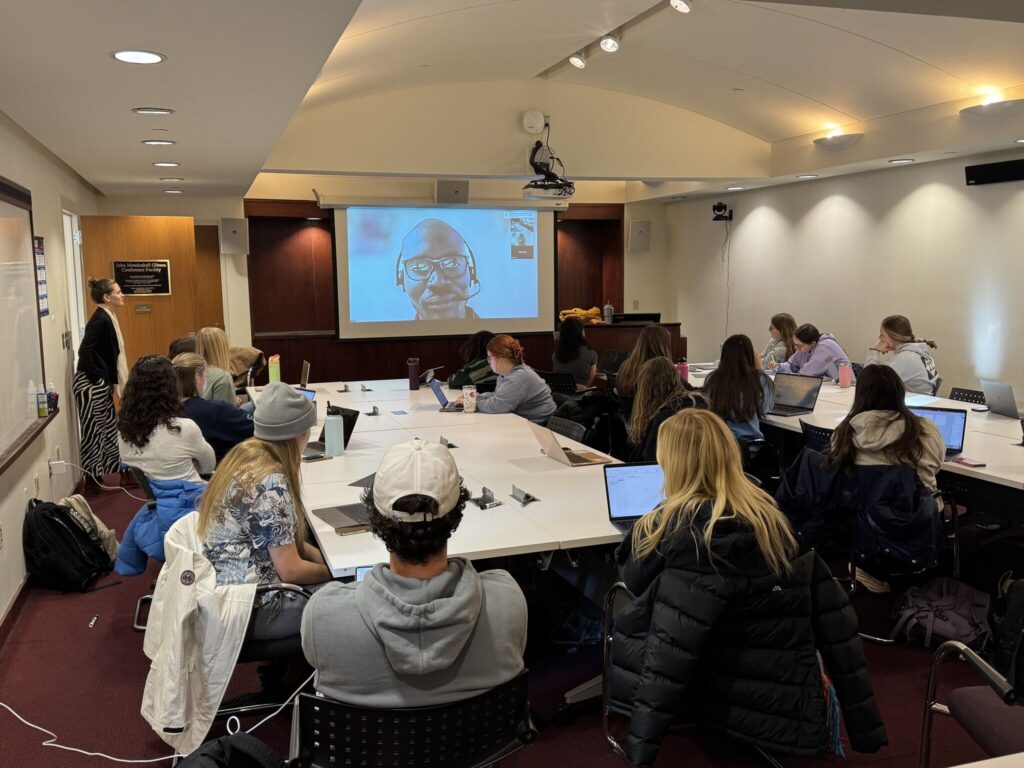 Students from Anderson’s MEJO 476 met virtually with representatives from CFK Africa throughout the semester.
Students worked in teams to support CFK’s initiatives, including proposals for baseball programming, curriculum updates and pathways to partnerships with the NBA.
“That was one of the highlights for me,” Anderson said. “Seeing them learning the content and then applying the real-world concepts.”
Anderson plans to travel to Kenya to witness his students’ work in action and collect data for his own research. He hopes the partnership will expand to include a summer experience for UNC Hussman students.
Athletics advocacy
As a recently elected member of the University’s Faculty Athletics Committee, Anderson is committed to advocating for student-athletes in and out of the classroom.
“It’s going to be monthly meetings with the chancellor to talk about everything from grades to well-being to the new atmosphere of NIL,” Anderson said.
Anderson noted the disparity between the ability of professional athletes to speak out on issues and the restrictions still facing college athletes. Some athletes are leveraging NIL deals to promote social causes.
“It’s still sort of a taboo topic in college sports because of so many rules and regulations,” he said. “It would be great to come in and have a space of advocacy for them to be able to spread their message.”
This spring, he attended the CAA World Congress of Sports, where he networked with commissioners, general managers and consultants in the hopes of connecting UNC athletic teams with social causes. One promising connection was with a consulting firm that hosts a women’s basketball tournament promoting female empowerment in sports.
“These are the things that I would love to advocate for,” Anderson said. “So what I’ve been doing over the past year is not just a meeting with teams on campus, but I’ve also really been focused on networking with people in industry.”
Writing the playbooks
Beyond teaching and advocacy, Anderson is the author of “The Black Athlete Revolt: The Sport Justice Movement in the Age of #BlackLivesMatter,” and he’s working on a first-of-its-kind textbook with UNC Hussman Associate Professor Livis Freeman.
“It’s basically a book that’s talking about how athletes have used their platforms to develop positive community initiatives and how they’ve engaged in social impact,” Anderson said.
The textbook will be the framework for a new research-based course that Anderson and Freeman are developing. Anderson is also laying the groundwork for a sports consulting center where students in the course can blend scholarship and research for big-name clients like Nike.
“What I would like for it to be is the central hub where sport organizations from across the world will come to this institution and work with us,” he said. “We’ll be the source they come to — to determine how to best disseminate, evaluate and implement social impact campaigns.”
He has another book in the works based on his sport and global impact theory that outlines how to measure the success of sport and social responsibility initiatives. Anderson’s evaluation strategy will be applicable across the industry, from professional athletics teams to apparel companies.
One of the world’s leading experts
Before earning his Ph.D., Anderson was a sports journalist.
“Ironically enough, coming up, I watched Stuart Scott on SportsCenter, and I was like, ‘I want to do that,’” Anderson said.
Encouragement from one of his undergraduate professors pushed him toward academia instead of industry.
“They said, ‘You do great research with your stories. Have you thought about taking it further?’” Anderson said.
He reluctantly returned to school for his master’s and Ph.D. Now a decade later, he has become one of the world’s leading experts in his field.
“I love it because it’s not only on the path of academia, but it’s networking and being an adviser to students who want to get into industry or pursue further education,” Anderson said.
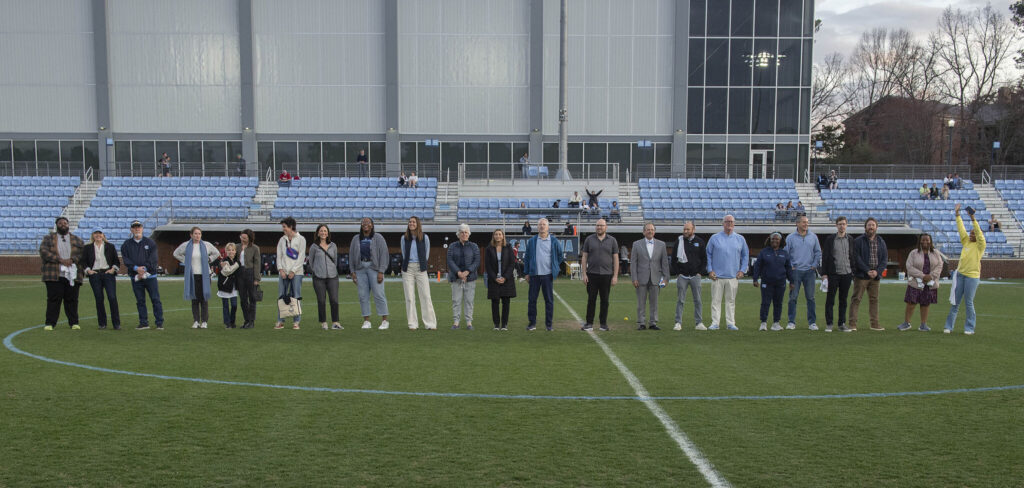 Anderson (left) was recognized during the 2025 women’s lacrosse game celebrating Educator Appreciation Day.
His students are a big source of inspiration for him. Adair Martin ’25, a women’s lacrosse player from his MEJO 476 class, invited Anderson to be honored during their Educator’s Appreciation Day game in March. Knowing that he’s making an impact though engaging his students in immersive experiences motivates his teaching and research.
“Being in this position at UNC Hussman has had my ideas bouncing everywhere because this is an entirely (pun intended) new ball game,” Anderson said.