
Education in Bosnia and Herzegovina is a battleground, where nationalism and ethnic divisions are highly visible. Thirty years after the war, more than 50 schools in the country are “schools under one roof”, where students are divided not only by curriculum but also physically. In one of these schools, a history teacher presents her lessons according to two different curricula.
July 8, 2025 –
Joshua Evangelista
Tatjana Dordevic
– 
History and MemoryIssue 4 2025Magazine
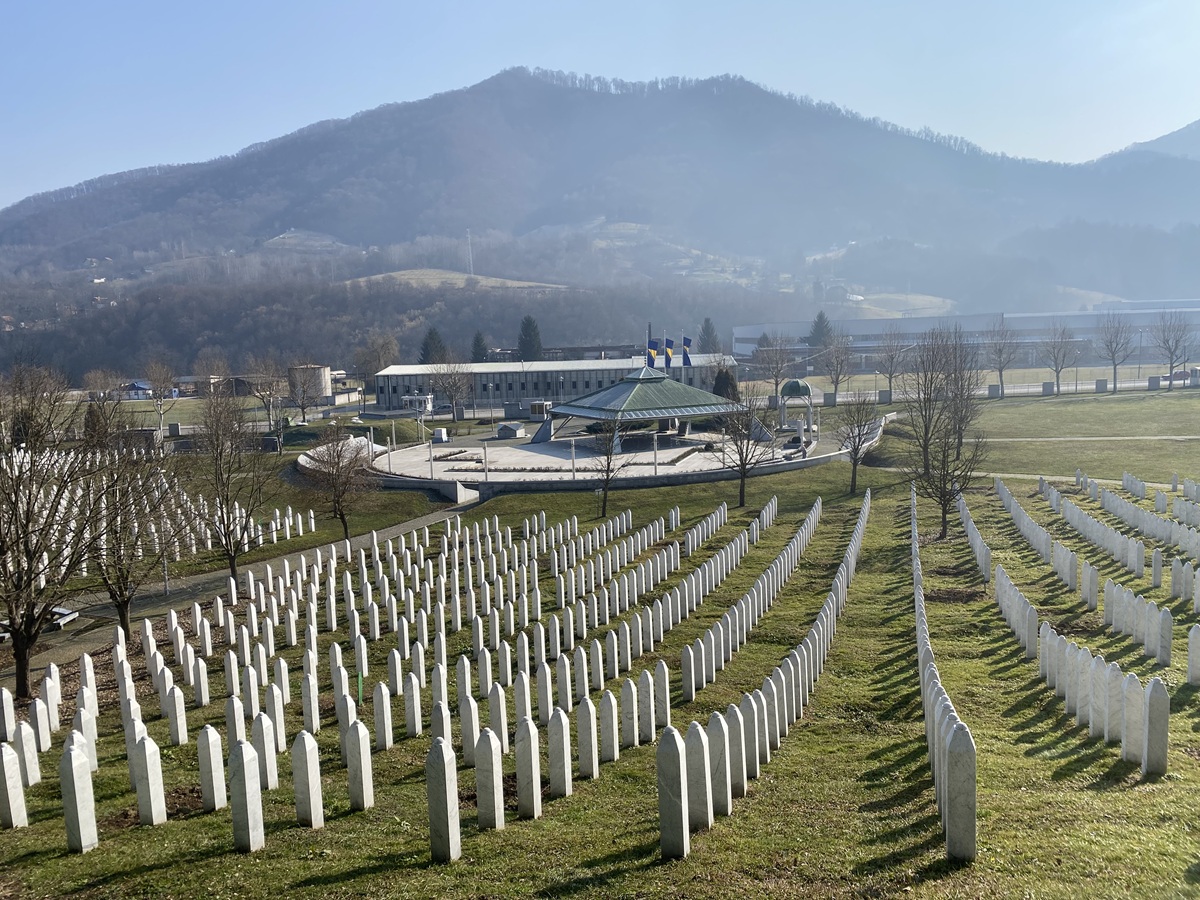
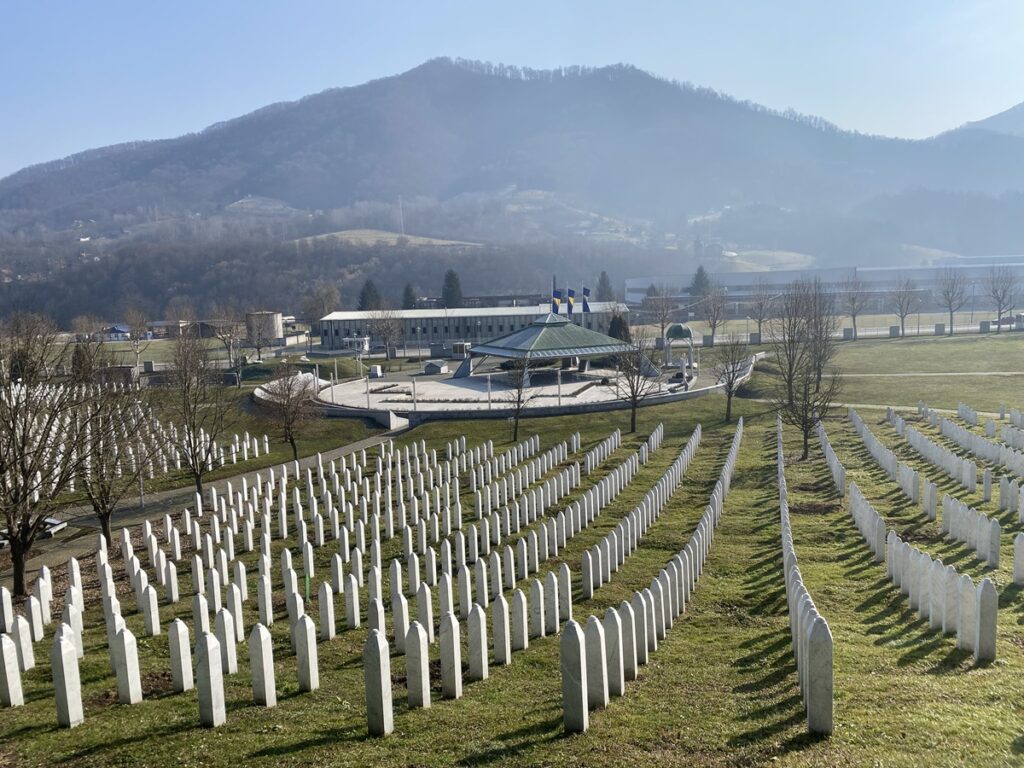
A picture of the Srebrenica Genocide Memorial and Cemetery for the victims of the 1995 massacre. This year marks the 30th anniversary of the massacre.
Photo: Tatjana Đorđević
Near the Srebrenica Memorial Centre in Potočari, Bosnia and Herzegovina, music fills the air. Children sing, accompanied by an acoustic guitar, keyboard and drums. The repertoire is diverse, the emotions strong and yet the music brings a smile to the face, especially considering that the earlier visit to the memorial centre chills both the heart and soul. Standing at the door is Ismar Porić, the founder and creative director of the “House of Good Tones” music school in Srebrenica.
“When someone comes to Srebrenica for the first time, they can feel the genocide in the air, which must never be forgotten. But there is one important thing: “We must not remain in the past. We must care for the living and invest in them,”” says Porić.
Revisionism
The Memorial Centre recently opened a new exhibition titled “The Path of Salvation”. It was displayed in one of the hangars where the Dutch UN battalion had housed refugees arriving in Srebrenica, a zone that was meant to be safe. Hundreds of remnants of shoes, sneakers, boots and tiny little shoes, were displayed on a glass table, symbolizing the suffering of July 1995. On panels and large fabric banners hanging from the ceiling, sentences written by men and boys reveal their thoughts as they tried to escape from Srebrenica.
“At night, we hold hands so we don’t get separated. Anyone who leaves the column has no chance of surviving.” These are just some of their reflections. Between 12,000 and 15,000 people set out on a 100-kilometre journey through the forests toward free territory near Tuzla. Over 8,000 were killed by the Army of the Republic of Srpska under the command of General Ratko Mladić.
Children from Srebrenica, Bratunac, Potočari and surrounding areas, attend the “House of Good Tones” music school as an alternative form of education alongside regular schooling.
“Children of Bosniak or Serbian ethnicity, born here after the war, carry a heavy burden,” says Porić. “They have a difficult childhood and upbringing, given the political climate that still exists, even 30 years after the war. They know more than a child should about those horrific events.”
In the ninth-grade history textbook authored by Professor Dragiša Vasić, which has been part of the official curriculum in Republika Srpska since September 2024, figures like Ratko Mladić and Radovan Karadžić are portrayed as individuals who played key military and political roles during the war. Karadžić is described as a poet, psychiatrist and politician who contributed significantly to the creation of Republika Srpska. The text omits any mention of his life sentence for genocide, crimes against humanity, and violations of the laws of war by the International Criminal Tribunal for the former Yugoslavia (ICTY). It simply notes that he was handed over to the tribunal.
Ratko Mladić, the former commander of the Army of the Republic of Srpska, is presented as a key general in the defence of Serbs in Croatia and as the figure most responsible for creating the Serbian entity in Bosnia and Herzegovina. While it is mentioned that he was extradited to The Hague in 2011, the reasons for his extradition are not explained.
The end of the war in 1995 is described through the lens of the Serbian capture of Srebrenica and Žepa; the fall of the Republic of Serbian Krajina; the expulsion of 450,000 Serbs from Croatia; and the signing of the Dayton ceasefire. There is no mention of the Srebrenica genocide, nor of the suffering of other ethnic groups.
On the other hand, the history textbooks used in schools in the Federation are also filled with inaccuracies and biased narratives. A supplementary ninth-grade textbook, authored by Almir Bećirović and Nazim Ibrahimović and introduced into the Tuzla Canton curriculum in 2022, dedicates 64 pages to the dissolution of Yugoslavia, the Bosnian war, war crimes, and the destruction of cultural and religious heritage. This book presents the conflict exclusively from the perspective of Bosniak victims, excluding the suffering of other ethnic groups and the crimes committed by the Bosnian Army, which have been documented and prosecuted by the ICTY and the Court of Bosnia and Herzegovina.
In January 2024 the Constitutional Court of Bosnia and Herzegovina annulled part of the curriculum in Republika Srpska related to “Topic 11: Republika Srpska and the Defensive-Homeland War”, following an objection regarding the glorification of war criminals.
However, the book is still in use according to Džana Brkanić, deputy editor in chief of the Balkan Investigative Reporting Network (BIRN). “Our analyses have shown that history textbooks for primary schools in Bosnia and Herzegovina present three different versions of history, often containing inaccuracies,” Brkanić says. “We cannot claim that history is taught better in some places and worse in others, but we do argue that it is politically conditioned, shaped by the views of the majority population in either the Federation or Republika Srpska.”
Genocide deniers
In May 2024 the United Nations adopted a resolution declaring July 11th as the International Day of Remembrance for the Srebrenica Genocide. Following this, the Association of Victims and Witnesses of Genocide launched a new website in October 2024 to monitor and document all forms of genocide and war crimes denial in Bosnia and Herzegovina.
Murat Tahirović, president of the association, says that every act of denial or glorification is now carefully documented, analysed and forwarded to the appropriate institutions, including the Prosecutor’s Office of Bosnia and Herzegovina, for further action. He points to the insufficient work of judicial institutions in prosecuting genocide denial under the 2021 law.
According to an analysis by the Srebrenica Memorial Centre, media outlets from Republika Srpska and Serbia play a crucial role in shaping public attitudes towards the genocide, with Milorad Dodik, the President of Republika Srpska, standing out as the most prominent genocide denier.
Tahirović, who was a member of the Army of Bosnia and Herzegovina, was severely wounded in the chest and abdomen and spent 59 days in a detention camp, emerging with serious consequences. In 2005, he was elected president of the Association of Camp Detainees in Bosnia and Herzegovina. Nia Abadžić, a student at the Faculty of Criminalistics, Criminology and Security Studies at the University of Sarajevo, criticizes how genocide and the horrors of the war are taught in schools. However, she finds even more disturbing the trend of passing down generational trauma.
“War traumas that my generation did not experience first-hand can still shape young minds, depending on how they are passed down to us,” Abadžić says, adding that her parents taught her and her sisters to remain open to any discussion.
Nia learned about the events of the war in high school through a curriculum that was based solely on one perspective: the tragedy and sorrow of the Bosniak people. In contrast, Jaska Pajić, a law student from Banja Luka, learned nothing about the war of the 1990s because that part of history was under an embargo for teaching in schools until 2018.
History through court-established facts
Education in Bosnia and Herzegovina is a battleground where nationalism and ethnic divisions are highly visible. Thirty years after the war, more than 50 schools in the country are “schools under one roof”, where students are divided not only by curriculum but also physically. One of these schools is located in Busovača, central Bosnia, and serves 240 students of Bosniak and Croat ethnicity. Emina Musić, a history teacher at the school, presents her lessons according to two different curricula.
“Croatian ethnicity students attend one shift, while Bosniak ethnicity students attend another,” Musić says. After analysing numerous history textbooks, BIRN created a database of court-established facts between April 2021 and March 2023. Professor Melisa Forić prepared these materials for use in formal education in Bosnia and Herzegovina.
“This database is divided into ten regions. We used all the Hague rulings to extract facts, which were then adapted for teachers,” Brkanić says.
“We also prepared multimedia materials, in which we avoided bloody scenes but included testimony from people who were witnesses to the war and certain crimes.”
BIRN offered this material to all education ministries in Bosnia’s cantons and the equivalent body in Republika Srpska. Memorandums were signed only with the ministries from the Sarajevo and Tuzla Cantons, which included the database as additional teaching material for history. BIRN never received a response from the ministry in Republika Srpska.
Tatjana Đorđević is the chairman of the Foreign Press Association in Milan and a journalist, writing for Al Jazeera Balkans, BBC News, Portal Novosti and La Stampa.
Joshua Evangelista is a journalist specializing in human rights and memory politics. His work regularly appears in prominent media outlets, including La Stampa, Avvenire, New Lines Magazine and Middle East Eye. He is also head of communications at the Gariwo Foundation, an international NGO dedicated to genocide prevention and honoring the memory of those who opposed mass atrocities.
