
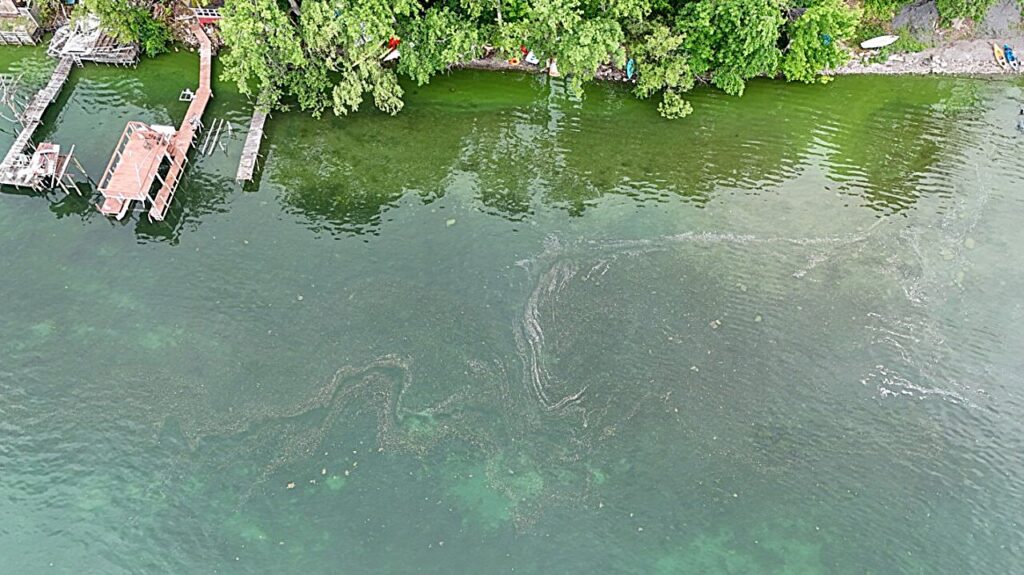
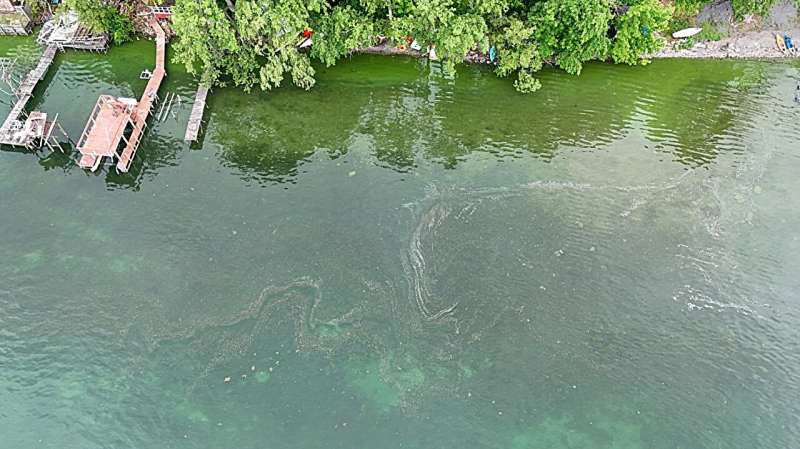
A harmful algae bloom along the west shore of Cayuga Lake. Credit: Thomas Bjorkman/Provided
An alga that threatens freshwater ecosystems and is toxic to vertebrates has a sneaky way of ensuring its success: It suppresses the growth of algal competitors by releasing chemicals that deprive them of a vital vitamin.
The finding was reported in a new study from Cornell University, describing how the cyanobacteria Microcystis aeruginosa manipulates its environment to give itself advantages to take over the water column, leading to harmful algal blooms and mats in lakes during hot summers.
“Microcystis seems to be able to dominate more and more in the changing climate,” said Beth Ahner, professor in the Department of Biological and Environmental Engineering and corresponding author of the paper.
The study shows how M. aeruginosa, a common harmful cyanobacteria, produces and releases chemicals, called antivitamins, that mimic thiamin, also known as vitamin B1. In the presence of the antivitamins, other alga species, some of which cannot synthesize their own thiamin, take up the chemicals from the water and are unable to distinguish them from the true vitamin.
Inside the host, the chemicals mimic vitamin B1 and inhibit the thiamin-dependent enzymes required for growth. The study also revealed that M. aeruginosa has a specialized thiamin-biosynthesis enzyme that makes it resistant to the antivitamins that it produces.
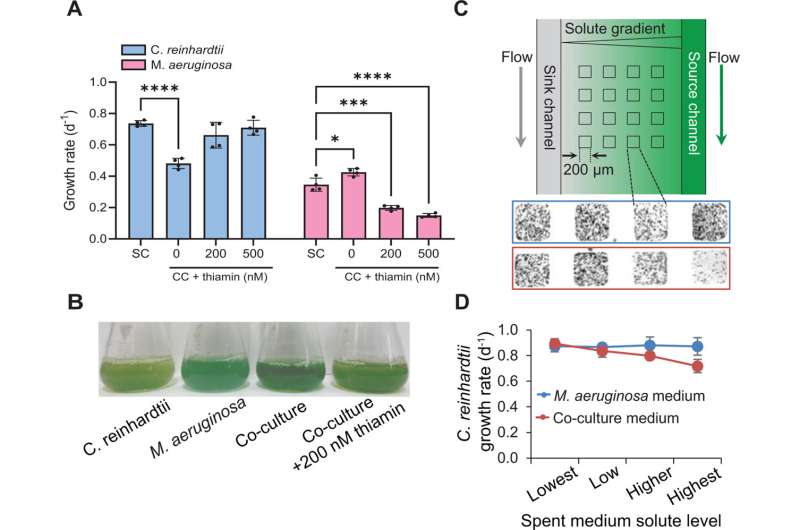
(A) Growth rate of C. reinhardtii and M. aeruginosa in single culture (SC) and co-culture (CC) with and without thiamin. (B) At t = 10 d, from left to right, single cultures of C. reinhardtii and M. aeruginosa, and the co-cultures without (blue-green) and with thiamin (yellow-green). (C) Schematic of the microfluidic device used to generate spent-medium exudate gradient in replicate microhabitats. Epi-fluorescent microscope images of cells in microhabitats exposed to M. aeruginosa spent medium (blue box) and co-culture medium (red box) at t = 3 d. (D) C. reinhardtii growth rate in individual microhabitats. For A and D, data are means ± SEM, with n ≥ 3. Asterisks indicate significance in two-way ANOVA with Tukey post-hoc test (*P < 0.05, ***P < 0.0002, ****P < 0.0001). Credit: mBio (2025). DOI: 10.1128/mbio.01608-25
While the frequency of these harmful algae blooms has increased, the reasons why have been unclear. People hypothesize the rise is related to watershed runoff that carries pollution and macronutrients, like phosphorus and nitrogen, Ahner said. Researchers are also perplexed about why blooms occur even in very clean lakes, such as Skaneateles Lake in the Finger Lakes region of New York.
“No one’s ever really shown that this organism has an advantage in taking up those macronutrients over other algae,” Ahner said.
In addition, M. aeruginosa produces chemicals toxic to vertebrates. “If you have a dog lapping up the water on the shore and it ingests these organisms, it has the potential to cause severe illness and even death,” Ahner said.
Using a technique called quantitative polymerase chain reaction (qPCR), the researchers identified a few genes they believe are involved in making antivitamins, Ahner said.
Co-authors from Oregon State University shared data that identified the presence of the antivitamin bacimethrin in the environment and at elevated levels when M. aeruginosa bloomed.
Mohammad Yazdani, a postdoctoral research associate in the Department of Biological and Environmental Engineering, is the paper’s first author.
More information:
Mohammad Yazdani et al, Harmful algal bloom species Microcystis aeruginosa releases thiamin antivitamins to suppress competitors, mBio (2025). DOI: 10.1128/mbio.01608-25
Journal information:
mBio
Provided by
Cornell University
Citation:
Harmful algae blooms have secret to success over other algaes—manipulating its environment (2025, July 16)
retrieved 16 July 2025
from https://phys.org/news/2025-07-algae-blooms-secret-success-algaes.html
This document is subject to copyright. Apart from any fair dealing for the purpose of private study or research, no
part may be reproduced without the written permission. The content is provided for information purposes only.