
A new environmental group, Deep River Riverkeeper, Inc., was formed in December 2024 to support the health and well-being of the Deep River and its tributaries. It was officially licensed in June by the Water Keeper Alliance®, the international riverkeeper association that authorizes jurisdiction and supports environmental protectors for rivers. It is the final piece in riverkeeper oversights for the Cape Fear River Basin, the largest watershed in North Carolina. The DRRK joins the Haw River Assembly and the Cape Fear River Watch in advocacy for this major water source in the central part of the state.
The mission is, “To protect the Deep River and its neighbors through science, education, and stewardship.” The vision is, “Healthy waterways supporting communities and wildlife for current and future generations.”
The group, based in Jamestown, held an introductory meeting to a standing-room-only audience at the Jamestown Public Library June 26, sponsored in part by the Historic Jamestown Society and Piedmont Triad Regional Council. The presentation was “The Deep River Speaks: A new biography an exploration of how the Deep River created our cultures and shapes us now.”
“It is a live thing. It speaks,” said Dr. Patricia Gray, chairperson of the board of the river. “It was the Main Street for the community. It is inside us.”
She spoke about hydrophones (an underwater microphone), terrestrial monitoring and the biodiversity of the river.

Stephanie Stephens
Photo courtesy of Deep River Riverkeeper, Inc.
Stephanie Stephens is the actual Riverkeeper and holds B.S. and M.S. degrees in Environment and Sustainability from the University of North Carolina-Greensboro. She said a riverkeeper is a non-governmental licensed advocate for rivers, seeking to restore, protect and preserve the health of the rivers. Employed by DRRK, Stephens leads its activities in water testing and reporting, river clean-ups, public outreach and recreation opportunities.
At the meeting at the library, Ross A. Holt, head librarian at the Randolph County Public Library, spoke about how the county’s part of Deep River has played a part in the history of the County, citing instances during the Revolutionary War and all the mills that were along its banks.
Attorney Alan Edmunds, spoke about the river in Chatham County. He also mentioned how Regulators fought along its banks during the Revolutionary War and pointed out several locations that played a part in the Civil War, like the Endor Iron Works and Egypt Coal Mine.
A discussion on Guilford County’s connection to Deep River was postponed.
History and location
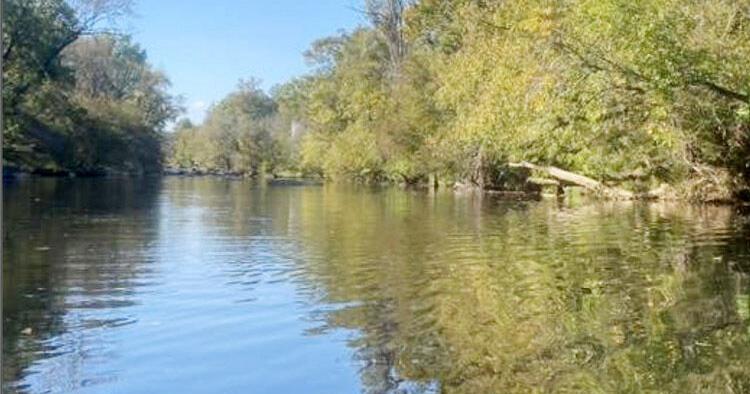
The Deep is an old river. It flows approximately 125 miles through six counties and has played a large part in the development of the Piedmont. According to the Triangle Land Conservancy, which protects almost 3,000 acres along the river in Chatham and Lee counties, the river gets its name from the steep banks on the shore, not the depth of the river. In the Jamestown area, the banks are not as steep as elsewhere along its course and the river is very shallow in spots.
Many people drive over Deep River in Jamestown near the High Point City Lake dam every day, not knowing the history of the water under the bridge. Beginning in two forks in Forsyth County — one in Kernersville and one in Colfax, and meeting at City Lake, it joins the Haw River and then forms the Cape Fear River, which flows to the Atlantic Ocean. East Fork Road in Jamestown is named for one of the branches of the river. Oak Hollow Lake in High Point was formed from the West Fork in 1974.
That is why The Deep River Riverkeeper, Inc., calls itself “The New Protector of the Cape Fear Basin.”
Iron ore once was abundant along the river and munitions factories provided supplies for soldiers and hunters. Jamestown once had 11 gunsmiths in the area. Records exist of coal mining on the river in 1775. The river was used to transport coal to fuel blockade runners on the coast during the Civil War, as well as cotton and arms.
Deep River
Photo courtesy of Deep River Riverkeeper, Inc.
“The Deep River Coal Field is the only noteworthy source of coal in the state,” according to a report in 1885 by H.M. Chance. The coalfield was located in the present community of Cumnock, near Sanford. It operated at least into the 1920s.
“Deep River is a medium-sized river of sluggish, muddy and twisted flow. There are spots of great beauty in its length.” So reads a section of noted mapmaker and historian Fred Hughes’ book “Guilford County: A Map Supplement,” published in 1988.
“Originally clear, millions of shad came up the river each spring for spawning. Indians had camped on its banks, annually, for fishing, for thousands of years,” he continued.
But the Deep has been in trouble for many years.
“The year-round sustained water flow is one half what it was two hundred years ago,” Hughes wrote.
The Deep is a “working” river. Textile and grist mills once rose from the banks of the river. Local mills provided fabric for Southern troops during the Civil War. Jamestown’s Oakdale Cotton Mill, situated on the river, was once a gun factory.
Several factors have contributed to the deterioration of the Deep. Many mills sprang up along the river, building dams for power but impeding water flow and habitats of the shad.
Chemicals released from factories many years ago and sewage discharges are still evident in the waters and show up in tests and at the Randleman Reservoir, from which Jamestown receives its water.
About DRRK
In just a few months of existence, DRRK has established several programs to monitor the river, work within the community, and educate the public and college interns on important topics related to water quality.
Locally, the group is conducting PFSA sampling on Richland and Bull Run creeks and seeks to track PFSA contamination by industry and consumer products back to their source.
This fall DRRK will host river and stream cleanups in all counties along the Deep River along with other events.
The 501(c)3 non-profit’s Board of Directors represents professional expertise in science, public health, water systems management, community development, land management, education, arts, information technology, marketing and law.
For more information, visit http://www.deepriverkeepersnc.org.