
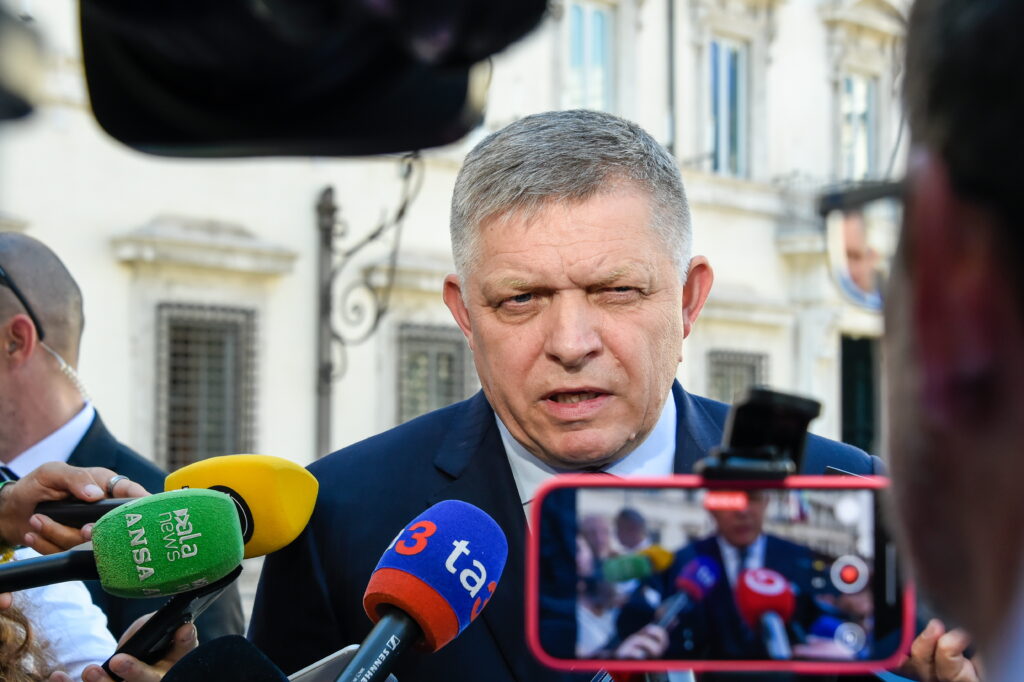
Brussels – It is a no-go on the 18th package of sanctions against Moscow. Delaying the adoption of the new restrictive measures, which the High Representative Kaja Kallas hoped to finalize during yesterday’s Foreign Affairs Council, is once again Robert Fico‘s Slovakia. Bratislava is dissatisfied with the reassurances offered by the Commission on Russian gas supplies, which the EU executive wants to ban by the end of 2027.
The letter sent yesterday (15 July) by the Commission, signed by Ursula von der Leyen herself, “does not offer Slovakia sufficient guarantees” regarding the crucial issue of cheap gas supplies from Russia. With these words, shared on social media on the same day, Prime Minister Robert Fico closed the door on discussions on the 18th sanctions package against the Kremlin, lengthening a political tug-of-war that
has been dragging on for months.
The EU High Representative for Foreign Affairs, Kaja Kallas, had hoped that the adoption of the new round of restrictive measures, presented by the twelve-star executive in early June, could take place during the meeting of the Foreign Ministers of the 27 member states held yesterday in Brussels. But it will have to wait, again.
 Slovak prime minister Robert Fico (sinistra) and Russian president Vladimir Putin (photo: Gavriil Grigorov/Afp via Sputnik)
Fico justified Slovakia’s opposition to the package based on energy security concerns in Bratislava. The national-populist prime minister (one of Vladimir Putin‘s closest allies in Europe, along with his Hungarian counterpart Viktor Orbán) is linking the adoption of sanctions against Moscow, which require unanimity, to the EU energy transition within the framework of the RePower EU strategy.
The Brussels Plan, which Fico described as “absurd,” envisions the gradual phase-out of fossil fuels imported by the Federation by 2028, including natural gas, with a decision to be taken by a qualified majority among the Member States (and which, therefore, Fico would not be able to block).
Slovak Prime Minister
dug in his heels during the June EU summit, calling for guarantees to protect its economy, which is heavily dependent on Russian gas imports. However, he continues to declare himself open to negotiating an agreement that could “guarantee a certain comfort level” for the central European country. If Bratislava receives acceptable assurances about mitigating the impact of the phase out, he says, he will no longer block the adoption of sanctions.
 European Commission president Ursula von der Leyen (photo: Dati Bendo/European Commission)
Fico’s preferred solution would be a national exemption until 2034, when the long-term supply contract signed with Gazprom, Russia’s state-owned energy giant, is set to expire. Otherwise, he claims, Bratislava would face a lawsuit and may have to pay a fine of up to EUR 20 billion. However, the Commission is having none of it and points out that legal prohibitions imposed at the EU level can be invoked as force majeure in litigation with Gazprom.
To lend a helping hand to the Slovak government, von der Leyen proposed setting up a task force to examine the country’s needs and monitor its green transition, assisting Bratislava in devising and implementing various types of technical, economic, and regulatory solutions, including a more flexible use of state aid and the use of EU funds to compensate for losses due to the phase out and energy diversification. In addition, she reiterated the possibility of using an “emergency brake” to temporarily suspend the application of the gas import ban if extreme price spikes are reached.
 EU High Representative for Foreign Affairs, Kaja Kallas (photo: European Council)
Fico, whose coalition partners at home would categorically oppose the Brussels openings, rejected all proposals, to the frustration of von der Leyen and Kallas. The former Estonian prime minister said yesterday that she was “really sad” that the agreement had not been reached and reiterated that “we were really close” to convincing Slovakia, emphasizing that “these negotiations have been going on for a long time” and pointing the finger at the obstructive attitude of the government in Bratislava, which, she complained, constantly presents new conditions. “Now the ball is in Slovakia’s court,” she added.
The technical discussions, at the Coreper ambassador level, are continuing today. The hope is to reach an agreement by the end of the week: “I am optimistic and still hopeful” that there will be a decision today, Kallas said yesterday. Perhaps a boost to the Slovak premier could come from the announced intention of Donald Trump‘s White House to impose heavy “secondary tariffs” on all of Moscow’s trade partners if there is no progress in negotiations with Ukraine in the next 50 days.
English version by the Translation Service of Withub