
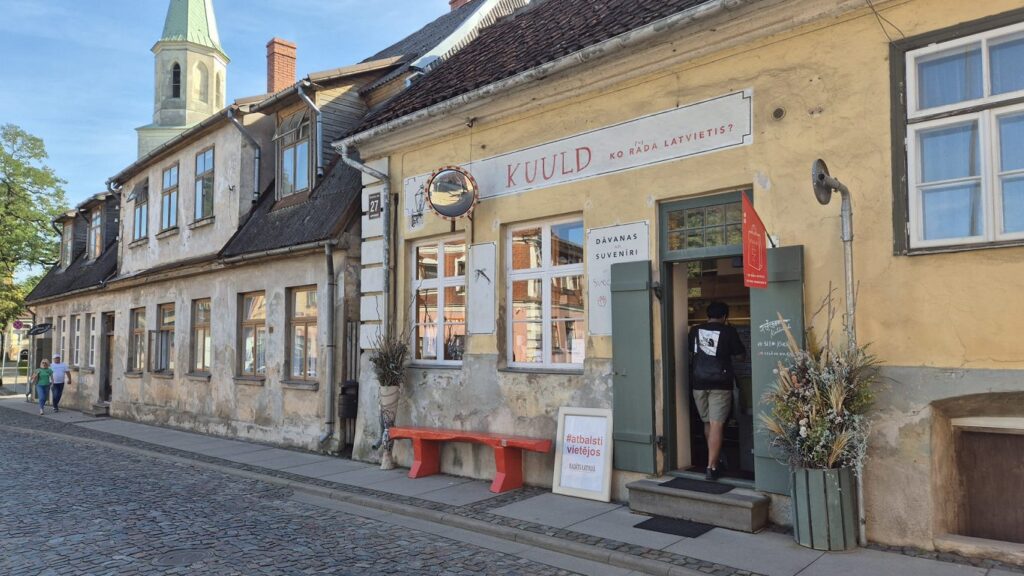
The cool start to summer has had a negative impact on tourism businesses across Latvia, and Kuldīga is among the towns seeing it most. Tourism businesses in Kuldīga see that the geopolitical situation has also made visitors interested in UNESCO heritage more cautious about travelling to the Baltic States, Latvian Radio reported on 21 July.
Jolanta Lange, the manager of the restaurant and hotel “Jēkaba sēta”, manages three buildings in the Old Town of Kuldīga. In her eleventh season in the family business, she has accumulated experience in the hospitality sector and has her conclusions about current events in the tourism industry, including geopolitical conditions.
“Before this whole geopolitical situation, our main tourists were Germans. That was really the case, 60-70%. Since the war and Covid, now our primary tourist is local. I was still reviewing today – 65% or so are Latvians, followed by Lithuanians, Germans, Estonians, the UK, and then there are other countries.”
The hostess reasons that they are able to maintain the restaurant because it is located in a hotel, while also catering for groups and keeping their long-standing staff employed in winter. In winter, the hotel is used by various companies, so they manage to maintain stability. At the same time, the representative of Jēkaba sēta praises the people working in the tourism sector in Kuldīga, whose contribution is obvious and is one of the reasons why people choose Kuldīga as a destination.
Jana Bergmane, head of the Kuldīga Tourism Development Centre, says that this year is definitely different, influenced by the weather and other factors.
“The tourist flow that I observe myself is that there are definitely fewer Lithuanian tourists than in the past, while German camper van tourists are relatively more numerous and can be seen in many parking lots in the city, especially in Krasta Street around the tower. Of course, there is a discussion here about what purely these types of tourists contribute to the city and to business, because they are quite self-sufficient,” said Bergmane.
“Accommodation is definitely not being used and catering services are being used less. That’s kind of a stumbling block because there is no one central place where they stay and they would probably be very keen to use the infrastructure, and there isn’t one in Kuldīga, only for some private ones, and they are very low-intensity.”
As for Kuldīga winning the UNESCO title and the earlier predictions that the number of tourists would grow faster, this has not happened at the moment. One of the main reasons for this is the geopolitical situation, with many people still cautious.
“This audience is clearly, you could say, middle-aged and older. Of course they [want to see] UNESCO sites, but they want to travel safely, they are very picky about destinations,” said Bergmanis. “It’s no secret – the border and the situation, which maybe once in a while gets a little bit louder, but we also don’t know that deeply how it is portrayed in which country.”
Bergmane believes that in the current circumstances, the tourism industry needs strong support from the state and at the same time external publicity to show Latvia as a safe destination. More needs to be done at the national level, she believes.
“I would say that this is an area for Latvia itself – the tourism department, not just Kuldīga or the Kurzeme region, should be talking about this, it should be the country as a whole. The country needs to do much more when we are talking about foreign markets,” said Bergmane.
Overall, Kuldīga is experiencing a tourist flow in July, but as in other parts of Latvia, the weather will certainly have an impact on the season’s overall figures. Kuldīga tourism spokesperson Bergmane admits that some people are saving money and that there is a seemingly invisible economic crisis that is influenced by several factors, including the geopolitical situation.
Select text and press Ctrl+Enter to send a suggested correction to the editor
Select text and press Report a mistake to send a suggested correction to the editor
Tell us about a mistake