
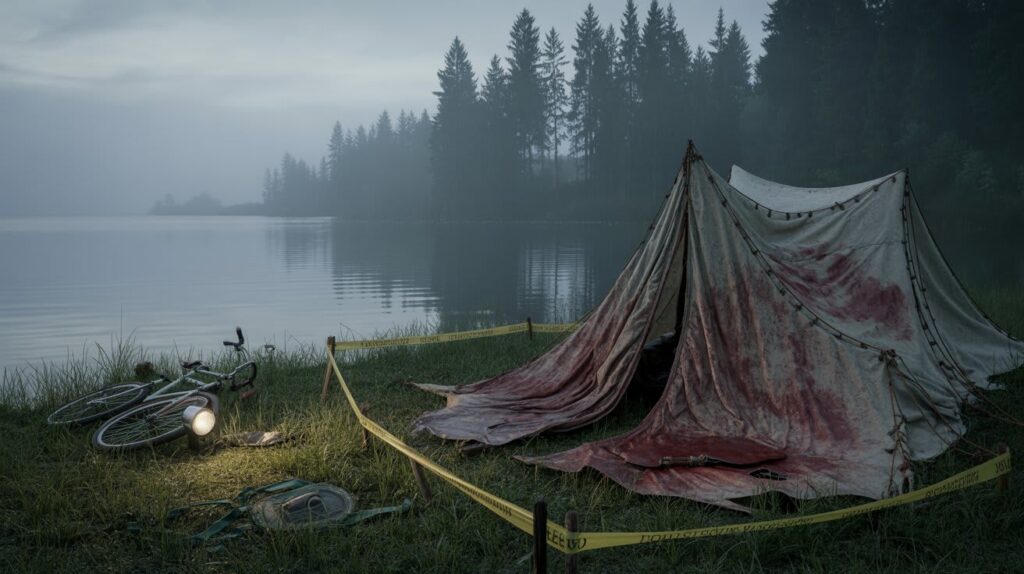
On the early morning of June 5, 1960, four Finnish teenagers 15 year olds Maila Björklund and Anja Mäki, and 18 year olds Seppo Boisman and Nils Gustafsson camped near Lake Bodom in Espoo, Finland. Between 4:00 and 6:00 a.m., a violent attack struck them in their sleep. A passerby discovered the blood soaked tent and three bodies by 11 a.m.Gustafsson survived with significant injuries, but the others were fatally wounded.
The Horrific Discovery
Police determined the assailant struck through the tent, using a knife and possibly a blunt weapon. Maila Björklund’s body was found partially undressed with severe postmortem wounds, suggesting a disturbing assault beyond simple violence. Oddly, wallets and clothing remained, yet the group’s motorcycle keys were missing and never found.^1
Investigation Blunders
Key investigative mistakes included:
- Crime scene contamination: locals, police, and press tampered with the area before proper documentation
- Lost physical evidence: the murder knife and blunt object were never recovered
- Unfollowed leads: witness reports of a flashlight or figure nearby were neglected
These failures crippled the possibility of discovering the truth.
Suspects and Theories
Decades later, in 2004, authorities charged Nils Gustafsson, accusing him of killing his friends in a jealous rage. However, forensics and DNA analysis contradicted prosecutorial claims. In 2005, he was acquitted due to insufficient evidence.^2
Other theories include:
- A psychopathic stranger attacking at random
- Sexual motive, implied by Björklund’s state
- A local woodsman or military deserter
- Hans Assmann, a suspect who matched early witness descriptions
No other suspects have been officially charged.
Cultural Echoes of a National Tragedy
Lake Bodom’s notoriety permeates Finnish culture:
- The melodic-death metal band Children of Bodom took their name from the tragedy.
- Documentaries and horror projects frequently invoke the lake’s eerie reputation.
- True-crime podcasts like Casefile and MrBallen have highlighted the murders, keeping global attention alive.
Modern Forensics, Too Late?
Other cold cases have been solved using genetic genealogy, including:
- The Golden State Killer (Joseph DeAngelo), tracked and convicted in 2020 via DNA and family trees^3
- Carla Walker’s 1974 murder, identified in 2021 via forensic genealogy^4
But Lake Bodom lacks preserved evidence. Due to contamination and no recovered weapons, the case cannot benefit from DNA breakthroughs.
The Human Toll
For decades, Gustafsson lived under public suspicion. Victims’ families were left with no resolution. Finnish authorities still list the case as unsolved the passage of 60+ years only deepens the mystery.
“They wanted a scapegoat. But I’ve lived with this pain since I was 18,” Gustafsson said after his acquittal.
Final Thoughts
The Lake Bodom murders continue to haunt Finland’s collective memory, not just because of the brutality involved, but because justice was never truly served. More than six decades have passed since that fateful summer morning, yet the questions surrounding what really happened remain unanswered. Families of the victims were denied closure, the surviving witness was nearly imprisoned for a crime he may never have committed, and the Finnish justice system endured one of its most controversial cold cases.
In an age of forensic breakthroughs, it is particularly frustrating that this case may remain permanently out of reach. Unlike more recent crimes where DNA evidence can be preserved and re-tested, the Bodom case suffered from early 1960s investigative shortcomings. Contaminated crime scenes, lost evidence, and outdated protocols ensured that even today’s most advanced forensic techniques like genetic genealogy cannot offer the kind of clarity seen in cases like the Golden State Killer.
Still, that hasn’t stopped amateur sleuths, investigative journalists, and true crime enthusiasts from continuing to explore new angles. Could previously overlooked witnesses be re-interviewed? Could advanced imaging or pattern analysis extract details from old photographs or police notes?
In truth, the only certainty in this case is its eternal mystery. Lake Bodom holds its secrets tightly and perhaps always will.
Would you reopen the investigation? If so, where would you begin?
Let me know in the comments.
Source & References