It’s at MDPI, but still, as it’s a systematic review, the truncated abstract:
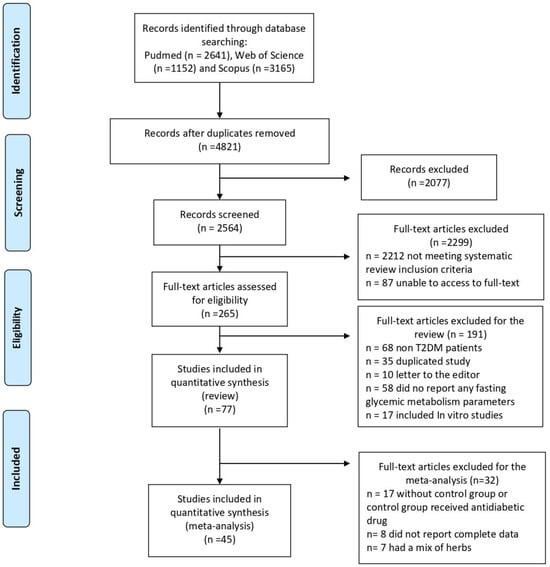
*Methods: PubMed, Web of Science, and Scopus databases were searched for interventional studies investigating the effect of these aromatic herbs and spices on the glycemic profile in T2DM subjects. Results: This systematic review retrieved 6958 studies, of which 77 were included in the qualitative synthesis and 45 were included in the meta-analysis. Our results showed that cinnamon, turmeric, ginger, black cumin, and saffron significantly improved the fasting glucose levels in T2DM subjects. The most significant decreases in fasting glucose were achieved after supplementation with black cumin, followed by cinnamon and ginger, which achieved a decrease of between 27 and 17 mg/dL. Conclusions: Only ginger and black cumin reported a significant improvement in glycated hemoglobin, and only cinnamon and ginger showed a significant decrease in insulin.*
They’ve used SE from this study, rather than SD, which massively overweights this study by making the variance appear tiny when pooled with the other studies.
This is a common critical mistake in poor quality meta analysis. It’s immediately obvious because Azimi contains a similar number of participants as the other studies, but is given 95% of the weight in fixed analyses. I’ve not spot checked any of the other data, so there may well be other critical problems
The paper should be retracted.
(This isn’t even getting into the very low quality of the constituent trials…)

2 Comments
It’s at MDPI, but still, as it’s a systematic review, the truncated abstract:
*Methods: PubMed, Web of Science, and Scopus databases were searched for interventional studies investigating the effect of these aromatic herbs and spices on the glycemic profile in T2DM subjects. Results: This systematic review retrieved 6958 studies, of which 77 were included in the qualitative synthesis and 45 were included in the meta-analysis. Our results showed that cinnamon, turmeric, ginger, black cumin, and saffron significantly improved the fasting glucose levels in T2DM subjects. The most significant decreases in fasting glucose were achieved after supplementation with black cumin, followed by cinnamon and ginger, which achieved a decrease of between 27 and 17 mg/dL. Conclusions: Only ginger and black cumin reported a significant improvement in glycated hemoglobin, and only cinnamon and ginger showed a significant decrease in insulin.*
All of the analyses involving Azimi (which is most of them)(https://pubmed.ncbi.nlm.nih.gov/26177486/) are badly wrong.
They’ve used SE from this study, rather than SD, which massively overweights this study by making the variance appear tiny when pooled with the other studies.
This is a common critical mistake in poor quality meta analysis. It’s immediately obvious because Azimi contains a similar number of participants as the other studies, but is given 95% of the weight in fixed analyses. I’ve not spot checked any of the other data, so there may well be other critical problems
The paper should be retracted.
(This isn’t even getting into the very low quality of the constituent trials…)