
REL on the Popovic case: Serbia’s game or political self-sacrifice

Express newspaper
23/07/2025 15:30
Misuse of opportunities and Serbs in Kosovo.
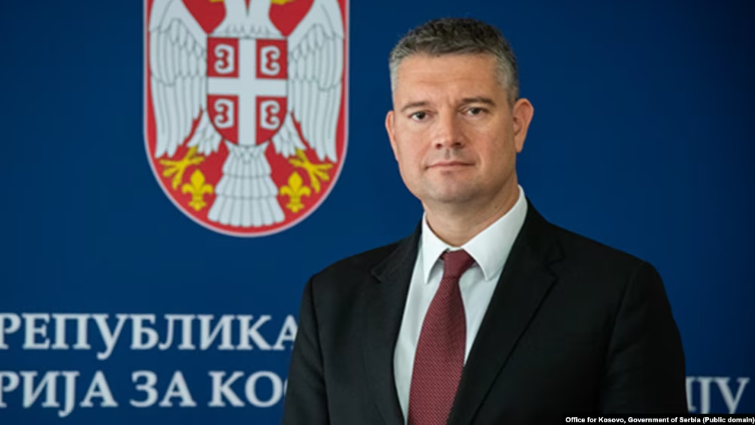
This is how Dušan Janjić from the Belgrade Forum for Ethnic Relations and Ehat Miftaraj from the Kosovo Justice Institute comment on the statement of Serbian official Igor Popović, who called the Kosovo Liberation Army a terrorist organization.
Popović was sent to detention for 30 days in Kosovo, for the criminal offense of “inciting hatred and intolerance”.
According to the Criminal Code of Kosovo, this offense is punishable by imprisonment of one to eight years.
The Director of the Office for Kosovo in the Government of Serbia, Petar Petkovic, said on July 21 that this was a “political decision” and that “there will be no continuation of the dialogue on the normalization of relations with Kosovo until Popovic is released.”
Janjic, speaking to Radio Free Europe, says it is a “senseless power game in Serbia.”
“Such an approach to the dialogue [with Kosovo], such an approach to reality, only shows that Serbia intentionally – I mean the Office for Kosovo – does not want to do its job… This is a misuse of the situation of Serbs in Kosovo, to remain in power in Serbia,” says Janjic.
Miftaraj shares the same view. According to him, Popovic was “very aware of his actions and the legal consequences it could have.”
“However, in this case, he made a self-sacrifice, as collateral damage to Serbian President Aleksandar Vučić, who uses [Director of the Office for Kosovo, Petar] Petković and other Serbian state officials, or even Kosovo Serbs themselves, as a means to divert attention from the current unrest and protests against his government throughout Serbia,” Miftaraj tells Radio Free Europe.
What did Popovic say and where?
The Assistant Director of the Office for Kosovo in the Government of Serbia, Igor Popović, stayed in Hoqë e Madhe on July 18, to mark the anniversary of the murder of several Serbs in the territory of the municipality of Rahovec, and in his speech he called the Kosovo Liberation Army a terrorist organization.
“Our brothers [Kosovo Serbs] have suffered because the KLA terrorists did not want Serbs in these lands, and by executing them, they wanted to scare other Serbian residents into leaving this country. It is also painful that the terrorists and organizers, the perpetrators of the crime, have not been found and punished all these years, even though we see that the entire Gaza Strip is being destroyed for a similar crime of kidnapping Israeli civilians,” Popovic said.
Because of these words, he was stopped at the border crossing in Jarinje and, later, sentenced to one month’s detention, under Article 141 of the Criminal Code for inciting hatred and intolerance.
For the criminal offense of inciting hatred, discord and intolerance between national, racial, religious, ethnic or other groups, in a manner that may endanger public order, the punishment may be a fine or up to five years of imprisonment.
Anyone who systematically or by abusing their position or authority commits this criminal offense is subject to a prison sentence of one to eight years.
Lawyer Lubomir Pantovic said earlier that he will appeal to the Court of Appeals against the decision to order detention for Popovic.
Agreement on mutual visits
In 2014, Kosovo and Serbia reached an agreement on mutual visits of officials, within the framework of the dialogue for the normalization of relations.
However, the parties often ignore it, banning visits by officials and accusing them of not following the procedures stipulated in the agreement.
The agreement stipulates that the parties must inform each other, through liaison officers, of visits by their first and second category officials.
The first category includes the president, the prime minister, the deputy prime ministers, the speaker of the parliament, and the ministers of interior, foreign affairs, and defense.
The second includes all other ministers, deputy speakers of the Assembly, directors of government offices and security agencies, presidents of the Constitutional Court and the Supreme Court, the public prosecutor, as well as all other persons who have physical security, such as religious leaders.
The Director of the Office for Kosovo in the Government of Serbia, Petar Petkovic, has been banned from visiting Kosovo several times due to, as it has been said, “provocative statements.”
However, his deputies and assistants have consistently stayed in Serb-majority areas in Kosovo.
“A specific vocabulary of words”
Janjic says that the current authorities in Serbia have a “certain vocabulary,” but that they cannot annul international documents.
“There is the Kumanovo Agreement, in which the demilitarization and transformation of the KLA, not as a terrorist organization, is clearly defined. Politicians in Serbia misuse the opportunities in Kosovo and during their rare visits there spread new rhetoric,” says Janjic.
He emphasizes that since the late 1970s, Western countries have supported changes in the organization of the KLA, no longer considering it as a terrorist organization, but as a political-military force that fought for liberation from Serbian forces.
Janjic also says that Popovic’s statement was “unwise”, especially because of the trials against former KLA members.
The Kosovo Specialist Chambers in The Hague are investigating war crimes allegedly committed by members of the KLA against ethnic minorities and political rivals from January 1998 to December 2000.
“Such a statement is devastating, especially when there are unfinished judicial processes for war crimes committed by the Serbian army and paramilitaries. This arrogance and this primitivism of the new discourse, which is being promoted in Serbia, cannot erase the facts. On the contrary, they contribute to the political propaganda that Serbs cannot integrate,” says Janjic.
“Instead of messages of peace, language of hate”
Miftaraj emphasizes that current laws in Kosovo, but also in other democratic societies, do not allow hate speech.
“Igor Popovic, instead of using his visit to promote peace and harmony among the Serbian population in Kosovo, misused it, using hate speech and sending political messages, which further contribute to division and the deterioration of ethnic relations in Kosovo,” says Miftaraj.
He believes that all actions of the Office for Kosovo are well organized and orchestrated by the Serbian President, Aleksandar Vučić, and the Serbian Government.
In 2022, Ivan Todosijevic, a Serbian List official, was sentenced to one year in prison for “inciting hatred and intolerance.”
His statement was related to the Recak massacre, which he described as a “fiction”.
But, in July 2023, the Supreme Court of Kosovo acquitted him of all charges, finding that the opinion expressed did not constitute a criminal offense, regardless of the event that had occurred.
Reactions from Kosovo and Serbia
Following Popović’s arrest, Kosovo’s acting Minister of Internal Affairs, Xhelal Sveçla, said that Kosovo will not tolerate the insult and desecration of history, much less the war waged by the KLA.
Then came the reactions of the director of the Office for Kosovo in the Government of Serbia, Petar Petkovic, the Serbian Foreign Minister, Marko Djuric, and other officials, who assessed that Popovic’s statement “held accountable those who committed crimes” and called for his immediate release.
Serbian President Vučić said that official Belgrade has informed all partners about Popović’s arrest, adding that this event “could have unpredictable consequences.”
“The arrest of Igor Popovic shows that [acting Kosovo Prime Minister] Albin Kurti has lost his mind and wants to provoke incidents and conflicts in the Western Balkans,” Vučić said during a guest appearance on Belgrade’s Pink Television.
Kurti said that he sees this statement by the Serbian president as a threat, because it comes from the supreme commander of a state’s army.
“With conflict-inciting tones, [the statement] can no longer be considered as an individual stance, but as state policy,” Kurti said in a press conference.
Serbian List calls on the international community to react
Serbian List official Dallibor Jevtic called on the international community on July 23 to react to the arrest of Igor Popovic, who, as he said, demanded “accountability and justice.”
“I call on representatives of the international community to react and for Popovic to be released and reunited with his family as soon as possible. I think this is important to say today, because, I repeat, someone wants to stop us from talking [about crimes against Serbs]. In addition to denying us justice, they also deny us the opportunity to hold accountable those who commit crimes,” Jevtic said on the 26th anniversary of the crime in Gracka i Vjetër, near Lipjan, where 14 Serb civilians were killed.
Jevtic also expressed regret that representatives of the international community did not attend the memorial service, because, as he said, “they promised to bring the perpetrators of this crime to justice.”
In October 2007, UNMIK police arrested Mazllum Bytyqi on suspicion of participating in the killing of civilians in Grackë i Vjetër, but he was released from detention two months later due to lack of evidence.
The investigation into this crime was subsequently suspended in 2017, but the EU Rule of Law Mission in Kosovo (EULEX) said it could be reopened if new evidence emerges.
During the 1998/99 war in Kosovo, around 13.000 people, mostly Albanians, were killed, while around 1.600 people still remain missing.
On July 21, the High Public Prosecutor’s Office in Belgrade asked the Criminal Police Directorate (UKP) and the Security and Information Agency (BIA) of Serbia to collect the information necessary for the “identification of the persons” who arrested Popović, in order to “verify the essential elements of the criminal offense: kidnapping.” /REL/