
By Sasa Dragojlo
Even after Russia publicly accused it of betrayal, Serbia approved the transit through its territory of almost 1,000 artillery shells from Bosnia on behalf of a Czech company tasked with keeping Ukraine’s army supplied with ammunition.
On June 12 this year, Serbia’s interior ministry signed off on the transit of 132 pallets of goods from Bosnia and Herzegovina, clearing their entrance via a small border crossing in the village of Sremska Raca, near the Sava river.
According to official documents obtained by BIRN, the pallets were to be stacked with 155-millimetre artillery rounds, 960 of them in total; the trucks were due to head north and enter Hungary at the Horgos border crossing.
The shipment was ordered by a Czech defence and aerospace company called Omnipol a.s, one of five firms reportedly selected by the Czech state to supply artillery rounds to the Ukrainian army; according to media reports, 155mm rounds are the most sought after by Ukraine as its fight against Russian invading forces rumbles on.
The route the trucks were due to take, however, is increasingly sensitive.
In late May, Russia’s Foreign Intelligence Service, SVR, had slammed Serbia for indirectly funnelling Serbian-made ammunition to Ukraine, accusing Serbian manufacturers “and their patrons” of seeking to “profit from the blood of fraternal Slavic peoples”.
The SVR statement marked an extraordinary public rebuke of Serbian President Aleksandar Vucic, who, in public at least, has declined to take a side in the conflict.
Though stressing he supports Ukraine’s territorial integrity, Vucic has refused to align with Western sanctions on Russia, knowing that to do so would risk alienating his most ardent nationalist supporters.
But behind the scenes, Serbian artillery shells and bullets have been finding a way to Kyiv, via intermediaries and ‘end-user’ certificates that list the ultimate destination elsewhere. Vucic admitted as much in an interview with the Financial Times in June last year.
Now, BIRN can reveal that Serbia is also allowing ammunition manufactured elsewhere to transit its territory en route to states and companies known to be supplying the Ukrainian army, further undermining Vucic’s claim of an unbreakable bond with Moscow at a time of unprecedented protests against his 13-year rule.
The transit represents one small link in a sprawling chain that has kept Ukraine supplied with artillery rounds and bullets, in this case from a majority state-owned factory in Bosnia with an influential American minority partner to a Prague-based firm on the frontline of a Czech-led initiative to support Ukraine’s defence.

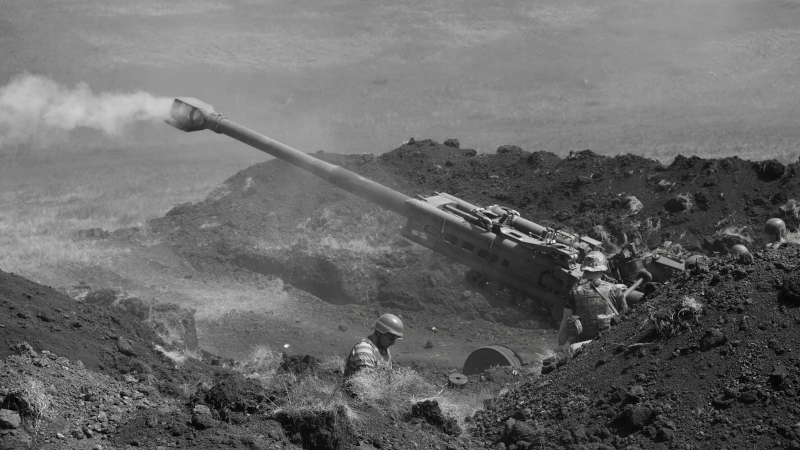
Serbia approved the transit through its territory of almost 1,000 artillery shells from Bosnia on behalf of a Czech company tasked with keeping Ukraine’s army supplied with ammunition. Illustration: Igor Vujcic
“Public evidence of Serbia enabling ammunition to reach Ukraine and Russia’s warnings are not good when it comes to preserving the image of himself that Vucic spent years creating in the country,” said Vuk Vuksanovic, a senior researcher at the Belgrade Centre for Security Policy, BCBP.
Balancing act
That Serbia has been helping supply the Ukrainian war effort has long been a public secret: in February 2023, a year into Russia’s full-scale invasion, Russian media outlet Mash reported on the use of Serbian-made 122mm Grad rockets by the Ukrainian army; weeks later, Reuters reported on a leaked classified Pentagon document – the authenticity of which it could not independently verify – showing Serbia had agreed to supply arms to Kyiv or had sent them already; then in June last year, the FT revealed that since 2022, Serbian manufacturers had exported roughly 800 million euros worth of ammunition to Western nations, which subsequently ended up in Ukraine through third countries.
Breaking with a longstanding policy of official denial, Vucic told the FT: “We cannot export to Ukraine or to Russia… but we have had many contracts with Americans, Spaniards, Czechs, others. What they do with that in the end is their job. (…) Even if I know [where the ammunition ends up], that’s not my job.”
That all changed on June 23 this year, when Vucic announced a halt to all weapons and ammunition exports.
Some saw it as a response to international outcry over Israel’s military operations in Gaza, which have relied on significant Serbian arms supplies. But the announcement came the same day as a second bombshell statement from Russia’s SVR, in which it said traditional bonds between Serbia and Russia were being “undermined by greed and cowardly multi-vector opportunism”, by Serbian arms manufacturers well aware “rockets and shells will be used to kill Russian soldiers and civilians in Russian settlements”.
Unimpressed by Serbia’s backdoor alignment with the United States and EU, Vuksanovic said Russia had decided to strike while Vucic was down, forced against the ropes by student-led protesters who are demanding snap elections.
“The Russians saw that Vucic was opening up too much to Trump’s administration,” he told BIRN. “They see that he is also wounded by domestic issues, so they could use it to embarrass him in front of his voters and thus reduce the shipments to Ukraine.”
Russia’s first angry missive to Serbia, however, did not prevent Belgrade from approving the transit of ammunition made elsewhere to Ukraine’s allies.
On June 12, some two weeks after Russia’s first warning, Serbia’s interior ministry followed the ministries of defence and foreign affairs in giving the green light to the transit of 960 Bosnian-made HE M107 artillery rounds, according to the final approval papers seen by BIRN.
Permission was given for a period between June 12 and July 11, via the Sremska Raca border crossing and along the E70 and E-75 highways north to Hungary.
The documents specify the ‘end-user’ – the ultimate user of the product – as the Czech defence ministry, a leading supplier of arms and ammunition to Ukraine.
From Bosnia, through Serbia
According to the documents seen by BIRN, the artillery rounds were sold by a company called Podin d.o.o., based in the small town of Grude, southwestern Bosnia.
Podin d.o.o. is registered as dealing in real estate, but it also holds a licence for the export of military equipment.
Arms experts say a single 155mm HE M107 artillery round costs between 2,000 and 3,500 euros, providing the buyer is willing to wait.
“If you want it immediately, the price can go up to between five and eight thousand euros,” Sarajevo-based defence technology expert Berko Zecevic told BIRN.
The identity of the manufacturer remains unclear, as does the reason why a small-town firm registered primarily as dealing in real estate acted as intermediary.
The transit documents obtained by BIRN specify only that the contents of the shipment are produced by “Bosnia and Herzegovina”.
If not coming from Bosnian stockpiles, arms industry sources say the most likely manufacturer is Pretis, a factory originally founded when Bosnia was part of socialist Yugoslavia and the only Bosnian producer of 155mm shells as a complete product rather than just parts of it.
Pretis is based in Vogosca, a suburb of the Bosnian capital, Sarajevo, just 1.5 kilometres from Bucan transport d.o.o., one of the transport companies listed in the transit documents as carrying the artillery rounds through Serbia.
According to Bosnian media outlet Klix.ba, the Czech Republic imported more than 30,000 artillery shells from Pretis. Though Pretis is majority-owned by the Bosnian state, US arms firm Regulus Global, which has procured arms and ammunition for Ukraine and previously Syria, holds a 41.5 per cent stake through an offshore company and recently proposed a $100 million upgrade of the company.
Regulus also owns 25.7 per cent of shares in another Bosnian arms manufacturer called Binas d.d, with Regulus CEO Joe Wallis telling Al Jazeera Balkans in July: “We see the chance to build something that serves both the European defence needs and also helps economic growth in Bosnia and Herzegovina.”
With Russia’s war in Ukraine, Wallis said artillery “is back in the centre” of modern warfare.
“And with Russia firing so many rounds, thousands of rounds a day, that puts pretty enormous pressure on the western stockpiles and also exposes the real vulnerabilities in the supply chain,” he told AJB.
Regulus says it has delivered “more than 100,000” 155mm artillery shells to Ukraine, though it is embroiled in a court dispute in London over a $1.7 billion contract to sell such shells to the Ukrainian government, the FT reported in May.
Neither Podin nor Pretis responded to requests for comment.
Czech-led ammo push
Like Serbia, Bosnia does not export arms or ammunition directly to Ukraine, due to opposition from Bosnian Serbs under pro-Russian strongman Milorad Dodik, president of the predominantly Serb-populated Republika Srpska entity.
Instead, Bosnian-made ammunition is sold to NATO countries, in particular the Czech Republic, which has spearheaded the Czech ammunition initiative for Ukraine, launched in February 2024 as a coalition of states committed to keeping Ukraine supplied with ammo in response to a slowdown in supplies of US military aid.
According to Biznis.info, Bosnia’s defence sector exports soared in the first quarter of this year, with the Czech Republic the biggest buyer after the United States.
Under the artillery initiative, Omnipol was reportedly one of five Czech companies granted exclusive rights to broker ammunition contracts, though critics have questioned the transparency of the project amid reports that some of the firms have ties to government officials and are charging commission fees far higher than those of Ukrainian state arms brokers.
Nevertheless, Czech President Petr Pavel announced in February this year that the Prague-led initiative had delivered 1.6 million shells to Ukraine.
Zecevic said Bosnia could hardly be blamed for the fact its ammunition was ending up in Ukraine despite an ‘end-user’ certificate listing the Czech defence ministry as the ultimate destination.
“These kinds of deals are coordinated by the European part of NATO,” Zecevic told BIRN.
“If there is a diversion it is not according to rules and it has nothing to do with Bosnia and Herzegovina. (…) It’s a fact that the rules built for four decades have fallen apart [in the last few years].”