
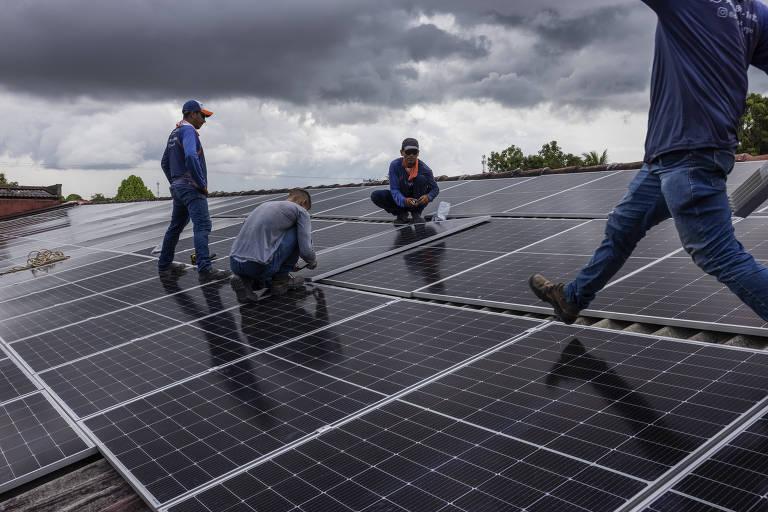
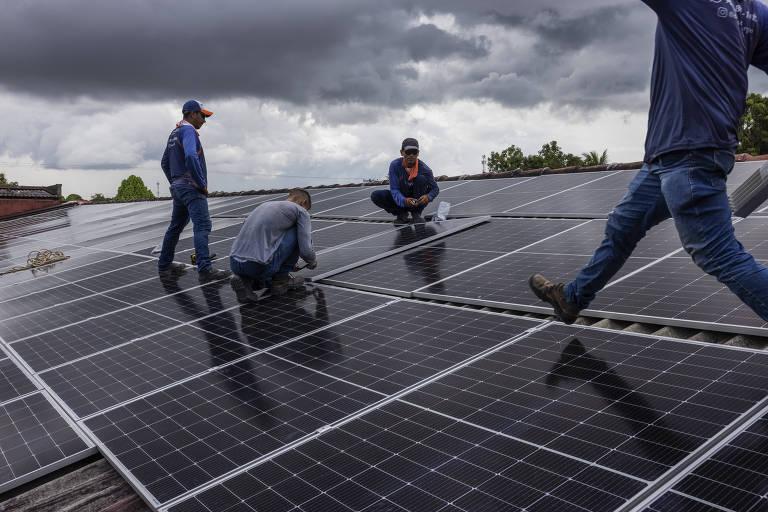
The reform of Brazil’s power sector could have significant impacts on solar energy projects in the country, according to lawyers consulted by BNamericas.
Established through provisional measure (MP) 1,300, which is currently under review in congress, the reform will particularly affect self-generation – a model widely used by energy-intensive industries, mostly relying on solar power.
Vitor Sarmento de Mello, partner at Rolim Goulart Cardoso Advogados, and Fabio Di Lallo, partner at Veirano Advogados, explained what is at stake in the proposed legislation.
Mello
“The most affected model under the MP is self-generation by equivalence, where a large consumer establishes a corporate partnership, becoming a shareholder in a generation project and thus gaining the right to a portion of the energy proportional to their voting shares.
“The MP impacts this type of arrangement for two reasons. First, because it begins to require – 60 days after the MP was published [a period that ended July 20] – that consumers must have an aggregated load of at least 30MW, compared to the previous requirement of just 3MW. Additionally, the participation in the share capital of the generation company must be at least 30%. So, in a way, this restricts the opportunities for solar projects to allocate energy through self-generation schemes.
“Moreover, new self-generation arrangements may only be implemented with generation projects that begin commercial operations after the MP’s publication date, which was in May. In other words, only new projects qualify. Those projects that were already in operation before the publication of the MP will no longer be allowed to allocate their energy to self-generation arrangements.
“The third point in the MP that affects solar generation projects, among other energy sources, is the provision that ends the discount on the rate for use of transmission and distribution systems for consumers starting January 1, 2026. This impacts the financial structure of the projects. The MP states that, in order to continue benefiting from the discount, contracts must be registered with the CCEE [electric power trading chamber] by December 31, 2025. These contracts often have terms of 10 to 15 years, and the market practice has not been to register the entire term or amount of the contract, but only the validity period of the guarantees provided by the buyers. These guarantees are generally six months to one year at most. Once a contract is registered and the counterparty validates it at the CCEE, it obliges delivery for the entire period in question. This is a major concern for generation ventures.
“There’s great uncertainty in the market. No one knows the outcome of the MP’s progress, whether it will be approved, or whether the full text will pass. There is an expectation that it will be modified, especially due to the large number of amendments [in the text] and the market impact caused by these changes. But no one knows exactly what the final text will be or if the MP will expire without becoming law by the end of its 120-day term [which ends in September].”
Di Lallo
“MP 1,300 aims to offset the increase in electricity bills due to the expansion of the social power rate [for low-income consumers] by targeting the benefits of self-generation and the discount on grid usage for renewables.
“In self-generation, the MP restricted equivalence-based self-generation projects to electro-intensive consumers that have an aggregated demand equal to or greater than 30MW and contribute at least 30% of the share capital in the generation company holding the concession. This means that access to this type of project has become much more limited, since the financial contribution required from the consumer to the generation company is now much higher, whereas the previous framework was more flexible.
“Furthermore, the MP limited new self-generation arrangements to greenfield projects after a 60-day period from the publication of MP 1,300. From now on, existing projects can no longer benefit from self-generation schemes.
“As for the discount on the rates for the use of transmission and distribution systems for renewable energy projects, the MP seeks to eliminate this benefit on the consumption side for contracts not registered with the CCEE by December 31, 2025. This provision is being heavily contested, given that the benefit was granted by law to projects aimed at expanding the renewable matrix. Therefore, the MP should not be able to revoke a right that was granted to these projects through a concession for a specific term. If the senate does not amend the MP in this regard, the trend will be toward legal challenges.”