

A meeting hosted by Davis Mayor Al Tomson (not pictured) kicks off at the Davis Volunteer Fire Hall in Tucker County on April 13, 2025. The meeting was held to discuss an air-quality permit application submitted by Fundamental Data LLC for a facility in the county.
Fifteen-year Tucker County resident Sheena Williams told the West Virginia Department of Environmental Protection her child has asthma.
Williams said she feared an expected data center facility for which the DEP has signaled it will approve an air quality permit despite facility plans to potentially emit hundreds of tons of air pollutants annually.
“We are scared,” Williams said. “We need your help.”
Williams was one of several dozen speakers who urged the DEP to reconsider its preliminary determination to approve an air quality permit for Purcellville, Virginia-based Fundamental Data LLC’s proposed gas turbine-fueled facility in Tucker County at a July 17 virtual public comment hearing on the permit request.
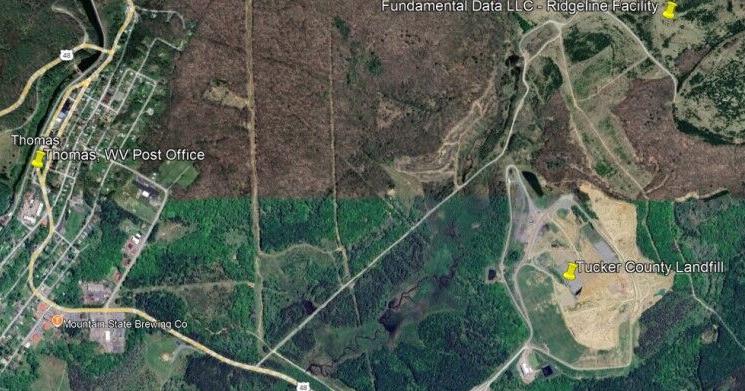
Fundamental Data’s permit application doesn’t include a data center, and the company hasn’t been definitive regarding the end use of its power, a nondisclosure the DEP says isn’t a cause to deny the permit. But despite significant redactions in the permit application the DEP has drawn Tucker County residents’ ire by accepting, enough planned facility details have been revealed to suggest it would be a large-scale data center site with vast diesel tank storage and a substantial increase in local air pollution.
And Tucker County isn’t the only front on which community advocates fear data center development.
The DEP this month invited public comment on two virtually identical proposed air quality permits for New York City-based TransGas Development Systems LLC to build neighboring gas-powered facilities for data center campus operations in Mingo County.
The proposed TransGas facilities would have the potential to emit hundreds of air pollutants, and the applications indicate there would be onsite haul road activities and equipment leaks.
The West Virginia Citizen Action Group, a progressive advocacy organization, has called for the DEP to hold public hearings covering both planned facilities.
Similar concerns have been triggered by Houston-headquartered Fidelis New Energy LLC’s plan for a 2,000-plus-acre data center campus in Mason County. In 2023, the West Virginia Economic Development Authority approved a forgivable $62.5 million loan for Mountaineer GigaSystem LLC, a Fidelis subsidiary.
Fundamental Data and TransGas representatives have not responded to requests for comment.
Large-scale data center development is still new to West Virginia, but it’s commonplace elsewhere in the United States. Northern Virginia is home to the world’s largest data center market. Several hundred data centers dot Loudoun, Fairfax and Prince William counties.
That development has been costly to Virginia ratepayers, whose bill burdens don’t appear to be going anywhere.
A typical Dominion Energy residential customer could see an increase in generation- and transmission-related costs of an estimated $14 to $37 monthly by 2040, according to a December 2024 Virginia state legislative staff report.
Large data centers can consume enough energy to power 80,000 households. They can consume 3-5 million gallons of water per day — roughly 5-8% of the total amount withdrawn for public water supply throughout West Virginia in 2023, according to DEP data.
The Trump administration stoked environmental and economic fears about data centers Wednesday by releasing an action plan for AI — artificial intelligence — that gives broad blessings to the tech industry, aiming to expedite AI growth instead of focusing on environmental health and model safety risks.
West Virginians already have experienced one of the country’s sharpest rises in electricity prices in recent years, which energy experts say has been driven by the state’s nation-highest dependence on increasingly uneconomic coal-fired power.
The carbon intensity of West Virginia’s economy — metric tons of energy-related carbon dioxide per dollars of gross domestic product — also has been one of the nation’s highest, pointing to a reliance on pollution-heavy industry that has saddled economically challenged communities with air quality worries.
“As we continue to see these data center proposals built out, that increase in electricity costs [is] just going to continue to go up, and West Virginians are going to continue to bear that brunt of the cost in their pocketbooks and in their health,” Morgan King, climate and energy manager at West Virginia Citizens Action Group, said at a virtual AI-focused roundtable discussion hosted by Sen. Ed Markey, D-Mass., Wednesday.
Not a ‘minor source’ to residents
Speaking on behalf of the West Virginia Highlands Conservancy and the Friends of the 500th, a Canaan Valley National Wildlife Refuge-supporting nonprofit, Marilyn Schoenfeld urged the DEP to make Fundamental Data reclassify its facility as a “major source” for permitting at the DEP’s hearing on the company’s site proposal.
Because Fundamental Data hasn’t reported the proposed facility as having the potential to emit more than 100 tons per year of any regulated pollutant, it’s not defined as a major stationary source. Instead, Fundamental Data has proposed the facility be permitted as a “synthetic minor facility,” a designation that includes limits on capacity to remain below major source thresholds.
But the proposed facility comes close to the 100-ton annual threshold with the potential to emit 99.35 tons per year of nitrogen oxides, which can harm the human respiratory system and contribute to acid rain.
“To treat this permit as a synthetic minor designation is totally inappropriate for a project of this size,” Schoenfeld said.
The U.S. Environmental Protection Agency Office of Inspector General found in 2021 that facilities may emit excess pollution that would otherwise subject them to more stringent federal major-source permitting requirements without clear and enforceable limits in synthetic-minor source permits.
The EPA watchdog found that, in 16 gas extraction industry synthetic-minor source permits from Colorado and Oklahoma, 102 of 529 permit limits didn’t have enough information in permitting documentation to determine whether the limits were technically accurate.
Tucker County residents have contended the Canaan Valley’s proneness to temperature inversions would make it especially susceptible to adverse air quality impacts from Fundamental Data’s planned operations. Temperature inversions occur when cold air builds up in a valley.
The Canaan Valley has had long-term summer temperatures similar to those found in northern New England and a shorter growing season than that of Fairbanks, Alaska, according to a study published in the peer-reviewed Southeastern Naturalist journal in 2015 that drew from climate data spanning 1944 to 2002.
But the DEP has declined to agree to conduct air dispersion modeling for the proposed project. Because the proposed facility isn’t subject to a state rule governing major stationary air pollution sources, air dispersion modeling isn’t required.
“It’s not just a label,” Tucker Countian Amy Margolies said of major-source classification at the DEP hearing. “It is a critical safeguard for public health.”
Mingo County permits sought for off-grid sites
The DEP has preliminarily determined that TransGas’ applications for air quality permits for its Mingo County data center facilities comply with state and federal regulations.
The West Virginia Department of Environmental Protection is taking comment on two permit applications from New York City-based TransGas Development Systems LLC for proposed off-grid power generation facilities near Holden and Wharncliffe in Mingo County.
The DEP has made preliminary determinations to issue the permits. Written comments or requests for a public meeting must be received by the DEP’s Division of Air Quality by 5 p.m. on Aug. 8. A public meeting may be held at the Division of Air Quality director’s discretion.
Comments may be submitted to:
Jerry Williams, P.E.
WV Department of Environmental Protection
Division of Air Quality
601 57th Street, SE
Charleston, WV 25304
304-926-0499, Ext. 41214
Draft permits and engineering evaluations are available at bit.ly/NSRPermitApplications.
The proposals are for planned off-grid power generation facilities to be located near Holden and Wharncliffe in rural Mingo County, respectively.
Each application indicates a maximum installed power output of 2,457 megawatts and a continuously delivered power output of 1,796 megawatts, making them some of the state’s highest-wattage operations.
Each application warns of potential emissions from truck loading of 40 170,000-gallon diesel storage tanks.
The applications for each facility report they potentially could annually emit up to 206 tons per year of carbon monoxide and 194 tons per year of nitrogen oxides, which can contribute to respiratory malfunction and acid rain.
Because the facilities don’t have the potential to emit any regulated pollutant above 250 tons per year, they’re not defined as major sources or governed accordingly, according to the DEP.
The DEP said in engineering evaluations of the TransGas permit applications that the agency’s determinations don’t consider “substantive non-air quality issues” like job creation, economic viability, strategic energy issues, non-air quality environmental impacts and nuisance issues.
How HB 2014 could limit local data center tax revenue
House Bill 2014, which Morrisey has held up as the economic development highlight of the West Virginia Legislature’s 2025 regular legislative session, is designed to ease in-state data center development in part by prohibiting counties and municipalities from enforcing or adopting regulations that limit creation, development or operation of any certified microgrid district or high-impact data center project.
HB 2014 includes a provision requiring that costs from electrical service to a microgrid district be absorbed by the generator or electricity consumers within that district rather than other electric utility customers.
But Appalachian Power regulatory and finance vice president John Scalzo predicted in testimony before the House of Delegates Energy and Public Works Committee during HB 2014’s advancement the legislation wouldn’t ensure against increased rates as intended.
Appalachian Power has said opening up business districts to nonrenewable energy as HB 2014 does could raise customer bills if independent power producers taking advantage of it need backup service from the utility since nonrenewable backup needs dwarf those of renewables.
HB 2014 claws property tax proceeds away from local governments, leaving just 30% of those proceeds to the county or counties where a data center is located and another 10% to all counties on a per capita basis.
A hypothetical high-impact data center investment of $2 billion in Tucker County would yield only $4.64 million in tax revenue for local entities under HB 2014 as opposed to $15.5 million prior to its passage, according to an analysis published last week by the West Virginia Center on Budget and Policy, a progressive think tank.
The analysis predicts HB 2014 could unintentionally incentivize school districts to enact excess levies to try to capture some benefit from data centers locating in their district.
White House AI plan relies on gutted agencies
The Trump administration’s AI Action Plan released Wednesday recommends withholding AI-related funding from states the federal government doesn’t find sufficiently inviting to AI developers.
The plan calls for requiring the federal government to consider a state’s AI regulatory climate when making funding decisions and limit funding if the state’s AI “regulatory regimes” could hinder the effectiveness of that funding.
“A serious AI plan would recognize that the regulation to which this administration is so hostile facilitates innovation — it can help us ensure that we have AI for social good, rather than just corporate profit,” Robert Weissman, copresident of Public Citizen, a consumer rights advocacy group, said in a statement criticizing the plan.
The Trump administration plan calls for relying on federal agencies it has downsized significantly through staff and funding cuts.
Employees at the National Science Foundation, one of those agencies on which the plan relies most, penned a dissent letter dated Monday condemning what they said have been unlawful terminations and threatened mass workforce reductions, coerced resignations, loss of expertise, and a proposed budget cut that would “[c]ripple American [s]cience.”
The letter was addressed to House of Representatives Science, Space and Technology Committee Democrats as an official whistleblower complaint to allow the committee to protect the 149 signers, which were redacted publicly or kept anonymous, from retaliation by the Trump administration, according to the committee’s top-ranking Democrat, Rep. Zoe Lofgren, D-Calif.
“Winning the AI race will usher in a new golden age of human flourishing, economic competitiveness, and national security for the American people,” the White House plan predicts.
Fear of being ‘railroaded’
But insecurity was a recurring complaint throughout the DEP’s Fundamental Data-focused hearing, at which the agency denied requests to extend the now lapsed comment period for that permit application.
It’s been a recurring complaint beyond the confines of that hearing, too.
“What will it take to see jobs and economic development that don’t threaten the integrity of our already stressed public health and environmental conditions?” Cannon wrote in his blog post.
West Virginia and federal leaders have laid groundwork for an environment enticing to data centers. But many West Virginians have found the environment that groundwork is setting up isn’t at all enticing to them.
“I’m concerned that … we are going to be railroaded by politicians and wealthy investors in data centers unfairly,” Barbara Weaner, a family nurse practitioner and 49-year Tucker County resident, said at the Fundamental Data permit application public comment hearing. “And I want the DEP to stick up for us.”