
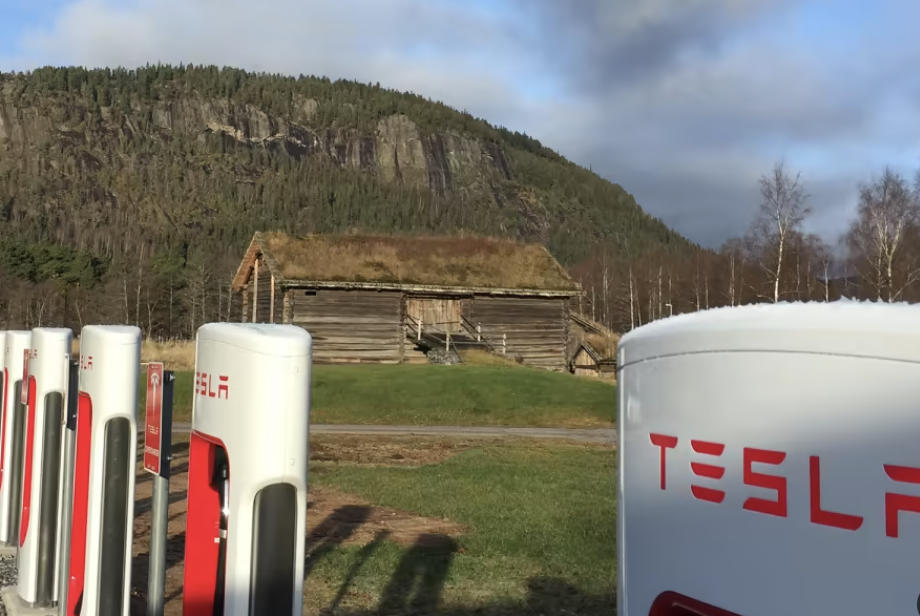
Norway is leading the charge in the global transition from petrol to electric vehicles with almost every new car sold in the country being electric.
Our World in Data reports that with 92% of all new cars sold now EVs hardly anyone in Norway buys a combustion engine car anymore.
The “EV capital of the world” has a political goal for the entire Norwegian car fleet to be emissions free (electric or hydrogen) by 2025.
However, Our World in Data notes that the data on new car sales does not show the distribution of cars on the road. There is a lag between sales and stocks, because people can hold on to their existing petrol and diesel cars for as much as a decade or more.
But after years of electric cars dominating the market, one-third of cars in use in Norway are now electric.
According to Visit Norway, the country has plenty of incentives in place – from subsidies, to cheaper parking, tolls and ferry tickets, and the right to use bus and taxi lanes on many roads.
Norway also has roughly 9,500 fast chargers all over the country.
Electric cars include battery-electric and plug-in hybrid vehicles. Our World in Data notes that the difference is that fully battery-electric cars do not have an internal combustion engine.
In contrast, plug-in hybrids have a rechargeable battery and electric motor, and an internal combustion engine that runs on petrol. That means a plug-in hybrid could be driven as a standard petrol car if the owner did not charge the battery.
Since plug-in hybrids will often run on petrol, they tend to emit more carbon than battery-electric cars. However, they do usually have lower emissions than petrol or diesel cars.
Write to Adam Orlando at Mining.com.au
Images: Our World in Data & Visit Norway