
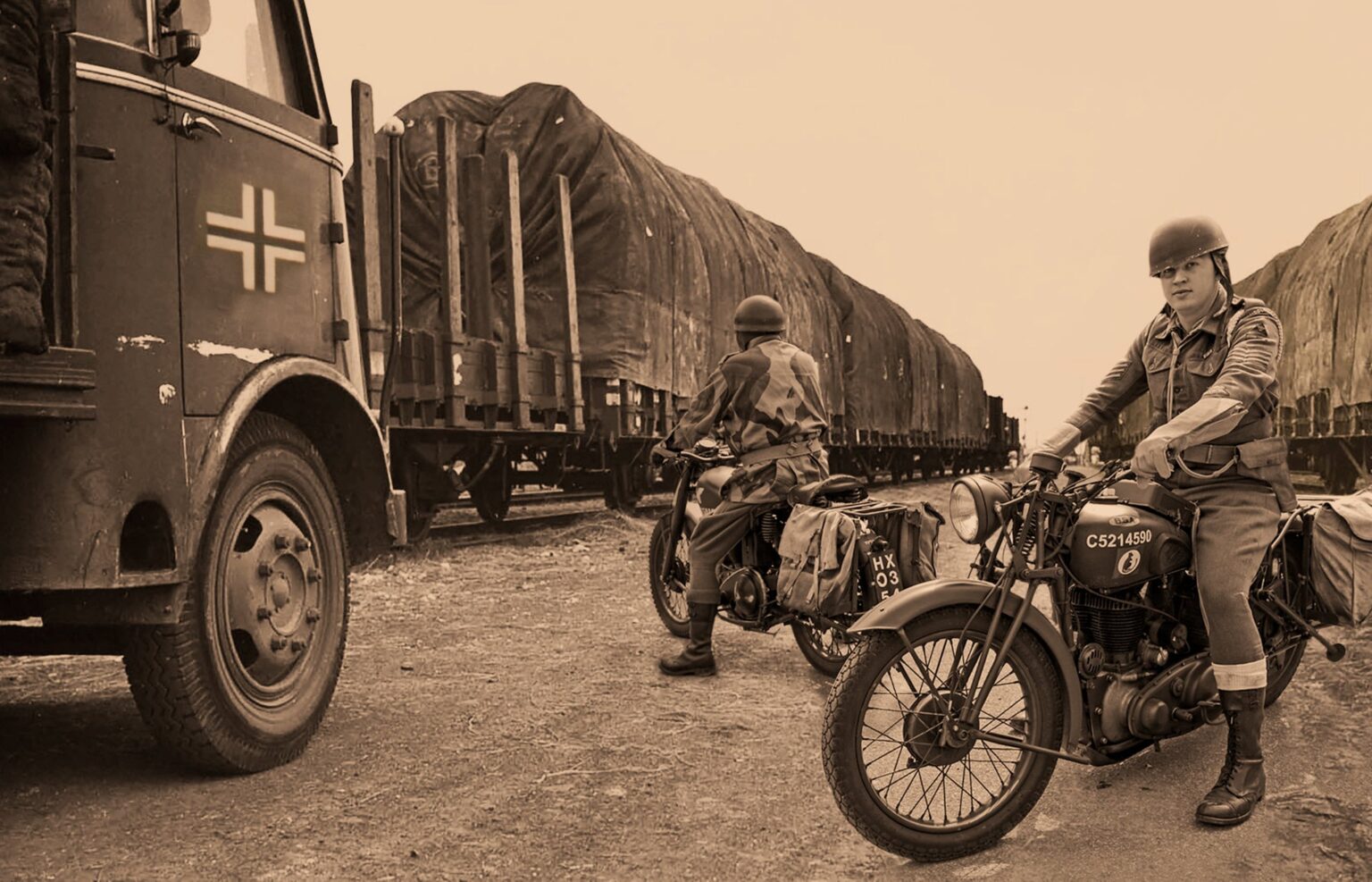
A team of treasure hunters in Poland received approval to begin excavations to look for a Nazi treasure in a former SS bunker. Credit: Jan Saudek – Public Domain via Flickr.
A team of treasure hunters in Poland has received official approval to begin excavations in search of a rumored Nazi treasure. After a decade of private investigation, the group is set to dig at a former SS training ground in the Kashubia region, where local legend claims a secret hoard may be buried—possibly even the long-lost Amber Room.
On July 1, Poland’s Pomeranian Provincial Conservator of Monuments granted permission to investigate a concealed bunker near the site of World War II–era SS barracks and a now-abandoned military training area.
According to engineer Jan Delingowski, a former merchant navy radio officer turned amateur historian, the treasure was transported west in 1945 from the Königsberg vaults (now Kaliningrad) but never made it to Berlin.
Prisoner initiated Nazi treasure search in Poland
Delingowski’s decade-long investigation was prompted by a former inmate at Barczewo prison, who claimed to have met Nazi war criminal Erich Koch there in the 1980s. Koch, the last Oberpräsident of East Prussia, was convicted in 1959 for atrocities that resulted in the deaths of some 400,000 Poles. He was never executed—reportedly because security services hoped to extract the treasure’s location from him.
“According to the prisoner’s account, Koch revealed that art, jewelry, and Nazi gold were loaded onto trucks bound for Berlin but were diverted near Czersk and Czluchow,” Delingowski said.
He added that Allied-era telegrams allegedly received by SS officer Gustav Wyst referred to a hidden cache marked only with the code “BSCH,” which Delingowski believes stands for Bruss Schutzraum—a type of slit bunker thought to lie beneath a hill overlooking a nearby lake.
The treasure, if discovered, could include priceless artworks, precious metals, and possibly even panels from the Amber Room—a legendary Baroque chamber looted from Tsarskoe Selo outside St. Petersburg. Dismantled by occupying Nazi forces in 1941, the Amber Room vanished without a trace, fueling decades of speculation involving sunken ships, hidden bunkers, and secret Alpine vaults.
Dr. Katarzyna Nowak, a historian at the University of Gdansk, urged caution. “There are many legends about hidden Nazi treasure in Poland and elsewhere. While these excavations are exciting, rigorous archaeological methods and peer-reviewed analysis will be crucial to distinguish fact from folklore,” she said.
Initial ground-penetrating radar surveys have identified subsurface anomalies consistent with a concealed bunker. Excavation is scheduled to begin later this month, under the supervision of the regional conservator’s office and in cooperation with qualified archaeologists.
Local officials are set to monitor excavations
Local officials say they will monitor the work closely to ensure the preservation of any wartime relics and the integrity of the site. “Our goal is to uncover the truth behind these stories while protecting this historic landscape,” said Anna Kowalska, a spokesperson for the Pomeranian conservator.
If the search yields artifacts, Poland’s cultural patrimony laws require that any discoveries be cataloged and preserved in state museums. The decades-long quest to rediscover the Amber Room and other lost treasures of World War II has long captured the public imagination—now, for the first time in this corner of northern Poland, the hunt has official sanction.