
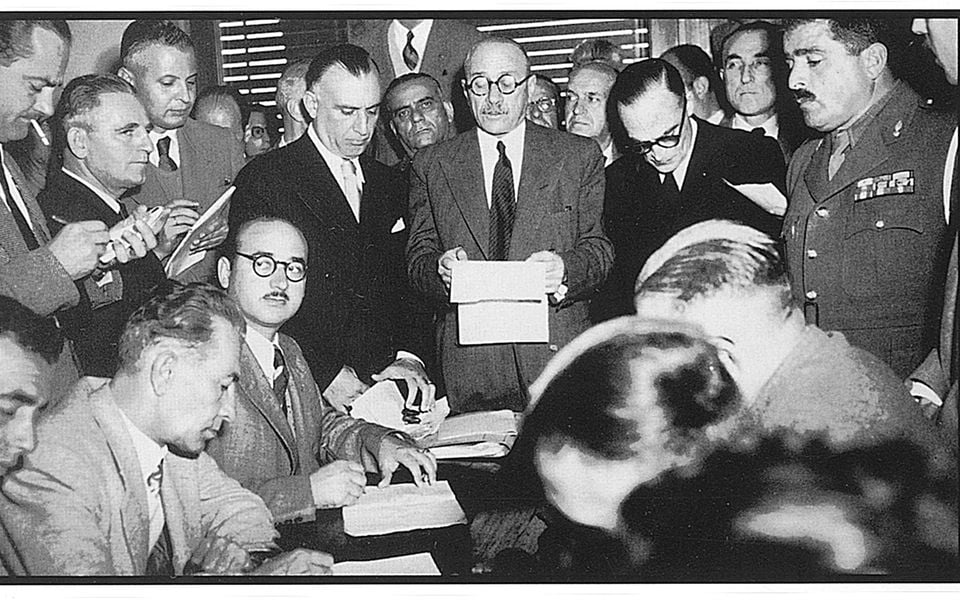
Public Order Minister Konstantinos Rentis (c), flanked by Justice Minister Georgios Melas (r) and US Consul-General Raleigh Gibson (l), reads an announcement attributing the murder of George Polk to communist agitators, on October 17, 1948. Grigoris Staktopoulos had already been in custody since August. [Michalis Tsangaris Collection]
Why does the murder of George Polk in civil war-era Thessaloniki continue to fascinate, decades later?
The answer is both indirect and simple: a foreign journalist – an American, no less, in the very year US aid to Greece was rapidly expanding – sets out to find one of the communist rebel leaders in the mountains of a country torn by civil war. At the same time, he uncovers evidence of irregularities in how the Greek government is managing American financial assistance. He is brutally murdered; his body is found floating in the Thermaic Gulf, hands and feet bound, a bullet lodged in his head. Who killed him? And why?
In a city crawling with informants, spies, gendarmes, and military officers – while battles rage in the surrounding hills – a Greek journalist, Grigoris Staktopoulos, is identified by the authorities as the prime suspect. The official narrative is straightforward: Communist agents killed the American reporter. Staktopoulos’ trial became a chapter of its own – effectively staged, riddled with inconsistencies and unanswered questions.
Another Greek journalist, Yannis Maris, who covered the case at the time, sensed something wasn’t right. Polk’s investigations had deeply unsettled the authorities – not least his attempt to secure an interview with the military leader of the insurgents.
It’s a story that could have easily come from the pages of a novel. Yet no definitive answers ever emerged. As explored in the book “Yannis Maris on the Polk Case / Yannis Maris: Who Killed Polk?” (Agra Publications) by Georgios A. Leontaritis, Staktopoulos spent many years in prison. In 1977, he sought a retrial, but his request was denied. He died without ever being vindicated.
Maris, of course, would later become a popular and influential crime novelist. He could have written the “Polk case” himself – but as Leontaritis notes, this time he lived inside the plot – and the conspiracy – of a real-life mystery, often at personal risk. We’ve seen how he was followed by Nikolaos Mouschoundis, then the powerful police chief of Thessaloniki.
Leontaritis’ new book, as the cliche goes, reads like a thriller. But more importantly, it illuminates just how bleak those years were for Greece. How dark and dangerous that era was – for nearly everyone.
It’s something we easily forget. Only 70 years ago, Greece was essentially a vast military camp without fences. Today, the mystery of political murders may seem intriguing. But, as has been said many times, for those who lived through it, history was not fascinating – it was unbearable.