
Serbia has once again been placed on the watchlist of countries experiencing a rapid deterioration in civil liberties by the CIVICUS Monitor, an online platform that tracks the latest developments concerning civil freedoms, including freedom of expression, association, and peaceful assembly, in 198 countries and territories.
This decision follows increased repression in response to mass student protests against government corruption, which have shaken the country since November 2024, after the deadly collapse of a railway station canopy, it was reported.
Civic space in countries is categorised into five levels: “closed”, “repressed”, “obstructed”, “narrowed”, and “open”, based on a methodology that combines multiple sources of data on freedoms of association, peaceful assembly, and expression.
Serbia has been assessed as having an “obstructed” civic space, indicating a moderate level of restriction. This classification applies to environments where the authorities interfere with the work of civil society organisations, demonstrators are subjected to excessive force, and independent media and editorial freedom are severely constrained.
A total of 37 countries received the same rating. Among Serbia’s neighbouring countries, Bosnia and Herzegovina, Greece, and Hungary have also been rated as obstructed.
Escalating threats
Serbia’s continued presence on the watchlist reflects growing threats to the rights to peaceful assembly, freedom of expression, and association, as the authorities resort to violence, surveillance, and politically motivated prosecutions to silence critical voices, the statement said.
The CIVICUS Monitor currently categorises Serbia as a country with an “obstructed civic space”, meaning that civil society operates but faces significant legal and practical obstacles.
“While demonstrators persist in their demands for accountability and systemic change, the government is attempting to crush the movement with a fresh wave of state violence,” said Ine Van Severen, Head of Civic Space Research at CIVICUS.
“Serbian authorities are actively punishing citizens who publicly voice their demands to their leaders,” she added.
Alongside Serbia, the latest watchlist also includes Kenya, El Salvador, Indonesia, Turkey, and the United States.
Mass protests met with violence and intimidation
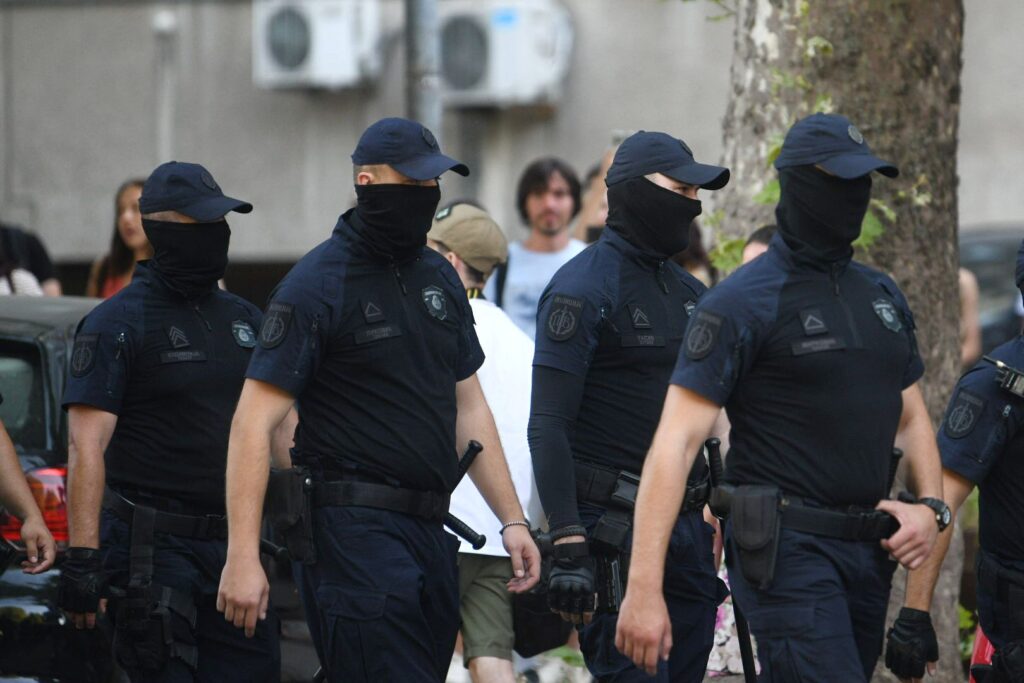
In an effort to suppress student protests, Serbian authorities launched a wave of violence involving police and groups linked to the ruling party, accompanied by mass arrests, surveillance, and intimidation, according to an assessment by the CIVICUS Monitor.
“Police repeatedly used tear gas and beat protesters, constituting an excessive use of force. In just the first week of July, more than 400 arrests were recorded. Reliable reports indicate instances of serious injuries and abuse during detention,” the report states.
Following a large protest on June 28, police violently dispersed the crowd and arrested 77 people, some of whom were denied medical assistance. In response, protesters launched acts of civil disobedience, setting up barricades and staging spontaneous demonstrations across the country, the report adds.
In March, pro-government counter-protesters, supported by city authorities and protected by police, set up camps around key institutions in Belgrade. These camps became hotspots of violence, with frequent clashes and attacks on journalists, CIVICUS Monitor recalls.
Protesters further accuse the police of unlawfully using a sonic weapon during the March 15 protest, attended by around 300,000 people. A moment of silence in honor of the victims was interrupted by a loud, disorienting sound that caused panic and a stampede. Civil society organizations demanded an investigation, which was supported by six UN Special Rapporteurs and a provisional measure by the European Court of Human Rights, the report notes.
Initially, police denied any involvement, but later admitted the presence of a specialized acoustic device for crowd control (Long Range Acoustic Device, LRAD), though they continued to deny its actual use.
Authorities justify violence
Senior government officials have supported and attempted to justify the violence against protesters, according to the CIVICUS Monitor.
“In July, Serbian President Aleksandar Vučić pardoned four men linked to his party who had brutally beaten a female student in Novi Sad – an attack that led to the Prime Minister’s resignation in January. Vučić also announced a pardon for a woman accused of attempted murder after she drove her car into a group of demonstrators, stating that more pardons would follow,” the report states.
Officials also exerted pressure on prosecutors and judges, accusing them of showing leniency towards protesters and undermining the independence of the judiciary, CIVICUS Monitor notes.
“Prior to major protests, state authorities intensified surveillance and the criminalisation of activists. In March, they secretly recorded a private meeting between opposition and civil society representatives without a warrant, and the footage was then broadcast on pro-government media. Police later arrested six participants from the meeting, charging them with attempting to overthrow the constitutional order, with prosecutors requesting the maximum sentence of five years, before they were placed under house arrest. A further six individuals currently abroad are awaiting trial in absentia,” the report continues.
New wiretaps
Just before the protest on 28 June, new wiretapped conversations were aired again, and eight student activists were arrested in front of university buildings. After the court rejected the request for their detention, the prosecution filed an appeal, the report states.
“The conduct of the security forces is deeply alarming. They protect those who attack demonstrators, use violence themselves, and wiretap activists without any legal basis,” said Uroš Jovanović, public policy programme manager at Civic Initiatives, as cited in the report.
“The violation of the right to freedom of assembly and expression does not serve the public interest – it only serves those who wish to cling to power.”
Intimidation and retaliation
Many citizens who support the protests have faced smear campaigns, dismissals, and threats. Foreign nationals have been expelled or threatened with deportation for expressing support for the demonstrators, while transport providers suspended services without explanation ahead of major gatherings, the report states.
In one case, severe police harassment of a private transport operator who was taking demonstrators to protests – including fines, sabotage, threats, and the violent arrest of his son – led the man to attempt self-immolation in front of the ruling party’s offices.
“We are witnessing the dismantling of civil liberties in Serbia in real time,” said Simona Mladenovska from the policy and advocacy programme at the Balkan Civil Society Development Network (BCSDN).
The report concludes: “We are raising the alarm once again and calling on the international community – particularly the EU – to move from words to action. We welcome growing awareness, but the response must match the scale of repression.”
(Vreme, 30.07.2025)
https://vreme.com/razno/srbija-pod-lupom-sve-veca-represija-i-gusenje-gradjanskih-sloboda/