
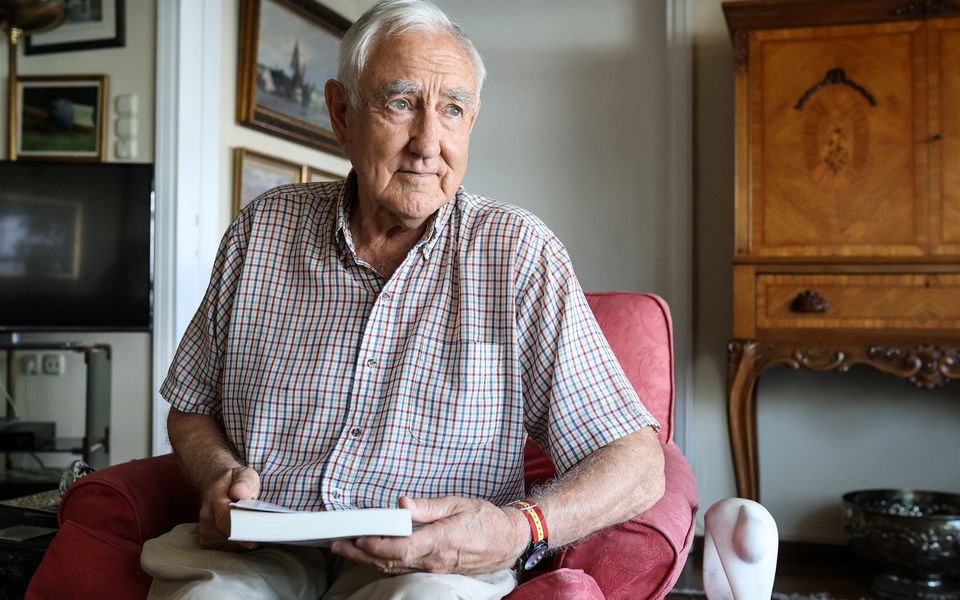
Richard L. Jackson is always gracious and, despite the heatwave, well dressed. We find ourselves, just a few days before his return to the USA, in his apartment in Kolonaki in downtown Athens, where he has resided for the last five years. He has ensured that there are cookies on the table, but his hospitality is not the only element in the room which alludes to Greece.
His bookcase is packed with books on Greece, from the polytomous work of British historian George Grote, “The History of Greece,” all the way to “Roumeli” by the British writer Patrick Leigh Fermor. Many of the paintings on his walls are by Greek artists and there is an evident inclination toward Spyros Vasiliou.
Collectively, the former American diplomat, thereafter president of two of the most highly esteemed private schools in the country – Anatolia College in Thessaloniki and Athens College – and finally author, Jackson lived in Greece for 23 years. Just before leaving his second homeland for his first, he spoke to Kathimerini about all those years. The best, as he says, of his life.
“Greece has been good to me,” he says, seated in his armchair. “In a way,” he continues, “it’s given me these three different careers.”
He recalls the first time he came to the country in 1972, employed as a diplomat in the American Consulate in Thessaloniki, and his most distinct memory during that period is associated with the military dictatorship and the opportunity he was given to witness firsthand the junta’s impact on the country.
“I became a member of the Rotary Club to try to improve my Greek. I was very struck by how little criticism I remember around those tables about the junta. Why? Because, the economy wasn’t doing that badly. They had stability. I mean, you’re talking about people that were importing things or medical equipment, and they could continue to do business,” he explains.
However, he underlines that he had met some people who criticized the dictators.
He remembers driving during that period in the area of Halkidiki in northern Greece and being stopped by a man who was trying to get to the hospital.
“His son had been in a life-threatening automobile accident. The man was just so outraged that all the money that’s supposed to go to the hospitals was going to the dictators. But you wouldn’t encounter many critics. For others it was the first time had electricity or cemented roads,” he says.
Toward the end of his tenure in Thessaloniki there were so many demonstrations in front of the consulate that he and his family had to relocate to the American Farm School, the president of which was a compatriot, Bruce Lansdale.
“I have come to believe that people like him, or like Bill McGrew [the former president of Anatolia College in Thessaloniki], that are here for the long run – 30, 40 years – are responsible for stitching the network between Greeks and Americans across the Atlantic. And, in doing so, structuring careers that take people back and forth, remaining in contact. They are performing a lasting service that in many cases outweighs the three-year contribution as an ambassador.”
After three years in Thessaloniki, Jackson was, from 1975 until 1977, the commercial attache at the American Consulate in Athens – a post which, he mentions, turned out to be the best of his diplomatic mission.
“Because with the return of [Konstantinos] Karamanlis [after the restoration of democracy], and the freedom to speak their minds, Greeks were not at all shy about doing so. They didn’t have a lot of interest in talking to the political officers or the economic officers, but when it came to trading with the United States, they were all for it. So there was a stream of people in my office and I worked very closely with my lifetime friend Simos Tsomokos.”
Diplomacy, then and now
‘Could you just trust ever again people who can, with the sweep of a pen and no person- to-person examination, fire 2,000 people at a time?’
He recalls Karamanlis addressing the crowds in Syntagma Square in Athens and Aristotelous Square in Thessaloniki, and he also remembers how Greek citizens welcomed him following the fall of the dictatorship – the sense of confidence and stability he brought to the country. However, beyond the personal recollections, in researching the book which he wrote during the Covid pandemic, “Far and Beloved – 80 Years of American Diplomacy in Greece,” published in Greek by Estia in 2023, he was able to gain a better sense of contemporary Greek history.
He speaks of the difficult years which Greece experienced during the Second World War and later during the Civil War, the junta, Cyprus during the period of terrorism committed by November 17 urban guerrilla organization. “Greece is a very resilient country,” he says and mentions how, despite the scandals, the present prime minister has been able to provide stability. “And I think the proof of this is the very respected status that Greece has taken on in both the EU and NATO. That wasn’t always the case,” he says. As he speaks about the recent history of the country, the US comes to mind.
In his opinion, the EU comprises the “savior of democracies – rather than the US.” He then contemplates how, post-war, the British had asked the US for their help in the reconstruction of Greece, and more.
He remembers a visit to Somalia in the 1960s and witnessing how efficient the US Agency for International Development (USAID) had been in helping the country. “It has been a tremendous shock for me to see the US rip it apart,” he says with regard to the decision of the Trump administration to cease the function of USAID “without any serious rationale or study. It’s a common thing for people like me that have been diplomats for 34 years to resist changes in routine. Of course, bureaucracies, the US government, the Greek government, they need constant trimming and rethinking and change. But not in the way this was done so brutally, with as many as 14,000 deaths in individual countries, because of the cut of US aid,” he says.
He mentions how, given the chance, he would not become a diplomat today. “Could you just trust ever again people who can, with the sweep of a pen and no person-to-person examination, fire 2,000 people at a time?” he explains.
Training
It was, he says, nonetheless a wonderful career and his experience in diplomacy was very valuable to him when he took over the presidency of Anatolia American College in Thessaloniki in 1999. On the first day of his tenure he was visited by a representative of the Philip Morris tobacco company in northern Greece. He spoke to him regarding the school’s scholarships and about how he heard that the presidency of Anatolia College had changed and did not want to make a donation until he met the new president. In Jackson’s office there was a huge, wooden sign that said “No smoking.” The representative spotted it the moment he was handing over a check for the scholarship program and attempted to take it back but Jackson would not let him. Finally he convinced him – although he didn’t smoke in the president’s office, the donation was made.
“You can be the ambassador in, let’s say Mauritania, in that it’s a frequently overlooked country in Africa. And you’re rated on what you did over the past year to improve relations with Mauritania. Well, how do you measure that? It’s a very vague concept. Whereas if you’re sitting in north Mauritania, you’re not really sure anyone in that gigantic building read the damn reports.” He continues: “If you’re the head of a good school… you can’t fake it. How much money did you raise for the school last year? What was your ratio of acceptances to applications? What were the high-end universities worldwide that your students were admitted to? Very specific and motivating, therefore, because you can feel, yes, we did improve our this or that.”
Last month, Anatolia College honored both him and McGrew for their contributions to the institution’s growth and development. Specifically, Tsipos Hall was renamed Jackson Hall. It was, he emphasizes, a tremendous honor and a deeply moving moment. His mind drifts to Ingmar Bergman’s film “Wild Strawberries,” about an elderly professor returning to the university where he worked for decades to receive an award – an experience filled with mixed emotions. “I had great pride, but equally I thought: And what did I do at Anatolia? It was a team effort and we all worked together.”
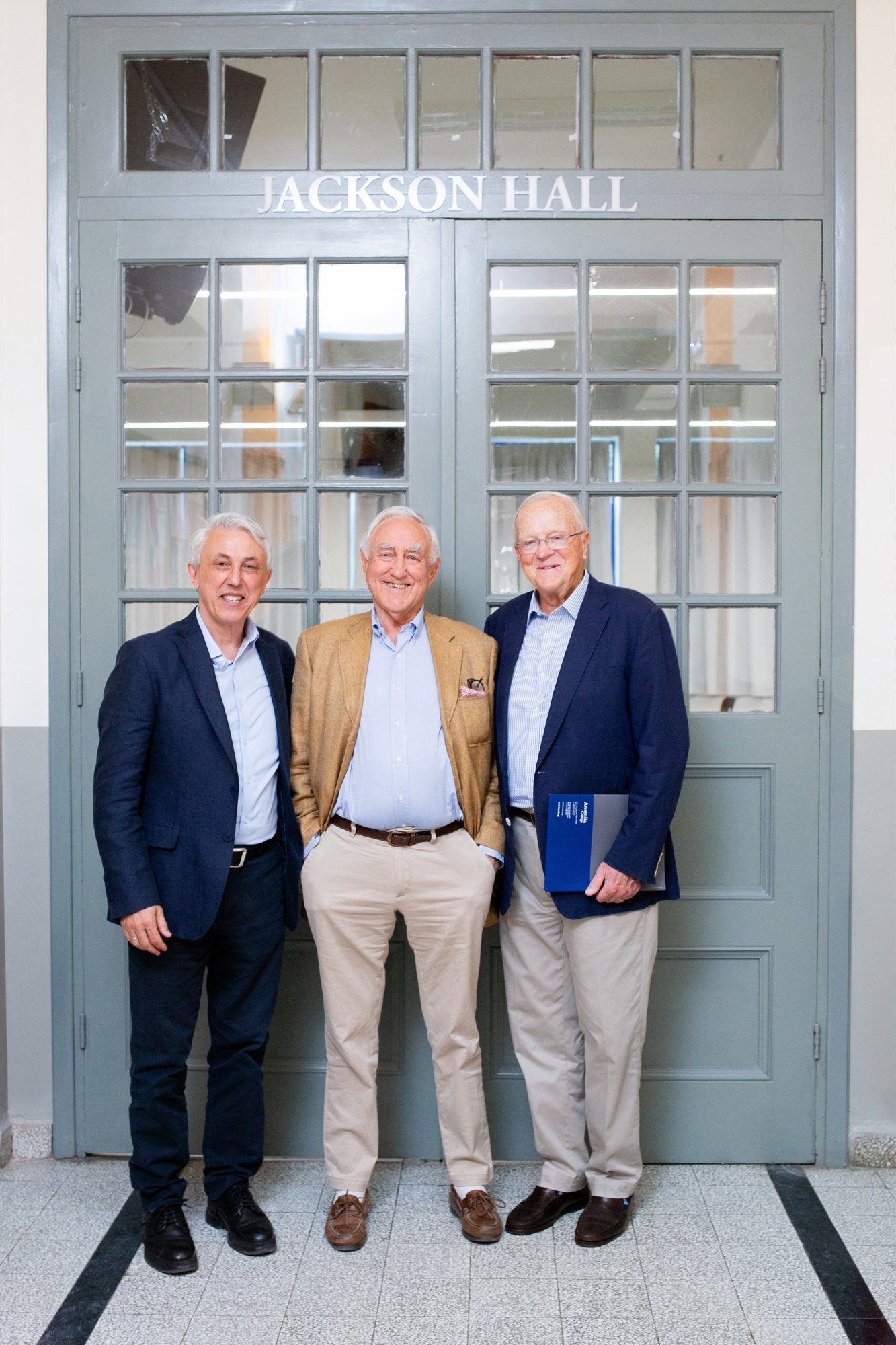 Richard L. Jackson stands between Anatolia College President Panos Vlachos (left) and Board of Trustees Chairman Albert H. ‘Chip’ Elfner outside Macedonia Hall in May, during a ceremony for the renaming of Tsipos Hall as Jackson Hall.
A wish
What he will miss most about Greece is his family. His son now lives in the US but his daughter and grandchildren remain here in Greece, along with his friends, his house, and the Greek light.
“The light,” he tells Kathimerini, “is extraordinary.”
For Greece, he wishes it stability, success and growth, but also something more. Earlier in the interview, he had mentioned that he is a close friend and admirer of photographer Robert McCabe, adding that he recently received his latest book.
“That was, uh, just a different landscape. I remember going in the jeep up Mount Chortiatis, and you come into those little mountain villages,” he says.
“I remember taking a jeep to about four churches in those villages, and people would pull you into their very, very modest houses, families and kids packed into just a couple of rooms, and insist that you have fruit or nuts or a drink, because they were really hospitable.”
As our conversation comes to a close, his final thought returns to Greece’s cultural soul and natural character:
“Keep a sense of Robert McCabe’s Greece. Don’t let that go. Don’t overgrow and over-modernize. Keep Greece pristine. And manage the gift of tourism in a way that it doesn’t take over and move the crowds on to some as-yet-undiscovered other country, which could happen.”
As he walks me out, I ask about one last piece of Greek art, two blue clay figures embracing above the front door. He got them from the island of Aegina years ago, Jackson notes, thanking me for reminding him they’re there. “So I don’t forget to take them with me, along with everything else,” he says, his belongings, and the memories of a life and three careers. “I hope,” he says, “to return soon.”