
Our taxi driver was spot on. Malta is in serious trouble and in need of emergency care. But he was anything but optimistic as to who might deliver that care. Neither the government nor the opposition was capable or even interested, he insisted. They were too busy engorging themselves or rescuing their immediate future.
As for the Maltese, he opined, corruption has long been a way of life, one that enables them to access favours, jobs and often a blind eye. Blaming foreigners for the country’s ills is currently popular, but Malta’s mess is entirely home grown, not just by politicians and businesspeople but by society at large.
Maltese people’s willingness to vote for corruption was evidence of this.
To be what it is capable of being, Malta needs radical surgery or there will be, in his words, a “big explosion”. As so often with taxi drivers, he was not short of solutions 1– a “complete political and social transplant” was needed.
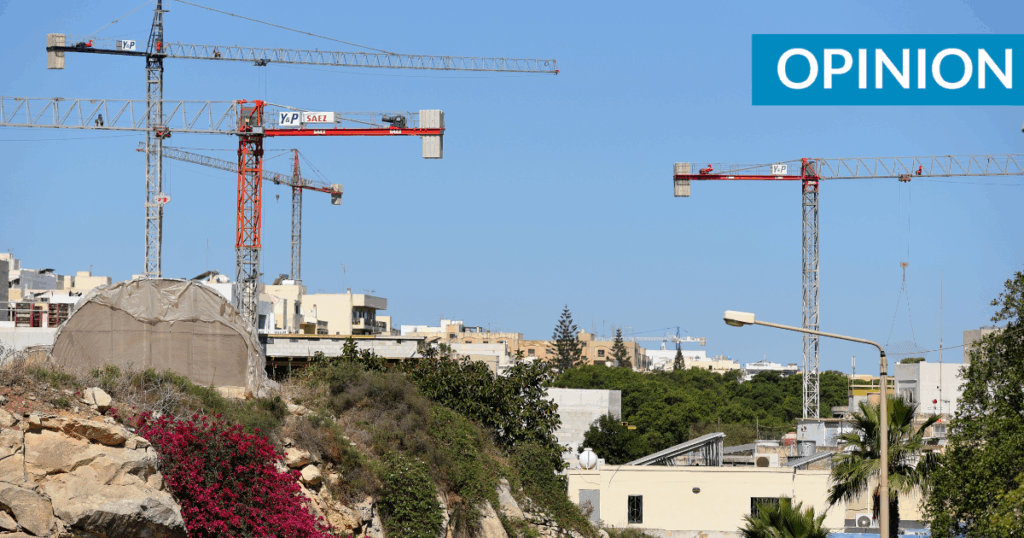
I normally disagree with taxi drivers, but this time it was hard to do so, especially in the context of the country’s current shambolic and largely lawless maldevelopment. That maldevelopment in all its dimensions is, once again on full public view in 2025 to date.
I have lived here for over 15 years. The root problem is clear and, in fairness, is quietly acknowledged by most Maltese in any serious conversation. There is an ingrained and now normalised lack of civic consciousness or care, matched by a “get rich quick at any cost” mentality accompanied by an aggressive two-fingered salute to all.
The approach can be readily observed in driving and parking, construction, waste disposal, hospitality, planning, the blocking of public pavements and roads, local and national political deviousness, policing (or the lack of it) – everyone will have their own favourite example of abuse.
Last Friday, a five-minute walk along the promenade in Marsalforn highlighted typical examples of the casual abuse of the public. Restaurant umbrellas were bolted to the public pavement, making it completely unusable’ tourist jeeps and quad bikes parked in numbers on a pedestrian street for the ease of clients; locals reversed their vehicles up a one-way street.
At a far more serious level, the abuse is obvious – the murder of Daphne Caruana Galizia and Lassana Cisse and the deaths through wilful neglect of Miriam Pace and Jean Paul Sofia. The fraudulent hospitals deal, the ‘new’ proposed planning reforms (and how they are being “sold” by the PM, relevant Ministers and officials), the a la carte application of policing and the law, the extension of impunity to key individuals,
Sadly and unforgivably, Maltese society remains in public denial as to the degree of its breakdown and the systemic violence that underpins it. Someone else is always to blame – “objectors”, foreigners (especially “those” ones), the media, Malta “haters” and that most useful of categories “the opposition” or “establishment”. Lots of chatter about all that is wrong unmatched by a willingness to act.
While particularly virulent in Malta, the malaise is not unique to these islands. Here and abroad, an increasing number of citizens in democratic countries while adopting a superficial and individualised ‘rights’ disposition devoid of the corresponding responsibilities.
Due diligence, decency and care towards community and environment; social solidarity and commitment – some of the values typical of mature civil consciousness are daily mocked in practice by government Ministers and officials, by business magnates, by hoteliers, planners and developers and by many of Malta’s “big noises”.
This continuing decline in civic responsibility will eventually undermine the basis of any viable democratic relationship linking citizens and residents to the institutions of the state and to its political and social life.
It doesn’t have to be like this. There are many other real and potential Maltas, and they have been described and outlined in detail by many Maltese organisations and individuals. These include Repubblika, ADPD, Momentum, Moviment Graffitti, Flimkien Għal Ambjent Aħjar, Aditus, Birdlife, the Migrants Commission and the Environment Commission of the Archdiocese of Malta and Jesuit Refugee Service, among others.
Malta’s independent media also plays a vital active role in building civic consciousness.
There are endless opportunities for those wanting to contribute to the building of a vibrant civic consciousness and life. What seems to be in short supply is the will to do so.
Far too many Maltese seem to be prepared to leave the heavy lifting of caring for Malta to others.