
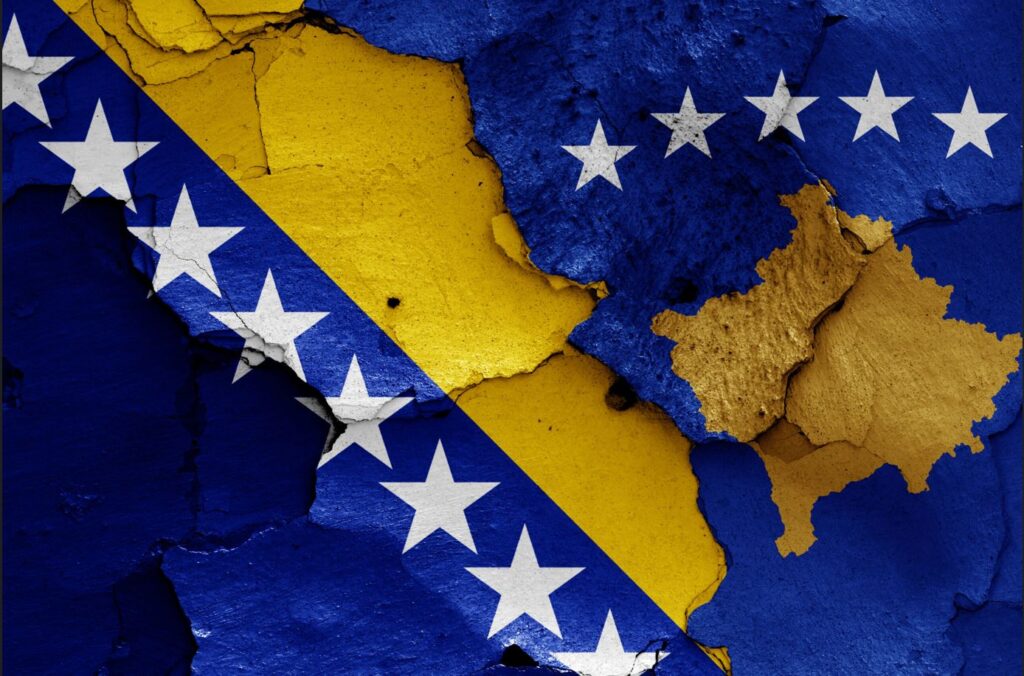
Kosovo’s wait for visa waiver from Bosnia and Herzegovina could last for years

Express newspaper
04/08/2025 7:12
Nearly two years and nine months after the signing of the agreement on mutual recognition of identity cards, within the framework of the Berlin Process, Kosovo citizens cannot travel to Bosnia and Herzegovina without visas.
The latter has not yet ratified the agreement on free movement, due to opposition from Serbian representatives in state institutions there.
While sharing her experience with visa facilities, in a response to TV Dukagjin, the acting Deputy Prime Minister, Emilija Rexhepi, said that she expects “ratification to happen very soon, despite the complexity of the current government in Bosnia.”
“I recently visited Bosnia, on the occasion of the 30th anniversary of the Srebrenica genocide, and I barely got a visa for only a few days, which is a great concern for the citizens and also a financial expense. In mid-September, Bosnian representatives will come to visit us and plan to raise their voice in the House of Peoples on this issue, put it to a vote, and expect the support of Croatian representatives as well,” stated Emilija Rexhepi, Acting Deputy Prime Minister.
The acting Deputy Prime Minister emphasized that hopes are in cooperation between Bosniaks and Croats.
“We are in constant communication with the Minister of Foreign Affairs, Mr. (Elmedin) Konakovic, and he promised me that he will present a proposal for the abolition of visas for Kosovo citizens to the Council of Ministers and will pave the way for ratification in Parliament. Serbian representatives in both the government and parliament are still very tough and against this international agreement that they themselves signed in Berlin, we hope that Bosniaks and Croats will be able to bring this process to an end,” she emphasized.
Although as a party they support the agreement from the Berlin Process, referring to the political situation in Bosnia and Herzegovina, the deputy in the Federal Parliament, Amir Puric, told TV Dukagjini that he does not expect a quick solution.
“It is unrealistic to expect the ratification of the agreement to take at least another year or two. Given that the state level of government is blocked, only rare technical decisions are being made and not a single important issue will be resolved before the end of 2026, when the next elections will be held,” stated Amir Purić, Member of the Federal Parliament of Bosnia and Herzegovina (Naša Stranka).
Noting that his brother living in Kosovo has been repeatedly denied a visa, the president of the “Dardania” association in Bosnia and Herzegovina, Rizah Sokoli, said that the Albanian community suffers the most from this situation.
“A good example for BiH could be Greece, which has not recognized the Republic of Kosovo, but has recognized the documents of Kosovo. Of course, one day Bosnia and Herzegovina will also have to accept the reality. This reality is the fact that Kosovo is an irrevocably independent and sovereign state, which aims for full integration into regional economic structures and that it will also become a member of the United Nations. This is a process that cannot be stopped”, declared Rizah Sokoli, Chairman of the “Dardania” Association.
Even the Kosovo Government, in a response to television, said that they are ‘actively working and encouraging BiH to fulfill its obligations’.
As of January 1st of this year, Kosovo unilaterally lifted the visa regime for citizens of Bosnia and Herzegovina – while the Republika Srpska entity led by Milorad Dodik continues the blockade on the other side.