
What are journalists missing from the state of Delaware? What would you most like WHYY News to cover? Let us know.
The two babies were hungry. The youngest, just a few months old, lay in a soiled diaper. Their teenage mother slumped on a couch.
That’s the scene that greeted a state trooper who responded to a 911 call from the manager of a motel north of Wilmington. The beleaguered young mother and her children were being evicted. They had no transportation, no money and nowhere to go.
The trooper realized he wasn’t equipped to help the family, so he summoned Tiffany Johnson, a Delaware social worker, and Chelsea Derryberry, a peer recovery specialist. The duo raced to the motel from their office at Delaware State Police Troop 1.
“It was just a bad situation,” Johnson recalled. “She was in distress. She had nothing. She had strollers, she had suitcases. She had limited formula. She had her two babies and this was a very young girl. And what are the cops gonna do, to be honest?”
No crime had been committed, so the trooper left matters to Johnson and Derryberry, who sprung into action. They cradled and comforted the boy and girl, changed their diapers and fed them apple sauce from their emergency food stash.
They began a delicate dialogue with the mother, who they quickly realized had mental health issues that prevented her from finding shelter and caring for her babies — the girl about 4 months old, the boy no older than 2 years old.
“I embraced her children and I talked to her as a human being, like ‘It’s going to be okay,’” Johnson recalled. “We talked and she felt comfortable.”
Johnson and Derryberry reached a private donor who agreed to provide diapers and formula. They used Instagram and then FaceTime to find and reach her friends and loved ones. Finally, they convinced the teenager’s reluctant sister, who has several of her own children, to take them in. They arranged transportation.
Over the next few days, the two women connected the teen mom to a program that provides care and resources for needy mothers, and to a state “bridge” clinic for mental health evaluation and treatment.
“It was a great solution and if she calls back again, we’ll welcome her with open arms and do what we need to do and connect her to services,” Johnson said.
The above scenario that unfolded this winter — mental health professionals working from police headquarters and assisting cops — was unheard of just a few years ago in Delaware.
It’s a blossoming collaboration that illustrates the new face of policing in Delaware and beyond. Prodded in part by nationwide calls to defund the police and reallocate money to community-based programs after George Floyd’s murder by police officers in Minneapolis in 2020, Delaware has joined other states in pairing mental health workers with officers.
Johnson and Derryberry are members of Delaware’s Police Diversion Program, a partnership between state police, the state Division of Substance Abuse and Mental Health and the Department of Justice. More alliances with smaller forces downstate, such as Ocean View and Bethany Beach, are in the works.
Joanne Champney, who heads the mental health division, lauded her agency’s union with law enforcement. She said troopers have referred nearly 10,000 people to the clinical teams. About one-third have accepted their assistance, and 2,200 people have agreed to undergo substance abuse or psychiatric treatment.
“There’s clearly a need,’’ Champney said. “People are reaching a desperation point. So it’s clearly struck a nerve and is being really well-utilized. And demand for it is growing.”
Chuck Sawchenko, a retired trooper and former therapist who oversees the diversion program for state police, praised the clinicians and peers who work with the cops.
“They are absolutely phenomenal,” Sawchenko said, pointing out that follow-up contacts several months after the initial outreach often persuade people to get into a treatment program.
“The clinician and peer are experts at establishing a rapport with these individuals that helps them one month, two months, three months later to go to treatment,” Sawchenko said. “So it’s that follow up and people have gone to treatment saying, ‘I didn’t realize somebody cared.’”
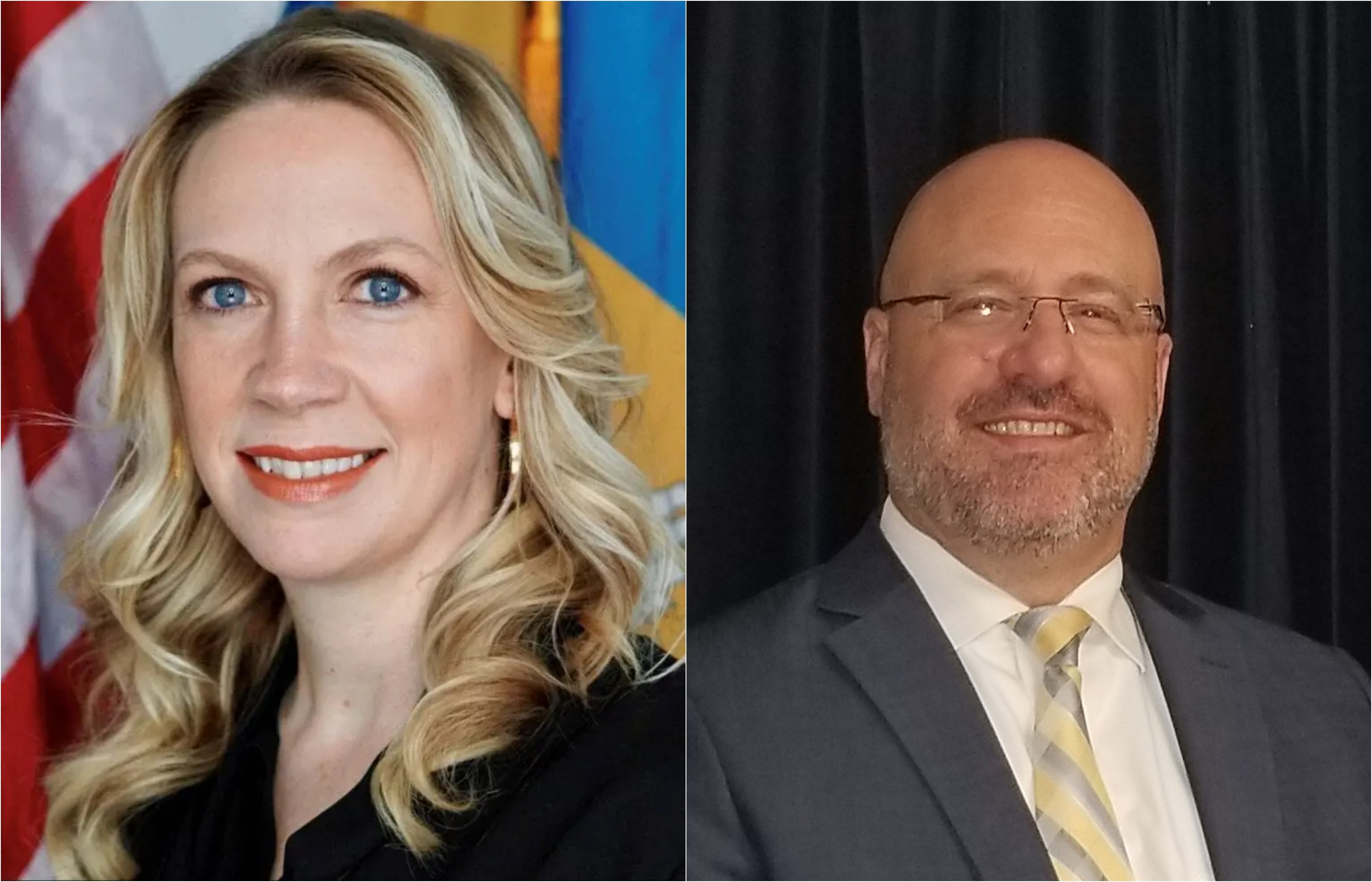 Joanna Champney, director of the state Division of Substance Abuse and Mental Health, says the program “is being really well-utilized.” Former trooper and therapist Chuck Sawchenko credits the persistence of the behavioral health professionals for getting reluctant people to seek help. (State of Delaware)
In addition to the statewide diversion program, ChristianaCare, the state’s dominant health system, has a behavioral health unit that does similar work with several police agencies, including in Wilmington and New Castle County.
In Wilmington, the Partners in Care program launched last year. A ChristianaCare clinician rides with a patrol officer and the pair respond to calls to help people who might need treatment for drug abuse or mental health issues. A case manager works from the city police station and a peer recovery specialist meets with clients.
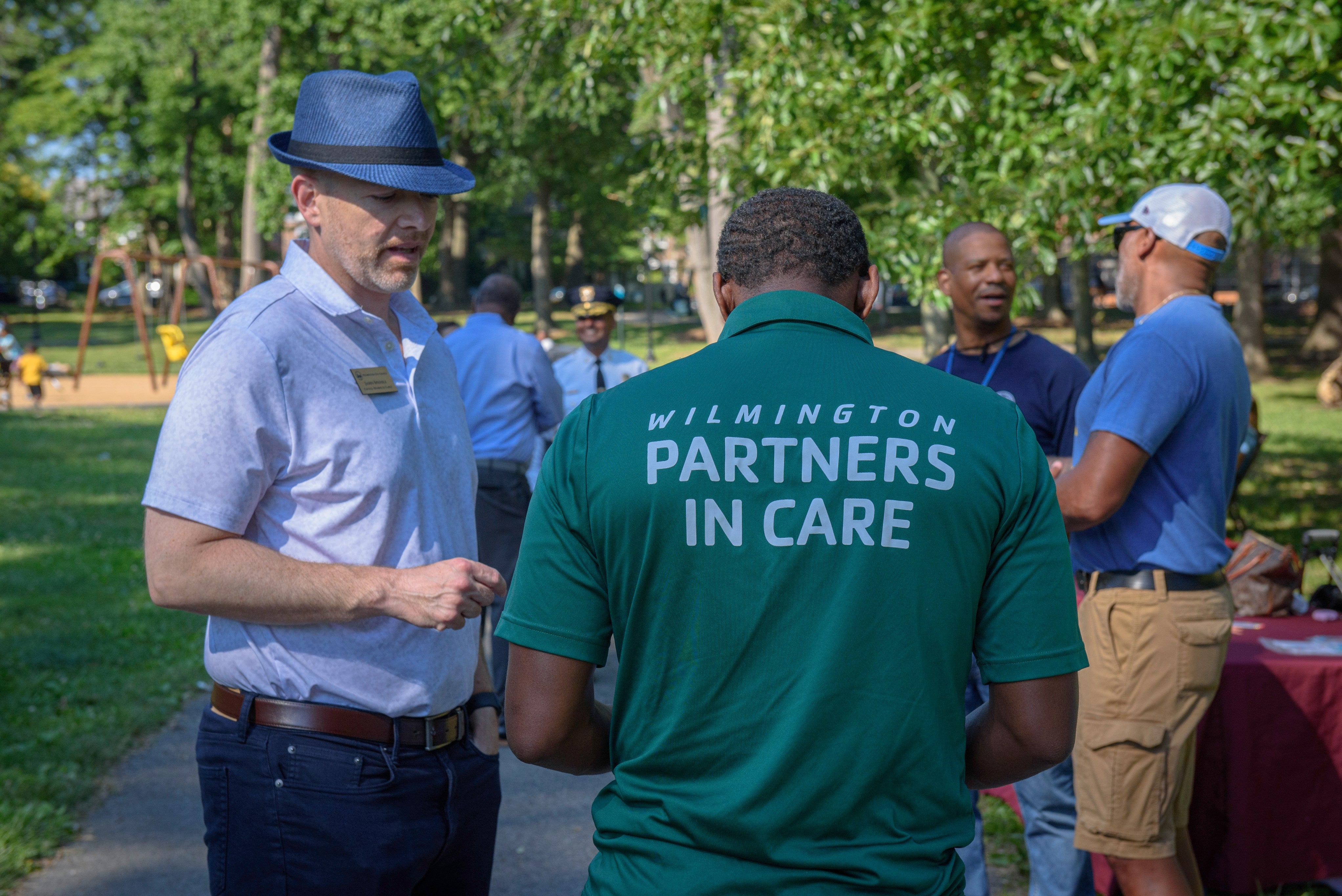 Wilmington City Councilman James Spadaro (left) speaks with a member of Wilmington’s Partners in Care program during an event at a city park. (Courtesy of Brett Garwood and Wilmington police)
More than 500 people have already received services from the teams in Wilmington, often after multiple attempts to connect with them, said David Karas, the force’s civilian police spokesman.
“Sometimes it may be five, six or seven times where they’ll actually reach out and offer somebody help,” Karas said.” But sometimes it’s that sixth or seventh or even the eighth time when somebody says, ‘Absolutely, I think I’m ready.’”