
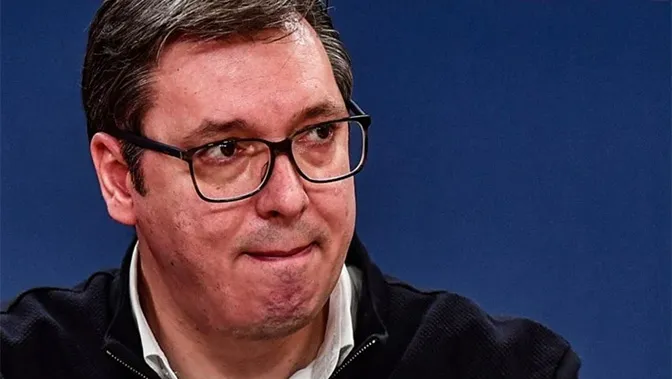
Vučić claims he was deceived about Kosovo, Serbian expert: He led every step himself, no one deceived him

Express newspaper
05/08/2025 6:50
Just days after Serbian Interior Minister Ivica Dacic claimed that Serbia was deceived during the signing of the Brussels Agreement, President Aleksandar Vucic also accused the international community of being responsible for the situation in Kosovo. In a speech in Sremski Karlovci on the anniversary of Operation Storm, Vucic figuratively explained how he had been deceived during the negotiations.
However, according to analysts and interlocutors of the Nova newspaper, both Vučić and Dačić have publicly admitted that they have violated the Constitution of Serbia.
Since the Brussels Agreement was signed in 2013, Serbia has not achieved any concrete success in the dialogue with Kosovo. According to critics, Serbia has already lost control over the four Serb-majority municipalities in northern Kosovo. Meanwhile, the only thing that was promised by – the creation of the Association of Serb-Majority Municipalities – has not been realized to date.
Vučić, in his speech, openly accused Western countries, saying:
“Three and a half years ago there were elections in northern Kosovo. They recognized the elections with only 2.5% turnout. And that was democracy. Shame on you, you scoundrels! They took me to Moldova to tell me ‘wait a minute, there will be new elections, the Serbs will win’. Did the elections take place? No!”
Further, he compared Serbian collaborators of Kosovo institutions to Nazi collaborators during World War II.
Following the statements of Vučić and Dačić, the European Commission reacted by clarifying that both parties, Serbia and Kosovo, entered into the agreements “knowingly and of their own free will”, and that both parties are expected to contribute to an atmosphere of reconciliation and normalization.
What was signed in Brussels?
The Brussels Agreement links Serbia’s progress towards EU integration to dialogue with Kosovo. The most important point of the agreement was the creation of the Association of Serbian Municipalities.
The agreement also provided for the integration of the Serbian police within the Kosovo system. However, after the escalation of the situation, Serbian representatives withdrew from the institutions.
According to Aleksandar Popov from the Center for Regional Policy, it is not the international community that has deceived Vučić, but himself. He emphasizes that for every step taken by the Serbian List in Kosovo – such as leaving institutions or removing uniforms – Vučić’s decision stands.
“For a symbolism like license plates, Vučić incited an escalation, which Serbia itself then unconditionally accepted. How can the president not know the consequences of such a decision? If he was truly deceived, he should resign,” Popov said.
Another expert, Dragisa Mijacic from the organization InTER, says that the claim that “we have been deceived” is a phrase traditionally used by Serbian politicians to hide the lack of results in foreign policy.
What did the subsequent agreements bring?
Following the Brussels Agreement, two other major agreements were signed:
Washington Agreement (2020): With the mediation of Donald Trump, an agreement was reached for economic cooperation between Kosovo and Serbia. The agreement also included issues not directly related to the conflict – such as recognizing Hezbollah as a terrorist organization and moving embassies to Jerusalem.
Ohrid Agreement (2023): This document, although only accepted verbally, brought the parties closer to de facto recognition of Kosovo. Serbia pledged not to hinder Kosovo’s membership in international organizations, including the UN, EU, and NATO, and to recognize Kosovo’s documents, symbols, and license plates.
However, Serbia later attempted to block Kosovo’s membership in the Council of Europe, which contradicts Article 4 of the Ohrid Agreement, which prohibits this type of objection.